
[论文解读] GRASP: A Grid-Based Benchmark for Evaluating Commonsense Spatial Reasoning
GRASP 是一个大规模、基于网格的基准测试,包含 16,000 个结构化环境,旨在通过要求智能体在步数限制内完成导航、收集能量并返回起点,来评估大语言模型(LLMs)的常识空间推理(CSR)能力。尽管具备先进能力,GPT-4o 的表现仍逊于贪心搜索智能体,暴露出其在高效空间规划与资源优化方面持续存在的局限性。
Spatial reasoning, an important faculty of human cognition with many practical applications, is one of the core commonsense skills that is not purely language-based and, for satisfying (as opposed to optimal) solutions, requires some minimum degree of planning. Existing benchmarks of Commonsense Spatial Reasoning (CSR) tend to evaluate how Large Language Models (LLMs) interpret text-based spatial $ extit{descriptions}$ rather than directly evaluate a plan produced by the LLM in response to a $ extit{specific}$ spatial reasoning problem. In this paper, we construct a large-scale benchmark called GRASP, which consists of 16,000 grid-based environments where the agent is tasked with an energy collection problem. These environments include 100 grid instances instantiated using each of the 160 different grid settings, involving five different energy distributions, two modes of agent starting position, and two distinct obstacle configurations, as well as three kinds of agent constraints. Using GRASP, we compare classic baseline approaches, such as random walk and greedy search methods, with advanced LLMs like GPT-3.5-Turbo, GPT-4o, and GPT-o1-mini. The experimental results indicate that even these advanced LLMs struggle to consistently achieve satisfactory solutions.
研究动机与目标
- 解决现有基准测试仅关注空间描述理解,而非评估实际空间任务中的规划与导航能力的不足。
- 开发一个可扩展的结构化基准测试,评估 LLM 在空间布局推理及资源收集有效计划生成方面的能力。
- 通过模拟障碍物、能量限制和移动成本等现实约束,评估 LLM 在常识空间推理中的实际应用潜力。
- 在统一评估框架中,将经典算法(随机游走、贪心搜索)与最先进 LLM(GPT-3.5-Turbo、GPT-4o)进行比较。
提出的方法
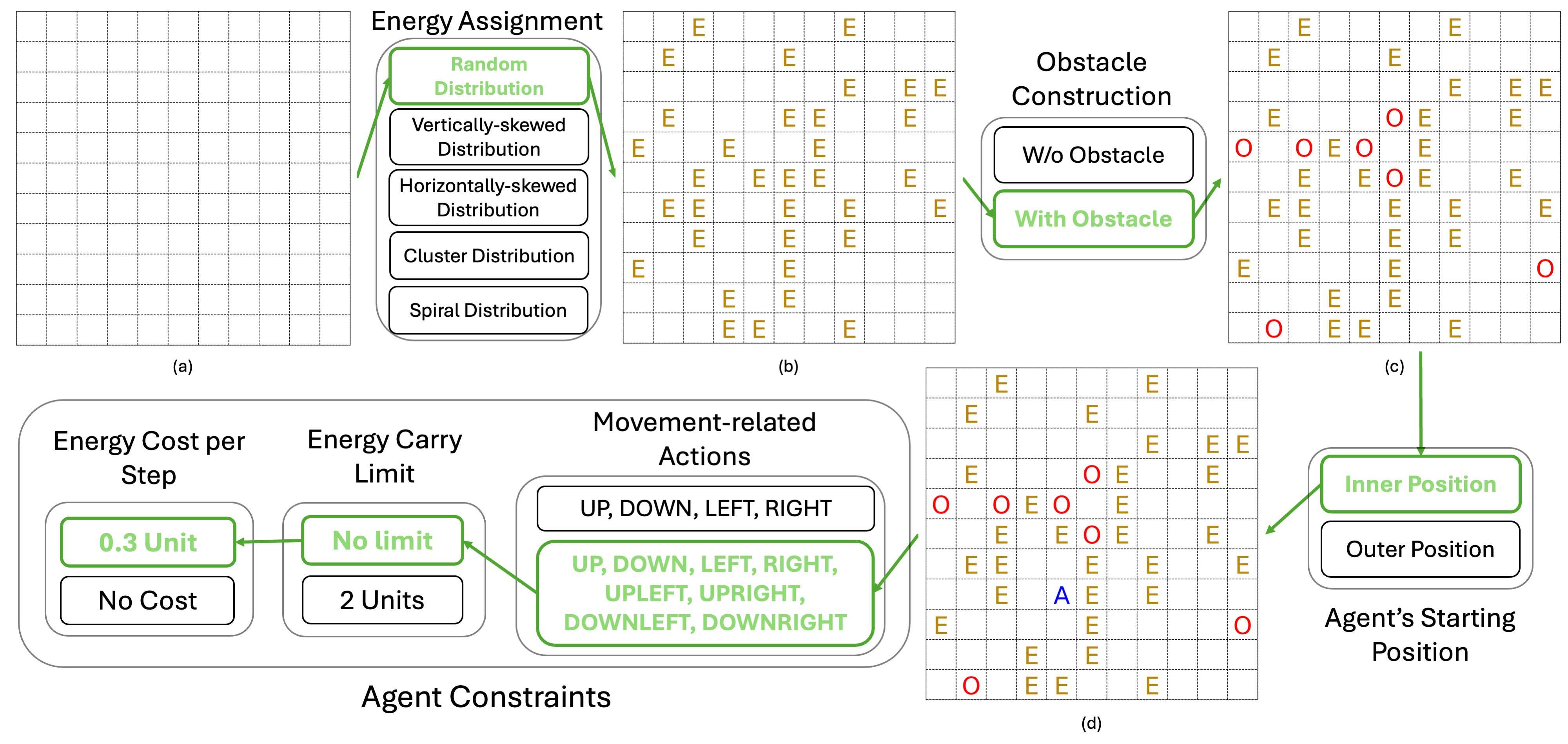
- 使用 160 种不同的网格设置构建 16,000 个基于网格的环境,每种设置包含 100 个实例,变化包括能量分布、障碍物位置、起始位置和智能体约束。
- 通过使用换行符和水平对齐方式的文本渲染网格来表示空间布局,以编码空间关系,无需视觉输入。
- 定义一项任务:智能体必须在固定步数内收集能量,避开障碍物,并返回起点以交付所收集的能量。
- 应用三种类型的智能体约束:移动选项(正交移动与对角线移动)、能量携带容量限制和步数成本。
- 采用零样本提示(zero-shot prompting)评估 LLM(GPT-3.5-Turbo、GPT-4o)在无微调情况下生成导航计划的能力。
- 根据总收集能量、路径效率、障碍物规避情况以及返回起点的完成度来评估性能。
实验结果
研究问题
- RQ1在无微调的情况下,GPT-3.5-Turbo 和 GPT-4o 等 LLM 能否在基于网格的空间推理任务中生成有效且高效的导航计划?
- RQ2LLM 智能体与经典基线算法(随机游走、贪心搜索)相比,在能量收集和路径效率方面表现如何?
- RQ3LLM 在多大程度上能识别并利用空间模式(如能量聚集或螺旋分布)以优化规划?
- RQ4LLM 在空间推理中的失败模式是什么?例如忽略附近能量单元、反复尝试穿越障碍物,或未能返回起点?
- RQ5能量容量有限和步数成本等约束如何影响 LLM 在空间任务中的性能与规划行为?
主要发现
- GPT-3.5-Turbo 表现甚至不如随机游走基线,频繁出现无法避开障碍物、无法收集能量或无法返回起点的情况。
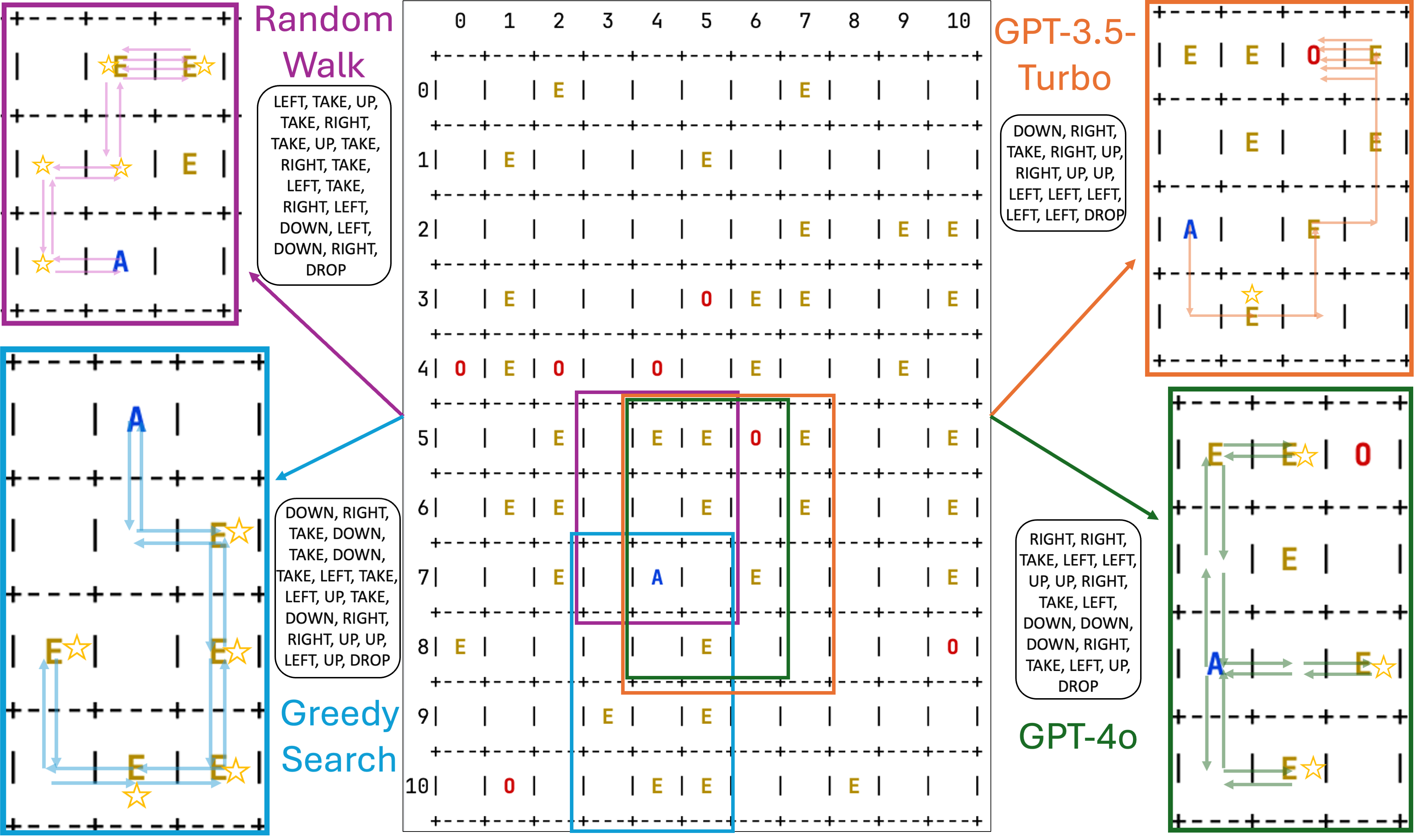
- GPT-4o 的表现与随机游走智能体相当,但效率低于贪心搜索智能体,表明尽管导航意识有所提升,其路径规划仍不够优化。
- 即使 GPT-4o 也常忽略附近的能量单元并采取不必要的步数,暴露出其在空间优先级排序与路径优化方面的低效性。
- LLM 常常在收集能量后无法执行返回起点的操作,表明其对任务完成要求的理解存在缺陷。
- 模型频繁出现幻觉行为,例如尝试从空单元格‘取走’能量或穿越障碍物,表明其在空间结构上的理解较弱。
- 尽管能识别空间关系,LLM 仍难以将这种理解转化为高效、目标导向的计划,凸显其在常识空间推理方面存在明显差距。
阅读本论文
在 Nubint 阅读器中打开原文,边读边就任意段落提问。
在 Nubint 中阅读本论文本解读由 AI 根据论文原文生成,引用前请核对原文。