
[论文解读] GRB 221009A, its precursor and two afterglows in the Fermi data
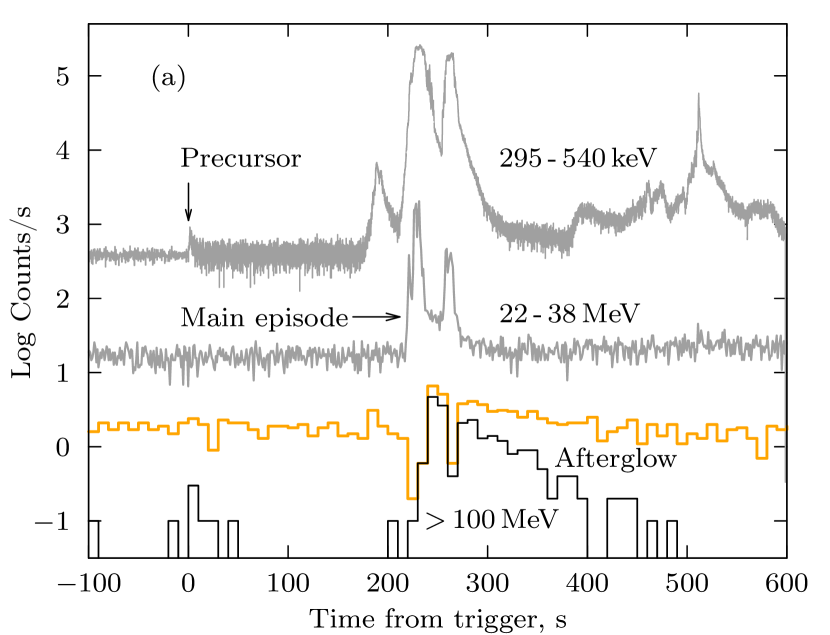
本研究分析了GRB 221009A的费米(Fermi)观测数据,该伽马射暴是迄今观测到的最明亮的伽马射暴,首次提供了在主暴发生前约三分钟出现的弱前体事件后伽马射暴余晖的直接证据。利用大倾角(>75°)下的校准大型面积望远镜(LAT)数据,作者在前体事件后50秒检测到10–200 MeV能量范围内的统计显著余晖,光谱指数为α = −2.5 ± 0.5,表明其起源于独立的外部激波。
We study GRB 221009A, the brightest gamma-ray burst in the history of observations, using Fermi data. To calibrate them for large inclination angles, we use the Vela X gamma-ray source. Light curves in different spectral ranges demonstrate a 300 s overlap of afterglow and delayed episodes of soft prompt emission. We demonstrate that a relatively weak burst precursor that occurs 3 minutes before the main episode has its own afterglow, i.e., presumably, its own external shock. The main afterglow is the brightest one, includes a photon with an energy of 400 GeV 9 hours after the burst, and is visible in the LAT data for up to two days.
研究动机与目标
- 探究GRB前体——即较弱的早期辐射事件——是否能产生自身的余晖,从而挑战‘仅主暴产生外部激波’的假设。
- 由于该暴源靠近视场边缘,需对费米(Fermi)LAT在大入射角(>75°)下的性能进行校准。
- 确定主暴与前体事件在GeV能量范围内的光谱和时间特性。
- 解决费米(Fermi)LAT数据与HAWC对8小时后TeV能量余晖未检测到之间的矛盾。
- 评估具有明亮余晖的前体事件的物理意义,提示其与主暴事件可能存在不同的辐射机制。
提出的方法
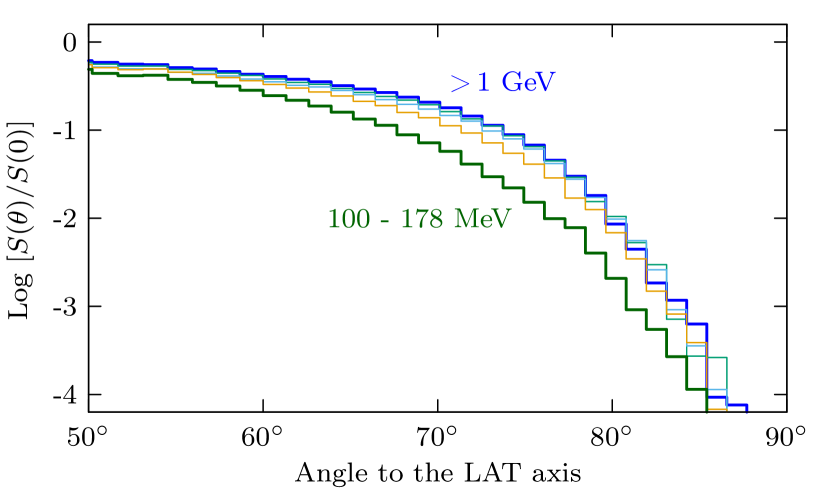
- 利用稳定且明亮的GeV源Vela X脉冲星,通过8°的角孔径校准费米(Fermi)LAT在大角度下的响应,以考虑偏离轴向的影响。
- 使用来自Vela X的940万 photon 和来自银河系附近区域的200万背景光子,建立能量与角度相关的有效面积模型。
- 应用Ajello等人(2021)提供的能量依赖响应函数,校正高入射角观测中的能量谱偏移。
- 对前体事件后50秒窗口内的LAT光子计数进行统计分析,实测6个光子,预期仅0.64个,显著性达4σ。
- 通过拟合6个后前体光子的能谱分布,估算出光子指数α = −2.5 ± 0.5。
- 将费米(Fermi)余晖通量与HAWC的上限(4.16 × 10⁻¹² erg cm⁻² s⁻¹)进行比较,评估光谱演化及可能的截断。
实验结果
研究问题
- RQ1一个与主暴间隔数分钟的弱GRB前体事件,是否能通过外部激波产生自身的余晖?
- RQ2如何可靠地校准费米(Fermi)LAT在大入射角(>75°)下的数据,以探测微弱的余晖辐射?
- RQ3与主暴余晖相比,前体事件后余晖的光谱和时间行为如何?
- RQ4为何费米(Fermi)检测到明亮余晖,而HAWC在8小时后未检测到100 GeV以上的余晖?
- RQ5前体事件及其余晖是否代表与主GRB事件根本不同的辐射机制?
主要发现
- GRB 221009A的前体事件,其峰值计数率约为主暴的1/300,能量通量低约2000倍,但产生了在费米(Fermi)LAT数据中可检测到的统计显著余晖。
- 在前体事件后50秒观测到的余晖由10–200 MeV能量范围内的6个光子组成,显著性达4σ,证实为真实的天体物理信号。
- 前体余晖的光谱指数为α = −2.5 ± 0.5,与主余晖的指数(α ≈ −2)一致,表明其具有相似的辐射机制。
- 主余晖为迄今记录中最明亮的,其在触发后9小时探测到能量达400 GeV的光子,且在LAT数据中持续可见长达两天。
- 前体及其余晖的通量约为1.5 × 10⁻⁵ erg cm⁻²,与前体本身的通量(约1.7 × 10⁻⁵ erg cm⁻²)相当,提示二者存在物理上的关联。
- 400 GeV光子未显示光谱截断,且与HAWC的上限存在张力,提示在10 GeV至TeV能量区间可能存在急剧的光谱衰减,尽管该结论尚未得到证实。
阅读本论文
在 Nubint 阅读器中打开原文,边读边就任意段落提问。
在 Nubint 中阅读本论文本解读由 AI 根据论文原文生成,引用前请核对原文。