
[论文解读] Group DETR: Fast DETR Training with Group-Wise One-to-Many Assignment
Group DETR 通过引入组内一对多分配机制,加速了 DETR 的训练过程,其中多个对象查询组在组内实现竞争学习,同时保持标准推理方式。该方法在不改变网络架构的前提下,提升了各类 DETR 变体的训练收敛速度与性能,训练 12 个周期时 mAP 最高提升 3.1,COCO test-dev 上达到 64.5 mAP。
Detection transformer (DETR) relies on one-to-one assignment, assigning one ground-truth object to one prediction, for end-to-end detection without NMS post-processing. It is known that one-to-many assignment, assigning one ground-truth object to multiple predictions, succeeds in detection methods such as Faster R-CNN and FCOS. While the naive one-to-many assignment does not work for DETR, and it remains challenging to apply one-to-many assignment for DETR training. In this paper, we introduce Group DETR, a simple yet efficient DETR training approach that introduces a group-wise way for one-to-many assignment. This approach involves using multiple groups of object queries, conducting one-to-one assignment within each group, and performing decoder self-attention separately. It resembles data augmentation with automatically-learned object query augmentation. It is also equivalent to simultaneously training parameter-sharing networks of the same architecture, introducing more supervision and thus improving DETR training. The inference process is the same as DETR trained normally and only needs one group of queries without any architecture modification. Group DETR is versatile and is applicable to various DETR variants. The experiments show that Group DETR significantly speeds up the training convergence and improves the performance of various DETR-based models. Code will be available at \url{https://github.com/Atten4Vis/GroupDETR}.
研究动机与目标
- 为解决 DETR 训练收敛缓慢的问题,通过优化过程中的更多监督来改进。
- 实现在 DETR 中有效的一对多分配,传统方法直接应用时会失败。
- 在不修改推理流程或网络架构的前提下,提升训练稳定性和性能。
- 探讨组内分配与参数共享多头网络结合查询增强的等价性。
- 展示该方法在多种 DETR 变体中的广泛适用性,包括 Deformable DETR 和 DINO。
提出的方法
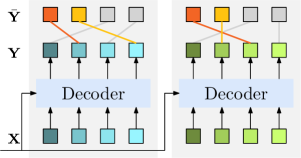
- Group DETR 使用 K 组对象查询,每组独立地与真实框进行一对一分配。
- 在每组内部,通过自注意力机制实现预测之间的竞争,促使正确分配得分更高,重复分配得分更低。
- 自注意力在每组内独立计算,解耦组间交互,从而稳定训练过程。
- 该方法等价于训练具有共享权重的并行解码器,有效增加了监督信号。
- 推理阶段仅使用一组查询,保持原始 DETR 架构与推理速度不变。
- 该方法与现有 DETR 变体兼容,可与其它技术(如去噪查询或 EMA)结合使用。
实验结果
研究问题
- RQ1能否在 DETR 训练中有效应用一对多分配,克服传统方法直接实现时的失败?
- RQ2组内竞争的组内分配是否能提升训练收敛速度与模型性能?
- RQ3该方法是否可无需修改架构即适用于多种 DETR 变体?
- RQ4组内分配与 DN-DETR 中的去噪技术等稳定方法相比有何差异?
- RQ5改进的训练动态是否也对编码器带来益处,而不仅限于解码器?
主要发现
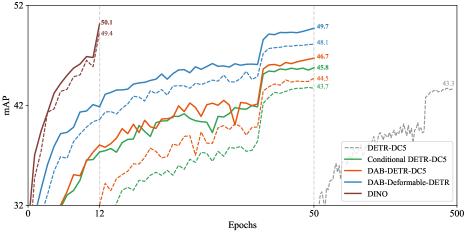
- 将 Group DETR 应用于 SAM-DETR 时,仅用 12 个训练周期即在 COCO val2017 上实现 3.1 mAP 的提升。
- 在 50 个周期训练下,Group DETR 使 SAM-DETR++ 提升 1.3 mAP,表明在不同训练周期下均具稳定增益。
- 使用 ViT-Huge 时,Group DETR 在 COCO test-dev 上达到 64.5 mAP,优于参数量更大、预训练数据更多的模型。
- Group DETR 显著加快了训练收敛速度,体现在 COCO 训练曲线中损失下降更快。
- 该方法与现有技术具有互补性:将 Group DETR 与 DINO 或 DN-DETR 结合可进一步提升性能。
- 实验表明,在 DN-DETR 中增加去噪查询数量超过 100 后性能不再提升,而 Group DETR 则持续获得增益。
阅读本论文
在 Nubint 阅读器中打开原文,边读边就任意段落提问。
在 Nubint 中阅读本论文本解读由 AI 根据论文原文生成,引用前请核对原文。