
[论文解读] Guiding Large Language Models via Directional Stimulus Prompting
DSP 使用一个可微调的小型策略模型来生成针对实例的定向提示,指导黑盒大型语言模型朝向期望输出,在有限标注数据下提升摘要、对话和推理任务的性能。
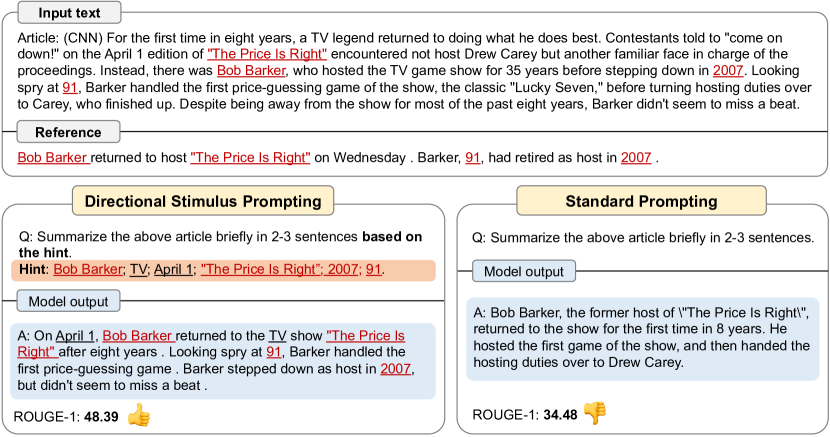
We introduce Directional Stimulus Prompting, a novel framework for guiding black-box large language models (LLMs) toward specific desired outputs. Instead of directly adjusting LLMs, our method employs a small tunable policy model (e.g., T5) to generate an auxiliary directional stimulus prompt for each input instance. These directional stimulus prompts act as nuanced, instance-specific hints and clues to guide LLMs in generating desired outcomes, such as including specific keywords in the generated summary. Our approach sidesteps the challenges of direct LLM tuning by optimizing the policy model to explore directional stimulus prompts that align LLMs with desired behaviors. The policy model can be optimized through 1) supervised fine-tuning using labeled data and 2) reinforcement learning from offline or online rewards based on the LLM's output. We assess our method across summarization, dialogue response generation, and chain-of-thought reasoning tasks. Our experiments demonstrate that the framework consistently improves LLMs' (e.g., ChatGPT, Codex, InstructGPT) performance on these supervised tasks using minimal labeled data. Notably, using just 80 dialogues on the MultiWOZ dataset, our approach enhances ChatGPT's performance by an impressive 41.4%, matching or surpassing some fully supervised start-of-the-art models. Additionally, the instance-specific chain-of-thought prompt generated by our approach improves InstructGPT's reasoning accuracy compared to human-crafted or automatically generated prompts. The code and data are publicly available at \url{https://github.com/Leezekun/Directional-Stimulus-Prompting}.
研究动机与目标
- 提出一种轻量级方法,在不对黑盒 LLM 进行微调的情况下引导它们。
- 引入在提示中提供实例特定提示的定向刺激。
- 展示如何通过监督微调和强化学习来优化一个小型策略模型。
- 展示在摘要、对话回应生成和链式推理方面的改进。
提出的方法
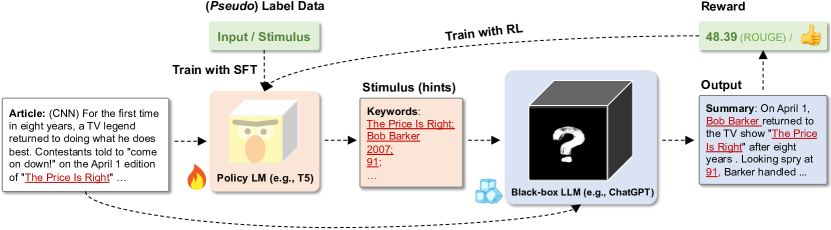
- 引入一个可微调的小型策略模型,为每个输入 x 生成定向刺激 z。
- 将刺激 z 与 x 连接,形成黑盒 LLM 的提示,其参数不可访问。
- 通过对 x, z* 对进行监督微调来训练策略模型,然后可选地通过强化学习来优化下游奖励 R。
- 将 R 定义为基于 LLM 输出的指标(如摘要的 ROUGE、对话任务成功率、链式推理的有效性等)。
- 使用带有 top-p 掩码的 PPO(NLPO 变体)来处理大动作空间,并应用 KL 散度惩罚以使策略保持接近初始化。
实验结果
研究问题
- RQ1一个小型策略模型是否能够生成实例特定的提示,从而引导黑盒 LLM 达到期望输出?
- RQ2基于强化学习的定向刺激优化是否在引导 LLM 方面优于监督提示?
- RQ3在有限标注数据下,摘要、对话系统和链式推理任务中的收益是否具有一致性?
主要发现
- 尽管标注数据极少,DSP 仍提升了 LLM 在摘要、对话和推理任务上的表现。
- 在摘要方面,使用 CNN/Daily Mail 的 4,000 对标注对,为 ChatGPT 获得 4-13% 的 ROUGE/BLEU 提升。
- 在 MultiWOZ 对话中,使用少至 80 次对话进行 RL 引导提示,综合指标上将 ChatGPT 得分提升最高达 41.4%。
- DSP 生成的实例特定链式思维触发比人为设计或自动生成的提示在 InstructGPT 上表现更优。
- 强化学习微调在任何情况下都优于单独的 SFT,尤其是在训练数据规模增大时。
阅读本论文
在 Nubint 阅读器中打开原文,边读边就任意段落提问。
在 Nubint 中阅读本论文本解读由 AI 根据论文原文生成,引用前请核对原文。