
[论文解读] Habits of Mind: Reusing Action Sequences for Efficient Planning
本文提出 MCTS-with-HABITS,一种利用贝叶斯动作分块(Bayesian action chunking)重用过去经验中统计上可靠的动作序列的规划算法,通过将树搜索偏向频繁使用的路径,提升规划效率,并支持多步扩展。该方法减少了搜索深度和节点数量,在物理建造任务中显著加速了求解过程,同时保持了高精度。
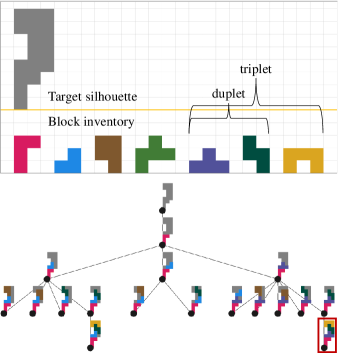
When we exercise sequences of actions, their execution becomes more fluent and precise. Here, we consider the possibility that exercised action sequences can also be used to make planning faster and more accurate by focusing expansion of the search tree on paths that have been frequently used in the past, and by reducing deep planning problems to shallow ones via multi-step jumps in the tree. To capture such sequences, we use a flexible Bayesian action chunking mechanism which finds and exploits statistically reliable structure at different scales. This gives rise to shorter or longer routines that can be embedded into a Monte-Carlo tree search planner. We show the benefits of this scheme using a physical construction task patterned after tangrams.
研究动机与目标
- 探究是否可重用过去经验中的重复动作序列以加速规划。
- 开发一种计算高效且符合认知合理性的方法,将学习到的动作模式整合进蒙特卡洛树搜索(MCTS)。
- 通过用可重用的分块替代长动作序列,减轻深度规划的计算负担。
- 测试在物理受限的建造任务中,此类分块重用是否能在资源受限条件下提升性能。
- 探讨行为中无价值的统计规律性(如动作分块)如何引导基于模型的规划。
提出的方法
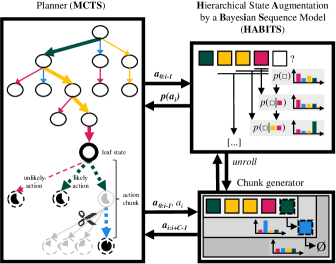
- 使用层次狄利克雷过程(HDP)贝叶斯序列模型,从过去的规划阶段中发现长度不一的统计上可靠的动作序列。
- HABITS 模型推断出在动作轨迹中可预测性重复的多步动作分块,支持开环的多步树扩展。
- MCTS-with-HABITS 算法将 HABITS 模型集成到树策略中,优先选择预测可能性更高的动作和动作分块。
- 规划器同时使用单步动作预测和多步分块扩展,分块可跳过中间状态,降低树的深度。
- 通过使用均匀随机策略的仿真来估计节点值,并将结果反向传播至树中。
- 在树策略中使用类似上置信度(UCB)的奖励,平衡探索与利用。
实验结果
研究问题
- RQ1是否可利用过去的动作序列来提升复杂、深度决策问题中的规划效率?
- RQ2重用统计上可靠的动作分块是否能减少规划过程中的节点评估数量?
- RQ3多步动作扩展在计算资源有限的情况下,能在多大程度上实现更深的搜索?
- RQ4将无价值的统计模式(如动作分块)整合进规划,如何增强基于模型的规划?
- RQ5使用动作分块是否是一种符合认知合理性的降低规划成本的策略?
主要发现
- 与基线 MCTS 相比,MCTS-with-HABITS 模型在节点预算约束下评估的节点数显著更少,实现了更快的求解发现。
- 当相同分块路径的预测可能性更高且价值相当或更优时,模型更倾向于选择动作分块而非原始动作。
- 多步扩展使模型能沿可预测路径进行更深层次的探索,有效降低了搜索树的有效深度。
- 在序列模糊的问题中,模型更偏好保留已学习分块的解决方案,表明其对动作模式具有稳健的重用能力。
- 在所有测试条件下,完整版 MCTS-with-HABITS 模型均以最少的节点评估次数找到解决方案。
- 该方法清晰地表现出规划成本与性能之间的权衡,倾向于在可靠路径上进行高效、浅层搜索。
阅读本论文
在 Nubint 阅读器中打开原文,边读边就任意段落提问。
在 Nubint 中阅读本论文本解读由 AI 根据论文原文生成,引用前请核对原文。