
[论文解读] Hardware-efficient ansatz without barren plateaus in any depth
本文提出了硬件高效量子线路(HEA)的两种新型参数初始化条件,可消除任意线路深度下的 barren plateaus 问题,确保梯度幅值不随系统尺寸或连通性变化。通过在局部哈密顿量下进行时间演化或映射至多体局域化(MBL)相,该方法可在含噪声中等规模量子(NISQ)设备上实现 HEA 的高效训练,避免梯度消失问题。
Variational quantum circuits have recently gained much interest due to their relevance in real-world applications, such as combinatorial optimizations, quantum simulations, and modeling a probability distribution. Despite their huge potential, the practical usefulness of those circuits beyond tens of qubits is largely questioned. One of the major problems is the so-called barren plateaus phenomenon. Quantum circuits with a random structure often have a flat cost-function landscape and thus cannot be trained efficiently. In this paper, we propose two novel parameter conditions in which the hardware-efficient ansatz (HEA) is free from barren plateaus for arbitrary circuit depths. In the first condition, the HEA approximates to a time-evolution operator generated by a local Hamiltonian. Utilizing a recent result by [Park and Killoran, Quantum 8, 1239 (2024)], we prove a constant lower bound of gradient magnitudes in any depth both for local and global observables. On the other hand, the HEA is within the many-body localized (MBL) phase in the second parameter condition. We argue that the HEA in this phase has a large gradient component for a local observable using a phenomenological model for the MBL system. By initializing the parameters of the HEA using these conditions, we show that our findings offer better overall performance in solving many-body Hamiltonians. Our results indicate that barren plateaus are not an issue when initial parameters are smartly chosen, and other factors, such as local minima or the expressivity of the circuit, are more crucial.
研究动机与目标
- 为解决硬件高效量子线路(HEA)线路中的 barren plateaus 问题,该问题阻碍了在近期量子硬件上的训练。
- 识别出可保证在任意线路深度或量子比特连通性下,HEA 中梯度幅值大且不消失的参数初始化区域。
- 证明 barren plateaus 的避免并非依赖于电路设计,而是通过智能初始化实现。
- 在量子机器学习与多体哈密顿量问题上验证所提方法,结果表明其性能显著优于随机初始化。
提出的方法
- 第一种方法将 HEA 映射为由局部哈密顿量生成的时间演化算符,利用 Park 和 Killoran(2024)的近期结果,证明了对局部与全局可观测量,梯度幅值均存在恒定下界。
- 第二种方法将 HEA 解释为多体局域化(MBL)系统,基于现象学 MBL 理论,论证在 MBL 相中,局部可观测量具有较大的梯度分量。
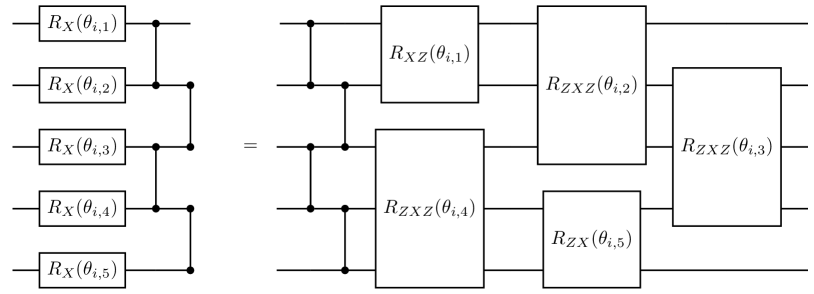
- 利用电路恒等式,从 HEA 模块中移除非参数化的 CZ 门,从而可将针对完全参数化线路推导出的梯度界应用于 HEA。
- HEA 以固定初始态 |0⟩^⊗N 实现,数据编码通过作用于最后 d 个量子比特的单位变换 E(ϕ) 完成,代价函数通过二元交叉熵损失定义。
- 参数初始化采用小方差高斯采样(Small)、基于 MBL 的取值或均匀随机采样(Random),优化使用 Adam 算法。
- 基于 MNIST 主成分分析数据的量子机器学习模型的数值模拟验证了不同初始化方案的性能表现。
实验结果
研究问题
- RQ1硬件高效量子线路是否可在任意深度下避免 barren plateaus 问题?
- RQ2是否存在特定的参数初始化区域,可确保 HEA 中梯度幅值恒定,且与系统尺寸或连通性无关?
- RQ3是否可通过将 HEA 映射为时间演化系统或 MBL 系统,来保证较大的梯度?
- RQ4在变分量子算法中,智能初始化是否在训练效率与准确率方面优于随机初始化?
- RQ5barren plateaus 是否是 HEA 训练中的主要障碍,还是其他因素(如局部极小值)更为关键?
主要发现
- 所提出的参数初始化条件可确保对局部与全局可观测量,梯度幅值均存在恒定下界,且与线路深度或量子比特连通性无关。
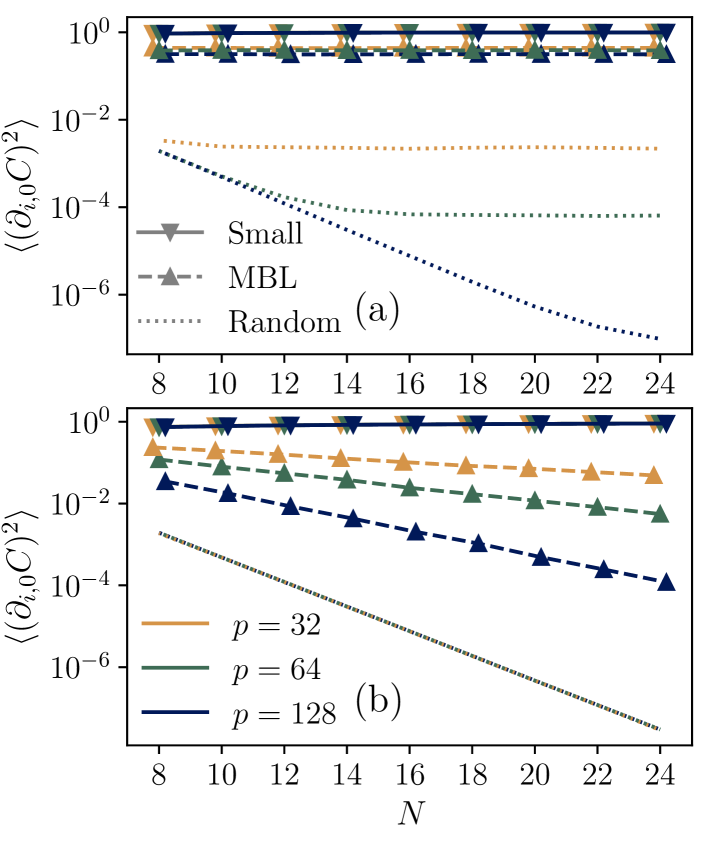
- 当使用时间演化条件初始化参数时,即使量子比特数量增加,梯度幅值仍保持远离零。
- 在 MBL 相中,HEA 对局部可观测量表现出较大的梯度分量,与现象学 MBL 理论预测一致。
- 数值结果表明,Small 与 MBL 初始化方案显著优于随机初始化,表现为损失衰减更快、量子机器学习任务中的测试准确率更高。
- 采用 Small 初始化的模型表现最佳,MBL 初始化紧随其后,而随机初始化则导致收敛缓慢且准确率低下。
- 结果表明,只要参数初始化得当,barren plateaus 并非 HEA 的固有问题,提示在 VQA 设计中,表达能力与局部极小值才是更关键的挑战。
阅读本论文
在 Nubint 阅读器中打开原文,边读边就任意段落提问。
在 Nubint 中阅读本论文本解读由 AI 根据论文原文生成,引用前请核对原文。