
[论文解读] Health-LLM: Large Language Models for Health Prediction via Wearable Sensor Data
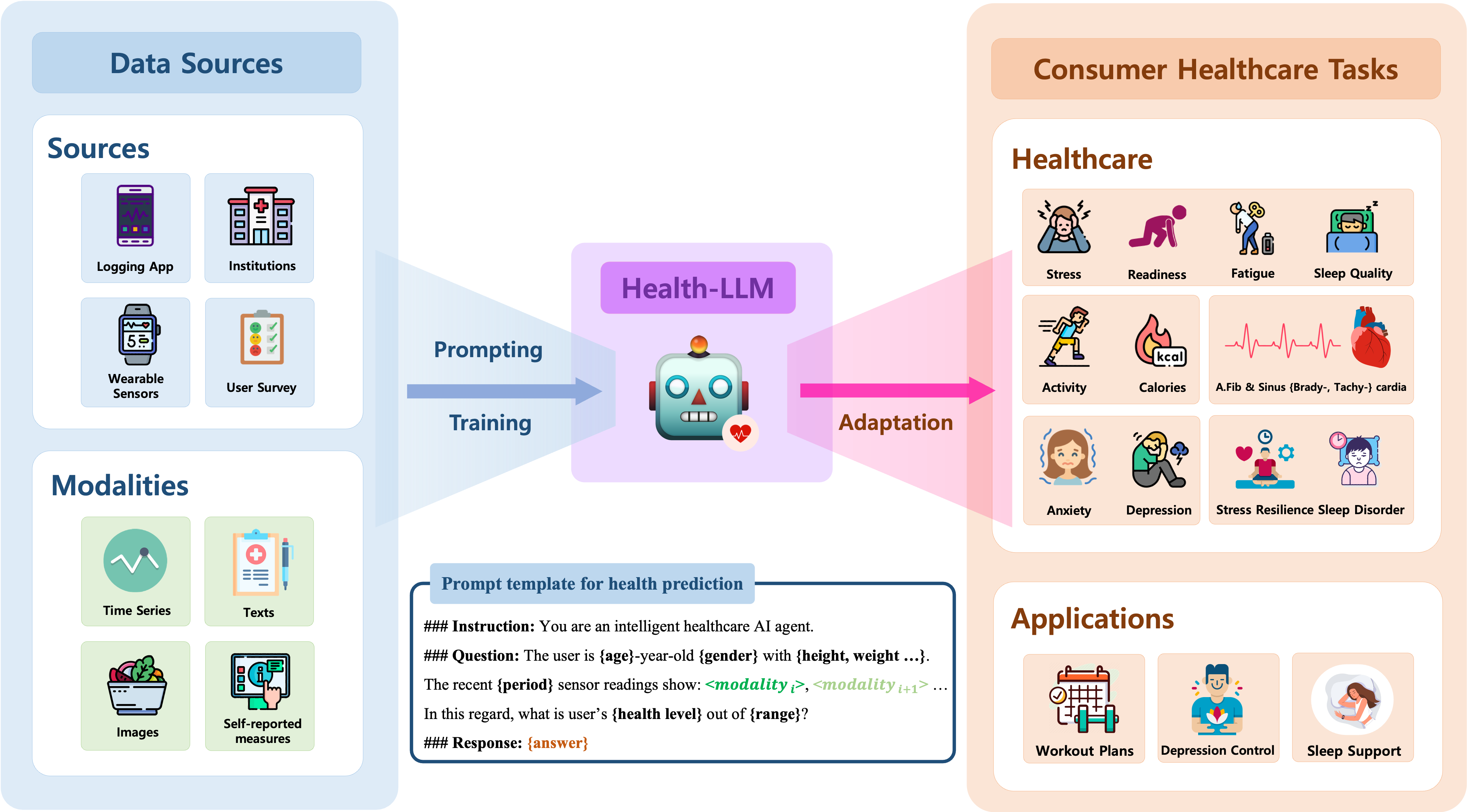
该论文在六个公开可穿戴传感器数据集上,对八个最先进的大语言模型在13个健康预测任务进行了评估,结果显示情境增强提示和微调后的 Health-Alpaca 能取得较强的性能,有时甚至接近 GPT-4/GPT-3.5。论文还分析了提示上下文类型和数据集的泛化性。
Large language models (LLMs) are capable of many natural language tasks, yet they are far from perfect. In health applications, grounding and interpreting domain-specific and non-linguistic data is crucial. This paper investigates the capacity of LLMs to make inferences about health based on contextual information (e.g. user demographics, health knowledge) and physiological data (e.g. resting heart rate, sleep minutes). We present a comprehensive evaluation of 12 state-of-the-art LLMs with prompting and fine-tuning techniques on four public health datasets (PMData, LifeSnaps, GLOBEM and AW_FB). Our experiments cover 10 consumer health prediction tasks in mental health, activity, metabolic, and sleep assessment. Our fine-tuned model, HealthAlpaca exhibits comparable performance to much larger models (GPT-3.5, GPT-4 and Gemini-Pro), achieving the best performance in 8 out of 10 tasks. Ablation studies highlight the effectiveness of context enhancement strategies. Notably, we observe that our context enhancement can yield up to 23.8% improvement in performance. While constructing contextually rich prompts (combining user context, health knowledge and temporal information) exhibits synergistic improvement, the inclusion of health knowledge context in prompts significantly enhances overall performance.
研究动机与目标
- 利用多模态可穿戴传感器数据弥合预训练大语言模型知识与消费者健康问题之间的差距。
- 在13个健康预测任务中评估零次/少量示例以及微调后的LLM性能。
- 研究提示上下文(用户健康知识、时间上下文)对模型性能的影响。
- 比较多种开源与闭源LLM,以为健康领域应用提供实用指导。
提出的方法
- 在六个数据集的13个任务上评估八个LLM(Med-Alpaca、PMC-Llama、Asclepius、ClinicalCamel、Flan-T5、Palmyra-Med、GPT-3.5、GPT-4)。
- 使用零-shot、带-CoT/SC的少-shot、指令微调以及PEFT微调(LoRA)等设定。
- 引入情境增强提示,包含:1) 用户上下文,2) 健康知识上下文,3) 时间上下文,4) 这些上下文的组合。
- 对健康导向模型 Health-Alpaca(以及 Health-Alpaca-LoRa)进行微调,并与更大规模的GPT模型进行比较。
- 评估跨数据集的泛化性并分析微调的训练规模效应。
- 提供一个开源的 Health-LLM 框架和一个 Health-Alpaca 模型。
实验结果
研究问题
- RQ1现成的LLM是否能够为健康预测任务对多模态可穿戴传感器数据进行建模?
- RQ2提示策略(零-shot 与带CoT/SC的少-shot)如何影响可穿戴设备健康 prediction 的性能?
- RQ3指令式或PEFT微调是否能让较小的模型在健康任务上达到甚至超过较大的LLM?
- RQ4情境增强提示(用户、健康知识、时间)在健康预测中的好处是什么?
- RQ5微调后的 Health-LLMs 在跨数据集和不同任务类型上的泛化能力如何?
主要发现
- 零-shot 提示在某些任务上取得了与任务特定基线竞争的结果。
- 使用GPT-3.5/GPT-4 的少-shot 提示在数值时间序列对齐方面显著优于零-shot,超越一些基线。
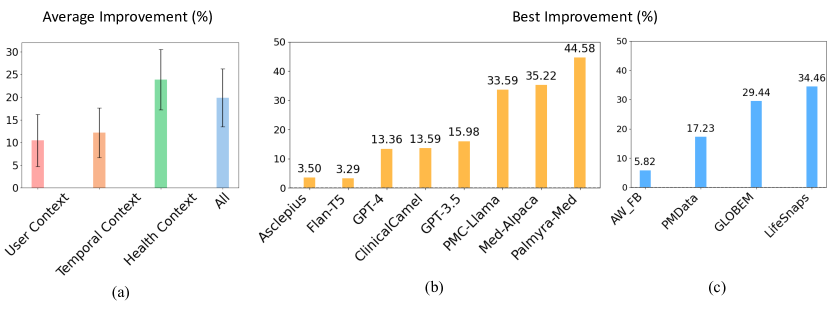
- Health-Alpaca 模型(比 GPT-3.5/4 小 25 倍至 250 倍)在完全微调时,在13个任务中的5个任务上取得最佳性能。
- 情境增强可将性能提升最高达 23.8%,具体取决于任务、数据集和模型,其中健康知识上下文往往提供最强的增益。
- Health-Alpaca-LoRa 也能提升许多任务,显示了参数高效微调在健康任务中的可行性。
- 在单一数据集上进行微调通常会获得良好结果,但多数据集的 Health-Alpaca 展现出对不同任务的合理泛化能力。
阅读本论文
在 Nubint 阅读器中打开原文,边读边就任意段落提问。
在 Nubint 中阅读本论文本解读由 AI 根据论文原文生成,引用前请核对原文。