
[论文解读] Hete-CF: Social-Based Collaborative Filtering Recommendation using Heterogeneous Relations
Hete-CF 提出了一种通用的协同过滤推荐框架,通过元路径建模异质社交网络(如 EBSNs、LBSNs)中的三种关系类型——用户-用户、用户-物品和物品-物品——来利用所有三类关系。通过整合多种关系信号并动态加权社交信息,Hete-CF 在数据稀疏的情况下显著提升了推荐性能,该结论已在 DBLP 和 Meetup 数据集上得到验证。
Collaborative filtering algorithms haven been widely used in recommender systems. However, they often suffer from the data sparsity and cold start problems. With the increasing popularity of social media, these problems may be solved by using social-based recommendation. Social-based recommendation, as an emerging research area, uses social information to help mitigate the data sparsity and cold start problems, and it has been demonstrated that the social-based recommendation algorithms can efficiently improve the recommendation performance. However, few of the existing algorithms have considered using multiple types of relations within one social network. In this paper, we investigate the social-based recommendation algorithms on heterogeneous social networks and proposed Hete-CF, a Social Collaborative Filtering algorithm using heterogeneous relations. Distinct from the exiting methods, Hete-CF can effectively utilize multiple types of relations in a heterogeneous social network. In addition, Hete-CF is a general approach and can be used in arbitrary social networks, including event based social networks, location based social networks, and any other types of heterogeneous information networks associated with social information. The experimental results on two real-world data sets, DBLP (a typical heterogeneous information network) and Meetup (a typical event based social network) show the effectiveness and efficiency of our algorithm.
研究动机与目标
- 通过整合来自异质网络的丰富社交关系,解决协同过滤中的数据稀疏性和冷启动问题。
- 克服现有基于社交的推荐方法仅利用部分关系(如用户-用户或用户-物品)的局限性。
- 开发一种适用于多种异质社交网络(包括基于事件和基于位置的社交网络)的通用推荐框架。
- 智能地加权社交信息,以在历史用户-物品评分不稀疏时避免偏差。
- 使用基于元路径的表示方法,将多种异质关系(用户-用户、用户-物品、物品-物品)整合到统一的协同过滤模型中。
提出的方法
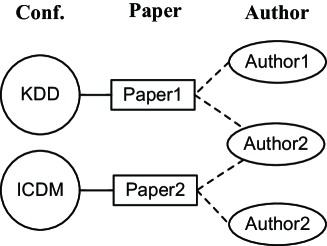
- 使用元路径对用户-用户、用户-物品和物品-物品关系进行建模,以捕捉异质信息网络(HINs)中的语义关系。
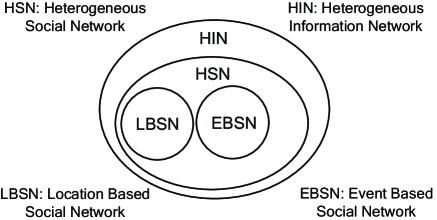
- 构建一个统一的网络结构,将三种关系类型整合为单一的异质社交网络(HSN)模型。
- 应用社交正则化技术,将社交关系融入协同过滤框架,以增强潜在因子的学习。
- 设计一种动态加权机制,根据数据稀疏性评估社交信息的贡献,降低在密集评分场景下的偏差。
- 使用带有元路径感知正则化的矩阵分解方法,学习反映多关系交互的用户和物品嵌入。
- 利用 HIN 中的结构信息,实现跨异质实体(如 DBLP 中的作者、论文、会议;Meetup 中的用户、事件、位置)的偏好传播。
实验结果
研究问题
- RQ1协同过滤模型能否有效利用异质社交网络中多种关系类型(用户-用户、用户-物品、物品-物品)来提升推荐性能?
- RQ2在数据稀疏条件下,异质关系的整合如何影响推荐的准确性和鲁棒性?
- RQ3所提出的方法能否在不同类型的异质社交网络(如 EBSNs 和 LBSNs)中实现泛化?
- RQ4当用户-物品评分矩阵不稀疏时,加权社交信息的最优方式是什么,以避免偏差?
- RQ5与现有基于社交和协同过滤的方法相比,Hete-CF 在有效性与效率方面表现如何?
主要发现
- Hete-CF 通过利用异质社交网络中的多关系信息,在稀疏数据集上显著提升了推荐准确性。
- 该方法在 DBLP 和 Meetup 数据集上均优于基线协同过滤和基于社交的推荐算法。
- 动态加权机制有效降低了在用户-物品评分密集时社交信息的负面影响,防止性能下降。
- 通过元路径整合用户-用户、用户-物品和物品-物品关系,生成了更具鲁棒性和语义意义的用户与物品表征。
- Hete-CF 在包括 EBSNs 和 LBSNs 在内的多种异质社交网络中展现出强大的泛化能力。
- 实验结果证实,Hete-CF 在有效性和效率方面表现优异,且在真实世界数据上具备可扩展的性能。
阅读本论文
在 Nubint 阅读器中打开原文,边读边就任意段落提问。
在 Nubint 中阅读本论文本解读由 AI 根据论文原文生成,引用前请核对原文。