
[论文解读] Hidden giants in JWST's PEARLS: An ultra-massive z=4.26 sub-millimeter galaxy that is invisible to HST
本研究在JWST PEARLS巡天中识别出一个高度遮蔽的、红移z = 4.26的亚毫米波星系(850.1),该星系在HST和JWST/NIRCam成像中均未被探测到,尽管其恒星质量极高(M∗ ≈ 10¹¹.⁸ M⊙)且尘埃消光程度很高(AV ≈ 5)。利用SMA、JCMT、NOEMA、JWST、HST和Spitzer的多波段数据,作者揭示了一个具有棒状形态的紧凑、大质量恒星核心,表明其可能由棒驱动的内流供能,且推测其为一个正在与一个质量较小、遮蔽程度较低的伴星(850.2)发生并合的星系群的中心星系。
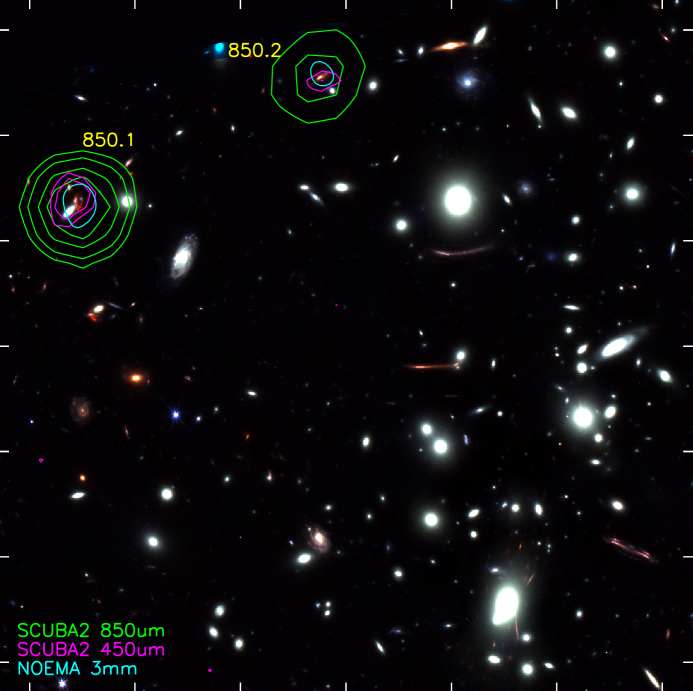
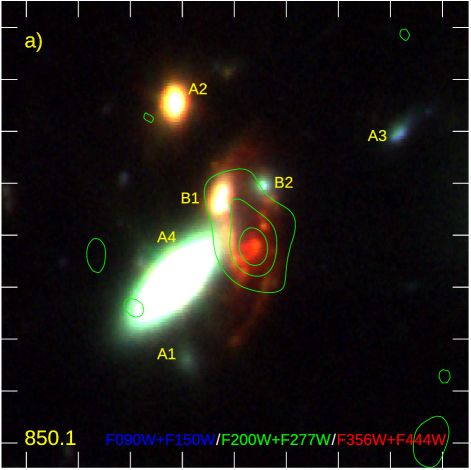
We present a multi-wavelength analysis using SMA, JCMT, NOEMA, JWST, HST, and SST of two dusty strongly star-forming galaxies, 850.1 and 850.2, seen through the massive cluster lens A1489. These SMA-located sources both lie at z=4.26 and have bright dust continuum emission, but 850.2 is a UV-detected Lyman-break galaxy, while 850.1 is undetected at <2um, even with deep JWST/NIRCam observations. We investigate their stellar, ISM, and dynamical properties, including a pixel-level SED analysis to derive sub-kpc-resolution stellar-mass and Av maps. We find that 850.1 is one of the most massive and highly obscured, Av~5, galaxies known at z>4 with M*~10^11.8 Mo (likely forming at z>6), and 850.2 is one of the least massive and least obscured, Av~1, members of the z>4 dusty star-forming population. The diversity of these two dust-mass-selected galaxies illustrates the incompleteness of galaxy surveys at z>3-4 based on imaging at <2um, the longest wavelengths feasible from HST or the ground. The resolved mass map of 850.1 shows a compact stellar mass distribution, Re(mass)~1kpc, but its expected evolution to z~1.5 and then z~0 matches both the properties of massive, quiescent galaxies at z~1.5 and ultra-massive early-type galaxies at z~0. We suggest that 850.1 is the central galaxy of a group in which 850.2 is a satellite that will likely merge in the near future. The stellar morphology of 850.1 shows arms and a linear bar feature which we link to the active dynamical environment it resides within.
研究动机与目标
- 调查由z ≈ 4.26的富马星系团A1489透镜的两个尘埃遮蔽强烈、恒星形成剧烈的星系(850.1和850.2)的物理性质。
- 理解为何其中一个星系(850.1)尽管具有极端质量与尘埃含量,却在HST和JWST/NIRCam成像中仍无法被探测到。
- 探讨动力学相互作用与内部结构(如棒状结构与紧凑恒星核)在高红移大质量星系中驱动强烈恒星形成的作用。
- 基于紫外/光学成像,评估高红移星系巡天的完整性,特别是z > 4的区域。
- 通过将850.1的观测性质与z ≈ 1.5处的大型宁静星系及z ≈ 0处的超大质量早型星系进行比较,确定850.1的演化轨迹。
提出的方法
- 利用SMA、JCMT、NOEMA、JWST、HST和Spitzer进行多波段观测,获取亚毫米波、毫米波、近红外与光学数据。
- 在像素级执行谱能部分布(SED)拟合,生成恒星质量与尘埃消光(AV)的亚千秒差距分辨率图。
- 采用引力透镜建模技术重建透镜星系的本征性质,校正放大率与形变影响。
- 应用galfit与GILDAS软件对恒星形态与尘埃连续发射进行建模,识别出棒状结构与紧凑核心等特征。
- 将850.1的观测质量与结构特性与已知的z ≈ 1.5处大型宁静星系及z ≈ 0处超大质量早型星系进行比较,推断其演化路径。
- 分析850.1与其伴星850.2之间的空间关系,评估并合动力学与环境扰动的影响。
实验结果
研究问题
- RQ1为何超大质量星系850.1在λ ≤ 2 μm波段仍无法被探测到,尽管其恒星质量极高且尘埃消光程度很高?
- RQ2850.1恒星质量分布中观测到的紧凑棒状结构的起源是什么?其与内部供能机制有何关联?
- RQ3850.1的结构与动力学特性与z ≈ 1.5处的大型宁静星系及z ≈ 0处的超大质量早型星系相比如何?
- RQ4在仅依赖紫外/光学成像的情况下,当前z > 4的星系巡天在多大程度上存在不完整性,尤其考虑到存在HST不可见、高度遮蔽的大质量星系?
- RQ5伴星850.2在通过动力学相互作用触发或维持850.1中心恒星爆发方面起到了何种作用?
主要发现
- 星系850.1是目前已知z > 4红移区中质量最大(M∗ ≈ 10¹¹.⁸ M⊙)且遮蔽程度最高的星系之一(AV ≈ 5),其恒星质量分布紧凑(Re ≈ 1 kpc)。
- 尽管JWST/NIRCam观测深度极高,850.1在λ ≤ 2 μm波段仍无法被探测,证实其极端尘埃遮蔽,凸显了紫外/光学巡天在z > 4红移区的局限性。
- 850.1的解析恒星质量图揭示了线性棒状结构与旋臂,表明其可能受伴星850.2相互作用驱动的活跃动力学过程影响。
- 850.1的形态与质量集中度与棒驱动内流一致,后者可为其中心星系核的重子主导区域提供燃料。
- 850.1的演化轨迹与z ≈ 1.5处的大型宁静星系及z ≈ 0处的超大质量早型星系一致,表明其可能是此类系统的前身。
- 该系统被解释为一个星系群,其中850.1为中央星系,850.2为质量较大但遮蔽程度较低的卫星星系,正沿并合路径运行,其动力学扰动可能增强了中心区域的供能。
阅读本论文
在 Nubint 阅读器中打开原文,边读边就任意段落提问。
在 Nubint 中阅读本论文本解读由 AI 根据论文原文生成,引用前请核对原文。