
[论文解读] High-fidelity remote entanglement of trapped atoms mediated by time-bin photons
该论文通过时间-箱编码光子实现了两个囚禁的 138Ba+ 离子之间高保真度的远程纠缠,贝尔态保真度达到 97.0(4)%。该协议利用时间-箱光量子比特的赫拉尔迪干涉,并抑制了关键错误——尤其是原子反冲和激光强度波动——为实现保真度超过 99.9% 的可扩展、模块化量子网络铺平了道路。
Photonic interconnects between quantum processing nodes are likely the only way to achieve large-scale quantum computers and networks. The bottleneck in such an architecture is the interface between well-isolated quantum memories and flying photons. We establish high-fidelity entanglement between remotely separated trapped atomic qubit memories, mediated by photonic qubits stored in the timing of their pulses. Such time-bin encoding removes sensitivity to polarization errors, enables long-distance quantum communication, and is extensible to quantum memories with more than two states. Using a measurement-based error detection process and suppressing a fundamental source of error due to atomic recoil, we achieve an entanglement fidelity of 97% and show that fidelities beyond 99.9% are feasible.
研究动机与目标
- 通过光子链路实现远程囚禁离子量子比特之间高保真度、长距离的量子互连。
- 克服偏振编码光子量子比特的局限性,后者对光学元件和光纤中的双折射效应敏感。
- 证明时间-箱编码可实现鲁棒、可扩展的远程纠缠,保真度高且错误率低。
- 识别并抑制主要错误源,如原子反冲、激光强度波动和探测器暗计数。
- 表明保真度超过 99.9% 是可行的,从而支持模块化量子计算和长距离量子通信。
提出的方法
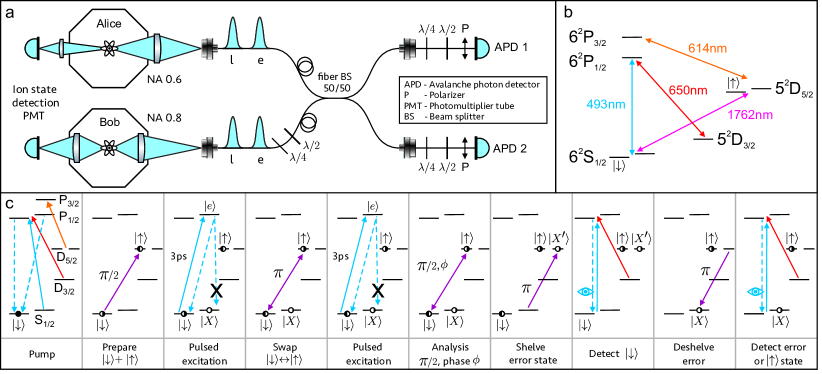
- 使用时间-箱编码将光子量子比特存储在囚禁 138Ba+ 离子发射的单光子时间轮廓中。
- 通过高数值孔径物镜收集来自两个远距离离子的光子,并在分束器上进行干涉,实现赫拉尔迪贝尔态测量。
- 采用基于测量的错误检测协议,以最小开销标记并纯化消光错误。
- 通过在 10 ns 窗口内稳定离子激发和光子探测的时序,抑制由原子反冲引起的错误。
- 通过主动稳定减少激光强度波动,降低 SPAM 和态交换错误。
- 对多普勒冷却极限和运动模式进行表征,以估算反冲引起的错误,重点关注最敏感的模式(离子 B 的 y 模式,平均激发数 n̄D ≈ 826)。
实验结果
研究问题
- RQ1时间-箱编码光子能否实现囚禁离子之间高保真度的远程纠缠,超越基于偏振的协议的保真度极限?
- RQ2在基于时间-箱的远程纠缠中,主要的错误源是什么?能否在实验中有效抑制?
- RQ3光子发射引起的原子反冲在多大程度上会降低纠缠保真度?能否通过时序控制加以缓解?
- RQ4在当前实验技术下,能否将保真度提升至 99.9% 以上,从而支持可扩展的模块化量子架构?
- RQ5光子编码方式的选择(时间-箱 vs. 偏振)在长距离量子网络中的可扩展性和鲁棒性方面有何影响?
主要发现
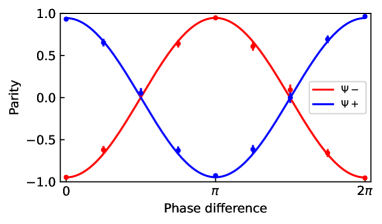
- 实验实现了 97.0(4)% 的贝尔态保真度,证明了使用时间-箱光子在两个囚禁 138Ba+ 离子之间实现高保真度远程纠缠。
- 最大的保真度误差源是驱动量子比特旋转的 1762 nm 激光的强度波动,贡献了 1.00% 的误差,是误差预算中的主导项。
- 通过路径长度稳定,光子波包重叠误差被最小化至 0.4%,时间轮廓匹配精度达 30 ps 以内。
- 由光子探测时间抖动(10 ns 窗口)引起的反冲误差贡献了 0.2% 的保真度误差,另有来自运动态纠缠和激光频率波动的额外贡献。
- 探测器暗计数和背景光对误差预算的贡献小于 0.2%,而分束器非理想性和模式失配的贡献小于 0.1%。
- 总保真度误差估计为 2.00%,其中残余相干时间 2.1 ms 在 8 μs 分析窗口内导致的误差小于 0.01%。
阅读本论文
在 Nubint 阅读器中打开原文,边读边就任意段落提问。
在 Nubint 中阅读本论文本解读由 AI 根据论文原文生成,引用前请核对原文。