
[论文解读] Higher vortexability: zero field realization of higher Landau levels
本文提出了陈能带中第一 Landau 亚层(1LL)量子几何的精确定义,实现了无磁场条件下高 Landau 亚层物理的实现。通过引入成对能带涡旋可实现性条件,定义了‘首涡旋能带’,作者表明周期性应变的 Bernal 石墨烯在无外磁场下实现了类似 1LL 的结构,支持类似于非阿贝尔分数量子霍尔态在 ν=1/2 和 2/5 处的分数量子陈绝缘体态。
The rise of moiré materials has led to experimental realizations of integer and fractional Chern insulators in small or vanishing magnetic fields. At the same time, a set of minimal conditions sufficient to guarantee a Abelian fractional state in a flat band were identified, namely "ideal" or "vortexable" quantum geometry. Such vortexable bands share essential features with the lowest Landau level, while excluding the need for more fine-tuned aspects such as flat Berry curvature. A natural and important generalization is to ask if such conditions can be extended to capture the quantum geometry of higher Landau levels, particularly the first (1LL), where non-Abelian states at $ν= 1/2,2/5$ are known to be competitive. The possibility of realizing these states at zero magnetic field , and perhaps even more exotic ones, could become a reality if we could identify the essential structure of the 1LL in Chern bands. In this work, we introduce a precise definition of 1LL quantum geometry, along with a figure of merit that measures how closely a given band approaches the 1LL. We apply the definition to identify two models with 1LL structure -- a toy model of double bilayer twisted graphene and a more realistic model of strained Bernal graphene.
研究动机与目标
- 将‘涡旋可实现性’的概念从最低 Landau 亚层(LLL)推广至第一 Landau 亚层(1LL),以捕捉陈能带中 1LL 的量子几何特性。
- 确定在无外磁场条件下实现类似 1LL 物理的最小条件。
- 提出一个量化指标,用于衡量能带系统与 1LL 结构的接近程度。
- 证明周期性应变的 Bernal 石墨烯在零磁场下实现了类似 1LL 的量子几何。
- 实现无磁场下非阿贝尔分数量子陈绝缘体的实验实现,其行为类似于强磁场下的对应态。
提出的方法
- 通过成对能带涡旋可实现性条件,提出‘首涡旋能带’的新定义:若一个陈能带与一个具有零级 Landau 亚层结构的伙伴能带构成涡旋可实现复数,则该能带为 1LL 类似结构。
- 定义一个量化指标 M = γ₁² / (γ₁² + 2(vℓ_B⁻¹)²),用于量化系统接近 1LL 几何的程度,其中 M=1 表示完美 1LL 结构。
- 利用非阿贝尔 Berry 曲率 Ω̂_mn(k) 来表征多能带系统的量子几何,通过晶胞周期性布洛赫态与投影算符进行计算。
- 对成对能带应用涡旋附加过程:在整数填充态上附加涡旋(Jastrow 因子),在短程相互作用下可获得精确的 Jain 类基态。
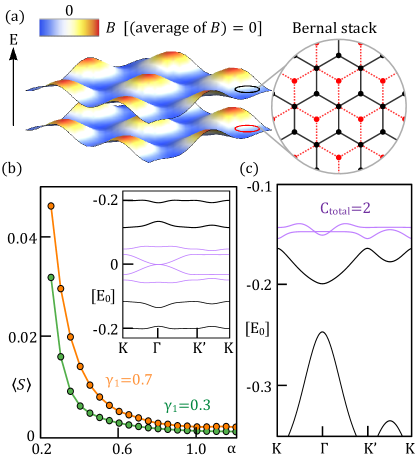
- 在具有周期性应变超晶格的 Bernal 石墨烯中进行解析计算,以在 k=0 处计算 Berry 曲率与涡旋可实现性指标 M。
- 在 24×24 个原胞上进行自洽的哈特里-福克计算,采用栅极屏蔽的库仑相互作用,以验证孤立陈能带的稳定性。
实验结果
研究问题
- RQ1‘涡旋可实现性’的概念能否推广至描述陈能带中第一 Landau 亚层(1LL)的量子几何?
- RQ2在无外磁场的平坦能带中,实现 1LL 类似物理的最小条件是什么?
- RQ3通过涡旋附加,陈能带系统是否能在零磁场下表现出精确的 Jain 类分数量子陈绝缘体基态?
- RQ4周期性应变的 Bernal 石墨烯是否在无磁场下实现了类似 1LL 的量子几何?
- RQ5陈能带中‘1LL 特性’的定量度量是什么?其随系统参数(如 γ₁)如何变化?
主要发现
- 本文定义了一类新能带——‘首涡旋能带’,其中陈能带与伙伴能带构成涡旋可实现复数,通过涡旋附加可实现精确的 Jain 类基态。
- 量化指标 M = γ₁² / (γ₁² + 2(vℓ_B⁻¹)²) 表征了能带接近 1LL 结构的程度,其中 M=1 表示完美 1LL 几何。
- 在周期性应变的 Bernal 石墨烯中,涡旋可实现性指标 M 达到接近 1 的值,表明即使在零磁场下也表现出强烈的 1LL 类似量子几何。
- 在 k=0 处解析计算了非阿贝尔 Berry 曲率 Ω̂_mn(k),结果表明 Ω̂_00 = B⁻¹ × [2(vℓ_B⁻¹)² / (γ₁² + 2(vℓ_B⁻¹)²)] 且 Ω̂_11 = B⁻¹ × [2(vℓ_B⁻¹)² + 2γ₁²] / (γ₁² + 2(vℓ_B⁻¹)²),与 C=2 的陈数一致。
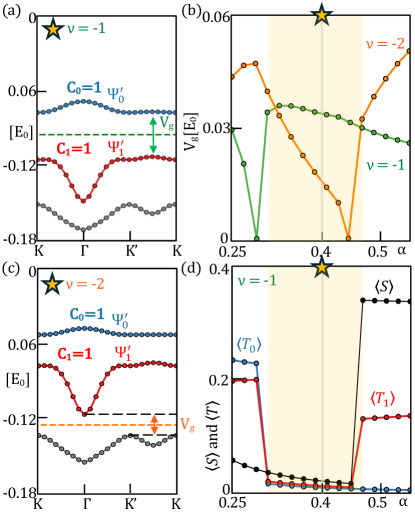
- 数值自洽哈特里-福克计算证实了应变体系中存在高度孤立的陈能带,支持潜在 FCI 态的稳定性。
- 结果表明,非阿贝尔分数量子陈绝缘体(如 ν=1/2 和 2/5 处的态)可在工程化莫尔超晶格(如应变石墨烯)中实现于零磁场下。
阅读本论文
在 Nubint 阅读器中打开原文,边读边就任意段落提问。
在 Nubint 中阅读本论文本解读由 AI 根据论文原文生成,引用前请核对原文。