
[论文解读] Highly nonperturbative nature of the Mott metal-insulator transition: Two-particle vertex divergences in the coexistence region
本文表明,半填满 Hubbard 模型中的 Mott 金属-绝缘体转变(MIT)表现出高度非微扰的特性,这通过在绝缘相中当温度趋近于零时,两粒子顶点发散线的无限累积现象得以揭示。通过系统的动力学平均场理论(DMFT)计算,作者发现发散线的数量随逆温度 β 增加,表明在 T=0 处存在一个临界累积点,这凸显了在 MIT 处微扰理论的失效。
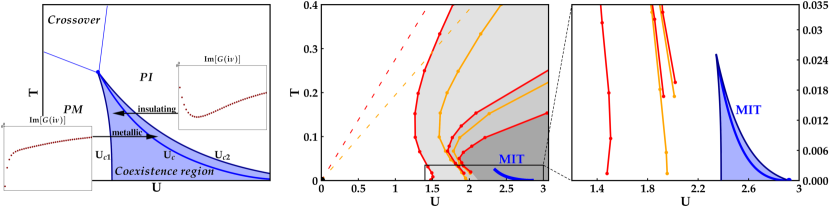
We thoroughly analyze the divergences of the irreducible vertex functions occurring in the charge channel of the half-filled Hubbard model in close proximity to the Mott metal-insulator transition (MIT). In particular, by systematically performing dynamical mean-field theory (DMFT) calculations on the two-particle level, we determine the location and the number of the vertex divergences across the whole coexistence region adjacent to the first-order metal-to-insulator transition. We find that the lines in the parameter space, along which the vertex divergences occur, display a qualitatively different shape in the coexisting metallic and insulating phase, which is also associated to an abrupt jump of the number of divergences across the MIT. Physically, the systematically larger number of divergences on the insulating side of the transition reflects the sudden suppression of local charge fluctuation at the MIT. Further, a systematic analysis of the results demonstrates that the number of divergence lines increases as a function of the inverse temperature ${β\!=\!(k_\mathrm{B} T)^{-1}}$ by approaching the Mott transition in the zero temperature limit. This makes it possible to identify the zero-temperature MIT as an accumulation point of an infinite number of vertex divergence lines, unveiling the highly nonperturbative nature of the underlying transition.
研究动机与目标
- 为解决微扰理论失效与 Mott 金属-绝缘体转变(MIT)之间尚未理清的联系,特别是在共存区域。
- 研究在 Mott 转变附近电荷通道中不可约两粒子顶点函数的行为,重点关注金属相和绝缘相中的发散线。
- 确定发散线的数量和结构如何在一级 MIT 的整个转变过程中以及在零温极限下演化。
- 确立零温 MIT 是无限多条发散线的累积点,揭示其非微扰本质。
提出的方法
- 在具有无限连通性的 Bethe 晶格上,对半填满 Hubbard 模型进行系统性的两粒子层次的动力学平均场理论(DMFT)计算。
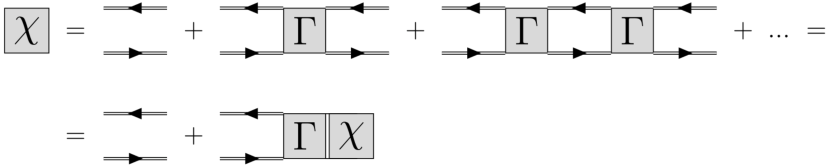
- 计算电荷通道中的不可约两粒子顶点函数,并通过 Bethe-Salpeter 方程核识别发散线。
- 将顶点核的负特征值数量 $N_{\nu<0}$ 作为共存区域中发散线数量的代理指标。
- 通过增加逆温度 $\beta = (k_B T)^{-1}$,将结果外推至零温,其中 $\beta$ 值最高达到 200。
- 使用多项式拟合转变线($U_{c1}(T)$, $U_c(T)$, $U_{c2}(T)$)和中间线,以映射参数空间中的发散行为。
- 构建一个有效 Hubbard 原子模型,其中 $U_{\text{eff}}(U) = U^2 / (U + U_{c1}^{T=0}( heta_0 - 1))$,以近似绝缘相中的发散结构,其中 $\theta_0$ 通过 $N_{\nu<0}(\beta)$ 的斜率比值校准。
实验结果
研究问题
- RQ1在 Mott MIT 的共存区域内,两粒子顶点发散的位置和数量如何变化?
- RQ2发散线数量与金属相和绝缘相在 MIT 附近的性质之间存在何种关系?
- RQ3当 $T \to 0$ 时,发散线数量如何随逆温度 $\beta$ 变化?
- RQ4零温 Mott 转变是否可被理解为发散线的累积点,从而表明其为非微扰临界点?
- RQ5在多大程度上,可通过具有重整化相互作用 $U_{\text{eff}}$ 的有效 Hubbard 原子模型来捕捉绝缘相的发散结构?
主要发现
- 发散线数量 $N_{\nu<0}$ 随逆温度 $\beta$ 增加,其标度行为为:当 $\beta \leq 75$ 时,$p(U) \propto U$;当 $\beta = 100, 133$ 时,$\propto U^2$;当 $\beta = 200$ 时,$\propto U^3$,表明发散累积过程具有强烈的非线性特征。
- 发散线在金属相和绝缘相中表现出定性不同的形状,且在一级相变处发散线数量出现不连续跃迁。
- 绝缘相中发散线的数量系统性地多于金属相,反映出在 MIT 处局域电荷涨落的突然抑制。
- 零温 Mott 转变被确认为无限多条发散线的累积点,证实其具有高度非微扰的特性。
- 具有 $U_{\text{eff}} = U^2 / (U + U_{c1}^{T=0}( heta_0 - 1))$ 和 $\theta_0 \approx 1.19$ 的有效 Hubbard 原子模型,能对绝缘相中的发散线数量提供良好的定量近似,其中 $\theta_0^{\text{slope}} = 1.22$ 由 $N_{\nu<0}(\beta)$ 的斜率比值导出。
- 在 $\beta = 40$ 时,采用 $\theta_0^{\text{slope}} = 1.22$ 的有效模型,对 Hubbard 模型的 $N_{\nu<0}$ 值的再现误差在 $U = 3.1$ 和 $U = 3.5$ 时仅为 1–3%。
阅读本论文
在 Nubint 阅读器中打开原文,边读边就任意段落提问。
在 Nubint 中阅读本论文本解读由 AI 根据论文原文生成,引用前请核对原文。