
[论文解读] HOTR: End-to-End Human-Object Interaction Detection with Transformers
HOTR 提出了一种基于 Transformer 的端到端集合预测框架,用于人体-物体交互(HOI)检测,可直接预测 <人, 物体, 交互> 三元组而无需后处理。通过利用带有 HO 指针的并行解码器和一种新型集合损失函数,HOTR 在 V-COCO 和 HICO-DET 上实现了最先进性能,推理时间低于 1ms,显著优于先前方法。
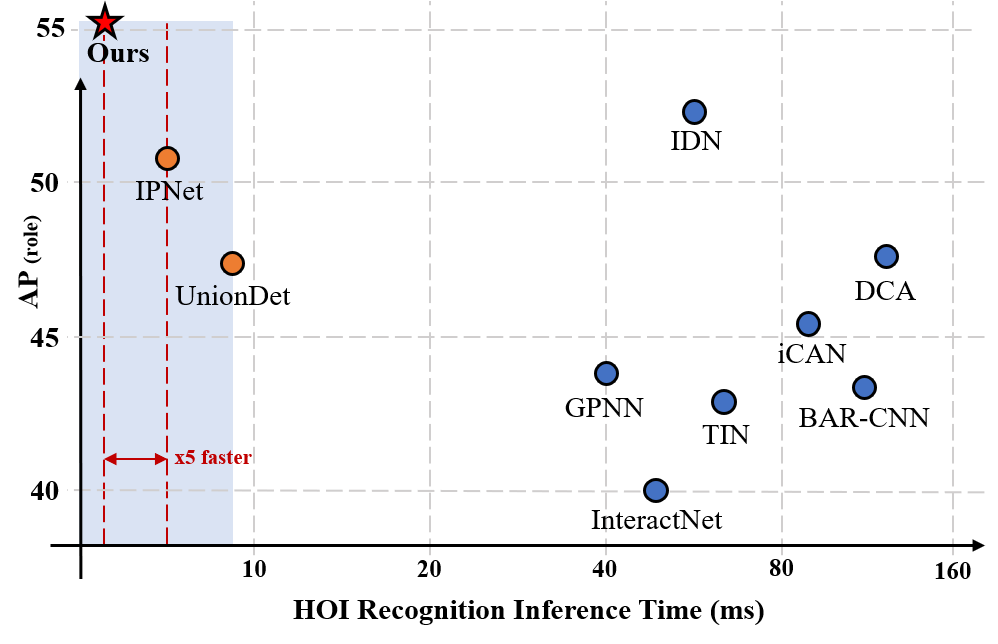
Human-Object Interaction (HOI) detection is a task of identifying "a set of interactions" in an image, which involves the i) localization of the subject (i.e., humans) and target (i.e., objects) of interaction, and ii) the classification of the interaction labels. Most existing methods have indirectly addressed this task by detecting human and object instances and individually inferring every pair of the detected instances. In this paper, we present a novel framework, referred to by HOTR, which directly predicts a set of triplets from an image based on a transformer encoder-decoder architecture. Through the set prediction, our method effectively exploits the inherent semantic relationships in an image and does not require time-consuming post-processing which is the main bottleneck of existing methods. Our proposed algorithm achieves the state-of-the-art performance in two HOI detection benchmarks with an inference time under 1 ms after object detection.
研究动机与目标
- 通过实现 <人, 物体, 交互> 三元组的直接集合级预测,消除现有 HOI 检测方法中耗时的后处理步骤。
- 利用 Transformer 架构中的自注意力机制,建模人、物体与交互之间的高层语义关系。
- 通过用可端到端训练的组件替代启发式匹配,实现在 HOI 检测基准中达到最先进精度与推理速度。
- 设计一种新型训练与推理流程,通过共享且并行的解码器,支持物体检测与交互预测的联合学习。
提出的方法
- HOTR 采用带有两个并行解码器的 Transformer 编码器-解码器架构:一个用于实例检测(人/物体),另一个用于交互预测。
- 引入 HO 指针,通过预测索引而非直接回归边界框,将交互预测与特定的人和物体实例关联起来。
- 在推理阶段引入重构层,利用表示向量之间的相似性分数,将交互预测与检测到的实例进行匹配。
- 提出一种新型集合匹配损失函数,通过将预测三元组与真实 <人, 物体, 交互> 集对齐,实现端到端训练。
- 在推理阶段应用交互性抑制策略,以抑制低置信度的冗余预测,提升多标签交互分类的精确度。
- 共享编码器使解码器之间能够共享特征,增强上下文理解能力,并提升在各类交互中的泛化性能。
实验结果
研究问题
- RQ1基于 Transformer 的直接集合预测方法是否能消除 HOI 检测中对启发式后处理的需求?
- RQ2通过自注意力机制建模交互之间的依赖关系,对 HOI 检测性能有何提升作用?
- RQ3与直接边界框回归相比,使用 HO 指针对准确率和推理效率有何影响?
- RQ4实例检测与交互预测解码器之间的共享编码对性能与泛化能力有何影响?
- RQ5交互性抑制在多标签交互预测质量提升方面有多大作用?
主要发现
- HOTR 在 V-COCO 和 HICO-DET 基准上均达到最先进性能,V-COCO(场景 1)mAP 达 55.2,HICO-DET(默认设置)mAP 达 23.5。
- 在完成物体检测后,HOI 识别的推理时间仅为 0.9ms,比先前的并行 HOI 检测器快 5–9 倍。
- 移除 HO 指针后,V-COCO 上性能降至 39.3 mAP,HICO-DET 上降至 17.2 mAP,表明其在减少冗余回归和提升准确率方面具有关键作用。
- 使用独立编码器而非共享编码器时,V-COCO 上 mAP 下降 21.3,HICO-DET 上下降 9.0,证实了共享视觉表征的优势。
- 交互性抑制在 V-COCO 上带来 3 mAP 的提升,在 HICO-DET 上带来 1.5 mAP 的提升,表明其在过滤低置信度预测方面的有效性。
- 消融实验确认,所提出的训练与推理流程(包括重构与基于指针的匹配)对实现高准确率与高速度至关重要。

阅读本论文
在 Nubint 阅读器中打开原文,边读边就任意段落提问。
在 Nubint 中阅读本论文本解读由 AI 根据论文原文生成,引用前请核对原文。