
[论文解读] How AI Ideas Affect the Creativity, Diversity, and Evolution of Human Ideas: Evidence From a Large, Dynamic Experiment
该研究在一个动态、类似群体的头脑风暴设置中,研究在披露与否的情况下,AI 生成的想法如何影响个体创造力与 800+ participants from 40+ countries 的参与者的集体多样性。
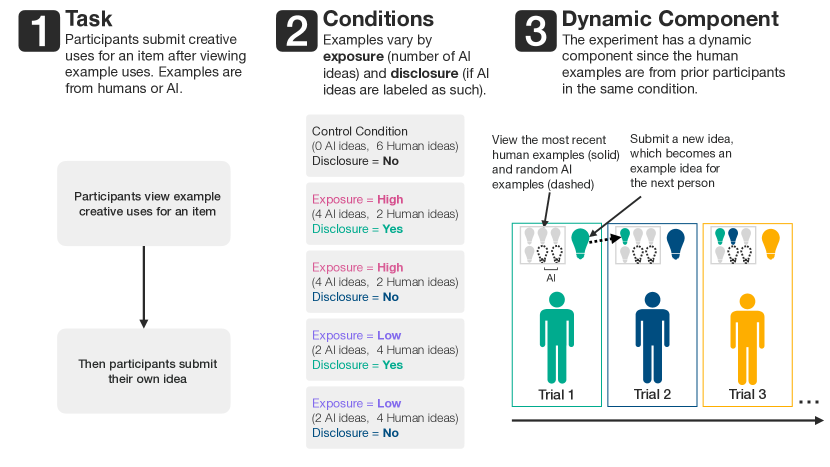
Exposure to large language model output is rapidly increasing. How will seeing AI-generated ideas affect human ideas? We conducted an experiment (800+ participants, 40+ countries) where participants viewed creative ideas that were from ChatGPT or prior experimental participants and then brainstormed their own idea. We varied the number of AI-generated examples (none, low, or high exposure) and if the examples were labeled as 'AI' (disclosure). Our dynamic experiment design -- ideas from prior participants in an experimental condition are used as stimuli for future participants in the same experimental condition -- speaks to the interdependent process of cultural creation: creative ideas are built upon prior ideas. Hence, we capture the compounding effects of having LLMs 'in the culture loop'. We find that high AI exposure (but not low AI exposure) did not affect the creativity of individual ideas but did increase the average amount and rate of change of collective idea diversity. AI made ideas different, not better. There were no main effects of disclosure. We also found that self-reported creative people were less influenced by knowing an idea was from AI and that participants may knowingly adopt AI ideas when the task is difficult. Our findings suggest that introducing AI ideas may increase collective diversity but not individual creativity.
研究动机与目标
- 在一个动态、文化循环背景下检验对 AI 生成的想法的暴露如何影响人类创造力。
- 确定 AI 披露(将想法标注为 AI)是否会调节创造力和多样性的影响。
- 评估 AI 想法对在 successive generations 的想法多样性演化的影响。
提出的方法
- 使用一种变体的 Alternate Uses Task (AUT),参与者在生成自己的创意前看到 AI 和/或人类的想法。
- 在动态、前向传播设计中操作 AI 暴露水平(无、低、高)和 AI 披露(有标注 vs. 无标注)。
- 将想法表示为嵌入(SBERT),以通过与 AI 典型样本的余弦相似度来衡量想法多样性和 AI 采纳。
- 用基于 GPT-3 的原创性分类器估计个体创造力,该分类器与人类判断相关(总体 r=0.81)。
- 通过允许同一条件下的想法向未来参与者前馈,来跟踪时间动态。
实验结果
研究问题
- RQ1高 AI 暴露是否提高个体创造力或群体层面的多样性?
- RQ2标注 AI 生成的想法(披露)是否改变创造力或 AI 想法的采纳?
- RQ3AI 暴露如何影响随时间变化的集体想法多样性的变化速度?
- RQ4自认有创造力的参与者在采用 AI 想法时是否比不自认有创造力的参与者受披露影响更小?
主要发现
- 高 AI 暴露增加了集体想法多样性,但未提高个体创造力。
- AI 暴露加速了随着时间推移想法多样性的形成速率。
- 自我认定为有创造力的参与者在采用 AI 想法时对 AI 披露的影响较小。
- 在任务困难且披露存在时,参与者更倾向于采纳 AI 想法。
- 在整个样本中,披露对创造力或多样性的主效应不显著。

阅读本论文
在 Nubint 阅读器中打开原文,边读边就任意段落提问。
在 Nubint 中阅读本论文本解读由 AI 根据论文原文生成,引用前请核对原文。