
[论文解读] How to build the best medical image segmentation algorithm using foundation models: a comprehensive empirical study with Segment Anything Model
本文在17个医疗影像数据集上对18种SAM微调策略进行实证比较,识别出有效的基于PEFT的方法以及在医疗图像分割中的数据集可用性场景。
Automated segmentation is a fundamental medical image analysis task, which enjoys significant advances due to the advent of deep learning. While foundation models have been useful in natural language processing and some vision tasks for some time, the foundation model developed with image segmentation in mind - Segment Anything Model (SAM) - has been developed only recently and has shown similar promise. However, there are still no systematic analyses or "best-practice" guidelines for optimal fine-tuning of SAM for medical image segmentation. This work summarizes existing fine-tuning strategies with various backbone architectures, model components, and fine-tuning algorithms across 18 combinations, and evaluates them on 17 datasets covering all common radiology modalities. Our study reveals that (1) fine-tuning SAM leads to slightly better performance than previous segmentation methods, (2) fine-tuning strategies that use parameter-efficient learning in both the encoder and decoder are superior to other strategies, (3) network architecture has a small impact on final performance, (4) further training SAM with self-supervised learning can improve final model performance. We also demonstrate the ineffectiveness of some methods popular in the literature and further expand our experiments into few-shot and prompt-based settings. Lastly, we released our code and MRI-specific fine-tuned weights, which consistently obtained superior performance over the original SAM, at https://github.com/mazurowski-lab/finetune-SAM.
研究动机与目标
- 研究哪些SAM微调策略在医疗图像分割中能实现最佳性能。
- 将基于SAM的方法与传统的UNet-based方法在多种医疗影像模态上进行比较。
- 评估数据可用性情景对微调策略选择的影响。
- 探索预训练策略(任务扩展提示和自监督学习)以及医疗影像中的少样本/交互式分割设置。
提出的方法
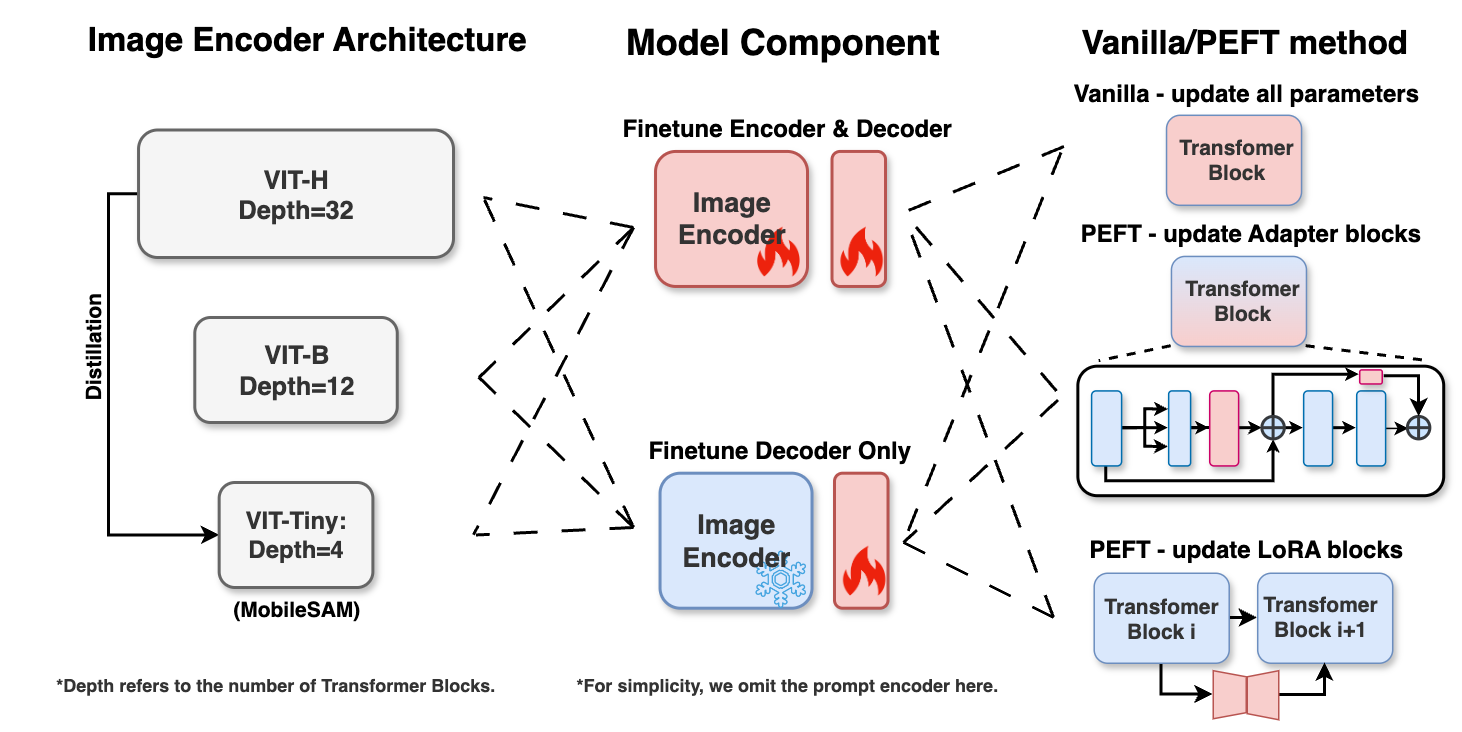
- 通过对医疗数据集微调SAM来评估18种架构-组件-方法组合。
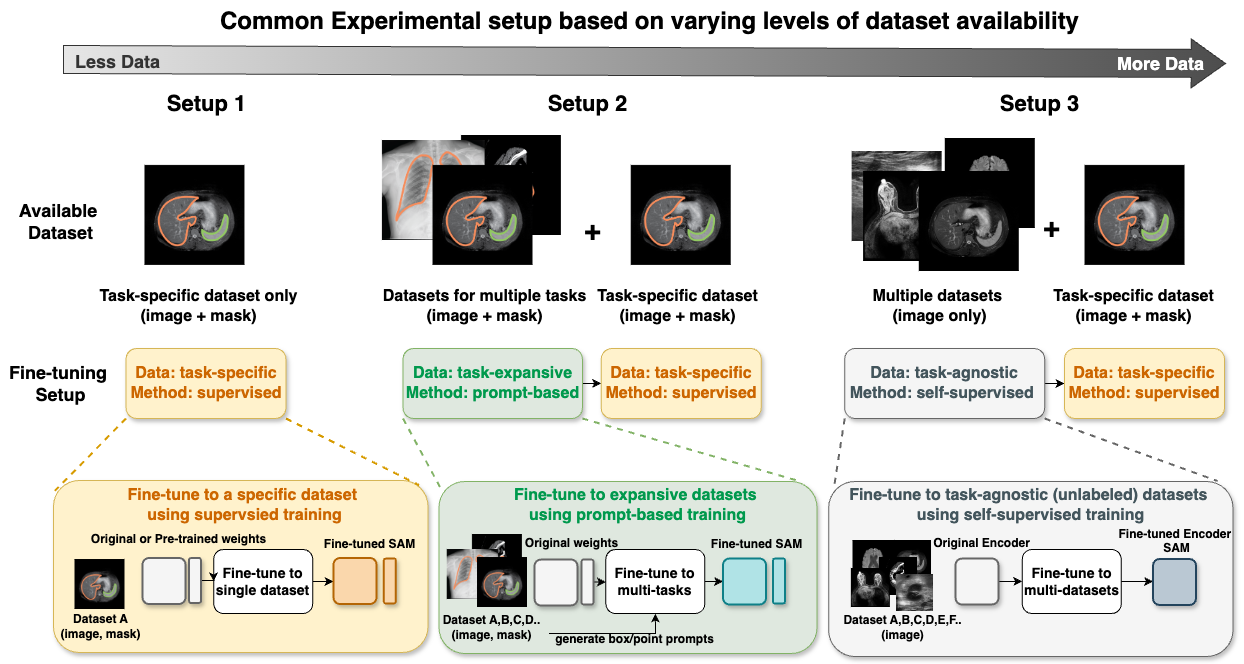
- 考虑三种数据可用性情景:单一标签数据集、多个带标签数据集,以及多个带标签+未标注数据集。
- 使用ViT-H、ViT-B和ViT-T 主干网络,配以解码器/编码器/标准及PEFT变体(Adapter和LoRA)。
- 按照数据可用性,依次应用任务特定有监督训练、任务扩展提示学习和任务无关自监督学习(MAE)。
- 将SAM微调与UNet、nnUNet和SwinUNet基线在17个数据集上进行比较;报告Dice相似系数(DSC)。
- 提供MRI特定的预训练权重和可复现的代码。
实验结果
研究问题
- RQ1在不同数据可用性情景下,哪种SAM微调策略最适合医疗图像分割?
- RQ2PEFT方法(Adapter/LoRA)是否在医学影像中的SAM中优于原生微调?
- RQ3额外的预训练(任务扩展提示或自监督MAE)能否提升SAM在医疗数据集的性能?
- RQ4在多样的放射学模态和器官中,SAM与传统的基于UNet的方法相比如何?
主要发现
- 全编码器和解码器均参与微调并使用PEFT(Adapter或LoRA)通常比仅更新解码器获得更好的DSC。
- 使用PEFT时,编码器选择的影响较小;由于数据规模和训练稳定性,较小的主干(ViT-B或ViT-T)在医学任务中可能超越ViT-H。
- 自监督预训练(MAE)和任务扩展提示学习在某些设置中还能进一步提升最终性能。
- 基于SAM的方法在复杂目标上可超越某些UNet变体,但在某些数据集的简单目标上,UNet变体(nnUNet)表现更出色。
- 直接对大型SAM(ViT-H, En/Decoder, Vanilla)进行微调可能在某些数据集导致模型崩溃,凸显在医学场景中PEFT的好处。
- 该研究提供了面向MRI的预训练以及可公开获取的代码库和微调权重,以便复现。
阅读本论文
在 Nubint 阅读器中打开原文,边读边就任意段落提问。
在 Nubint 中阅读本论文本解读由 AI 根据论文原文生成,引用前请核对原文。