
[论文解读] How to Understand Limitations of Generative Networks
本文主张使用 Neyman-Pearson 分类器权重来测试粒子物理中的生成网络,展示权重分布如何揭示在喷流、量能器淹没以及事件上的失败,并强调可解释性与不确定性。
These are the datasets used in "How to Understand Limitations of Generative Networks". The preprint is available on arXiv at: https://arxiv.org/abs/2305.16774 Four files are used in Sec.5 "Event generation": ev_truth.h5 is the true reconstruction-level sample used during training; ev_masspeak.h5 is the sample generated from the neural network of Sec. 5.1; ev_inn.h5 is the state-of-the-art sample used in Sec. 5.2; ev_binn.h5 collects the Bayesian samples of Sec. 5.3; The remaining three files are used for the "Calorimeter simulation" section.These are named according to the particle originating the shower: "calo_eplus.hdf5" for positrons, "calo_gamma.hdf5" for photons, and "calo_piplus.hdf5" for pions. Each sample contains 100k showers.
研究动机与目标
- 定义一个基于分类器的框架来评估粒子物理中的生成网络。
- 利用分类器输出推导权重分布,以诊断密度估计失败。
- 将方法应用于分布偏移的喷流、量能器模拟和重建级别事件生成。
- 演示权重模式如何与潜在物理机制相连接,并实现可解释的AI诊断。
提出的方法
- 从一个最优的 NP 分类器定义权重 w(x) = p_data(x)/p_model(x)。
- 分析权重分布和尾部以识别过度生成和不足生成的区域。
- 使用 ROC/AUC 的概念,但强调权重分布形状而非单一数值。
- 将集成分类器应用于喷流、量能器淹没和 Z+喷流事件。
- 探索标定、拉扯与贝叶斯回归之间的联系以评估不确定性。
- 演示如何用权重支撑的相空间聚类揭示具体的FAILURE 模式。
实验结果
研究问题
- RQ1 Neyman-Pearson 分类器是否能够在高能物理生成任务中准确学习数据与模型之间的似然比?
- RQ2分类器权重的尾部与聚类模式揭示喷流、量能器和事件生成器的具体失败?
- RQ3权重分布如何引导改进生成网络并评估不确定性?
- RQ4基于权重的分析如何与 HL-LHC 仿真中的相空间边界与物理特征相关?
主要发现
- 权重分布通常在 w=1 附近达到峰值,尾部指示过度生成或不足生成区域。
- 权重的尾部和聚类模式揭示缺失特征、相空间边界以及分布的展宽或偏移。
- 量能器淹没呈现不对称的权重尾部和与逐层能量沉积及噪声相关的特定失败模式。
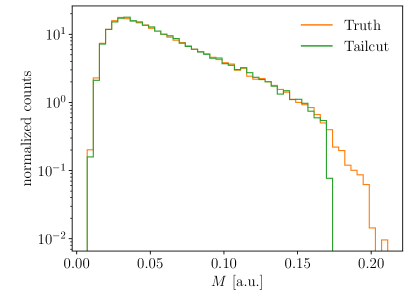
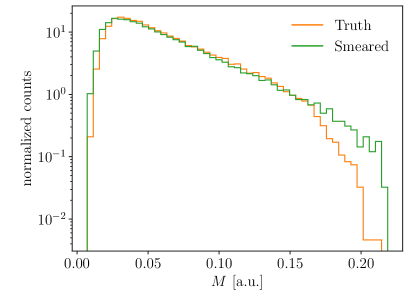
- 事件生成权重揭示质量峰值的模糊化和喷流相关性等具体且可诊断的问题。
- 集成方法与标定支持分类器学习密度比并实现可解释 AI 样式诊断。
- 权重可用于量化生成器版本之间的进展并指导有针对性的改进。
阅读本论文
在 Nubint 阅读器中打开原文,边读边就任意段落提问。
在 Nubint 中阅读本论文本解读由 AI 根据论文原文生成,引用前请核对原文。