
[论文解读] HSIDMamba: Exploring Bidirectional State-Space Models for Hyperspectral Denoising
简述: 引入 HSIDMamba(HSDM),一种用于高光谱去噪的双向状态空间模型,在线性(几乎)复杂度下实现了最先进的结果,并且推理速度比最近的变换器更快。
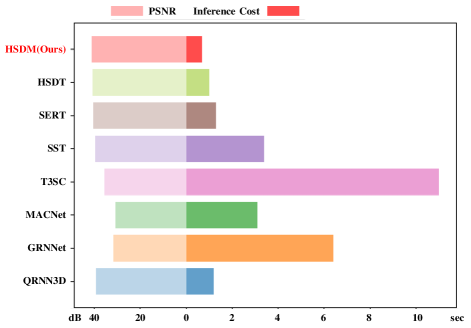
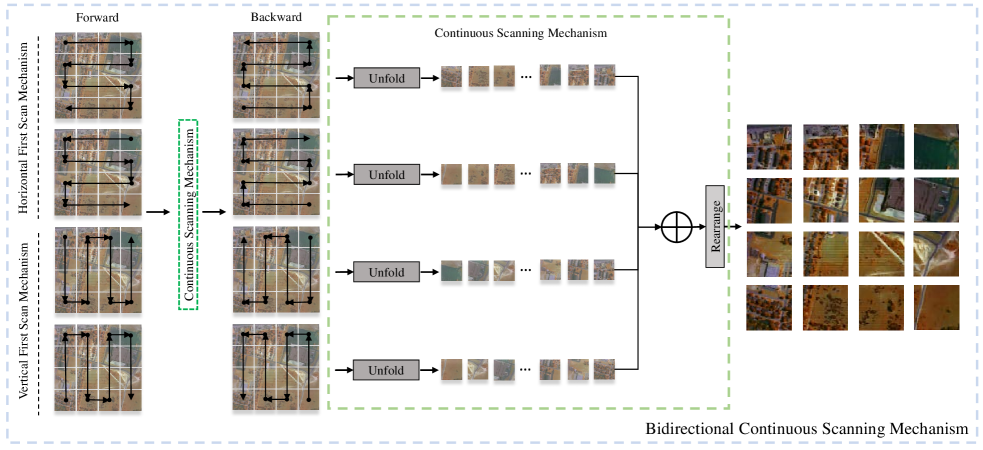
Effectively modeling global context information in hyperspectral image (HSI) denoising is crucial, but prevailing methods using convolution or transformers still face localized or computational efficiency limitations. Inspired by the emerging Selective State Space Model (Mamba) with nearly linear computational complexity and efficient long-term modeling, we present a novel HSI denoising network named HSIDMamba (HSDM). HSDM is tailored to exploit the capture of potential spatial-spectral dependencies effectively and efficiently for HSI denoising. In particular, HSDM comprises multiple Hyperspectral Continuous Scan Blocks (HCSB) to strengthen spatial-spectral interactions. HCSB links forward and backward scans and enhances information from eight directions through the State Space Model (SSM), strengthening the context representation learning of HSDM and improving denoising performance more effectively. In addition, to enhance the utilization of spectral information and mitigate the degradation problem caused by long-range scanning, spectral attention mechanism. Extensive evaluations against HSI denoising benchmarks validate the superior performance of HSDM, achieving state-of-the-art performance and surpassing the efficiency of the transformer method SERT by 31%.
研究动机与目标
- 促使在高光谱去噪中需要高效的长程时空建模。
- 提出 HSIDMamba(HSDM),一种面向 HSI 去噪的双向、连续状态空间架构。
- 融入双向连续扫描、缩放残差和光谱注意力来捕捉长程依赖。
- 演示最先进的去噪性能与相比变换器方法更高的效率。
提出的方法
- 采用 Selective State Space Models (Mamba) 结合双向连续扫描来处理长的一维光谱序列。
- 引入 Hyperspectral Continuous Scan Blocks (HCSB),将二维空间扫描与通道注意力结合。
- 使用 Bidirectional Continuous Scanning Mechanism (BCSM) 将前向和后向扫描在八个方向上连接。
- 应用层归一化、Conv1D 处理与光谱注意力以增强时空建模。
- 使用混合噪声合成数据进行训练,并以 PSNR、SSIM、SAM 对去噪基线进行评估。
实验结果
研究问题
- RQ1双向、线性复杂度的状态空间模型是否比CNNs或Transformers在高光谱去噪中更高效地捕获长程的时空相关性?
- RQ2提出的 BCSM 和 HCSL 设计在合成和真实 HSI 数据集、在多种噪声条件下,是否提高去噪质量(PSNR/SSIM/SAM)?
- RQ3HSIDMamba 是否比最近的基于变换器的去噪方法更快、参数更加高效,同时保持或提高准确性?
- RQ4扫描策略(双向 vs 单向,扫描 vs 交叉)以及隐藏维度选择对性能有何影响?
主要发现
- HSIDM 在合成 ICVL/CAVE 数据集上对高斯和混合噪声实现了最先进的去噪性能。
- HSIDM 提供优越的 PSNR/SSIM/SAM 指标,相较多种基线,包括 transformer 基方法 SST、SERT、和 HSDT。
- 双向邻近扫描机制(BCSM)在捕捉时空相关性上优于其他扫描策略。
- HSIDM 以线性时间复杂度运行,推理更快(约比最新变换器方法快 30%),并具有较有利的参数效率。
- 消融研究证实 Conv1D 处理、通道注意力,以及最佳块/隐藏维度设置对最佳性能的重要性。
- 效率分析显示 HSIDM 在扩展时保持 GPU 内存和 FPS,同时在 CAVE/WDC/Urban 数据集的速度上优于基线。
阅读本论文
在 Nubint 阅读器中打开原文,边读边就任意段落提问。
在 Nubint 中阅读本论文本解读由 AI 根据论文原文生成,引用前请核对原文。