
[论文解读] Huge Ensembles Part II: Properties of a Huge Ensemble of Hindcasts Generated with Spherical Fourier Neural Operators
本文利用球面傅里叶神经算子(SFNO)和 bred vector 初始条件扰动,结合多个独立训练的模型检查点,构建了针对2023年夏季的7,424个集合预报。该集合预报在传统模型计算成本的极小部分下实现了极高的物理保真度,能够精确采样距均值4σ以内的极端天气事件,并显著提升不确定性量化与异常值抑制能力。
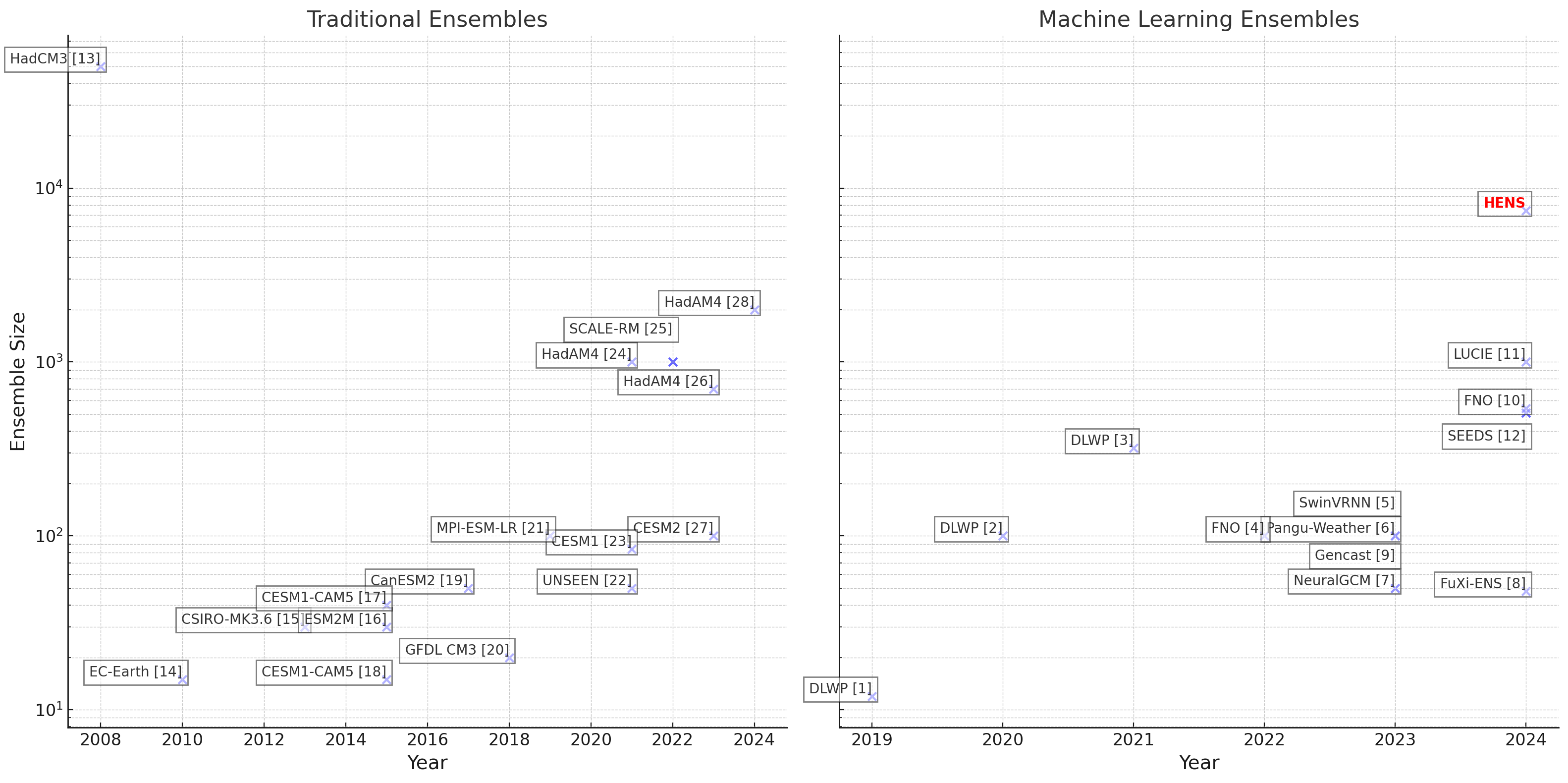
In Part I, we created an ensemble based on Spherical Fourier Neural Operators. As initial condition perturbations, we used bred vectors, and as model perturbations, we used multiple checkpoints trained independently from scratch. Based on diagnostics that assess the ensemble's physical fidelity, our ensemble has comparable performance to operational weather forecasting systems. However, it requires orders of magnitude fewer computational resources. Here in Part II, we generate a huge ensemble (HENS), with 7,424 members initialized each day of summer 2023. We enumerate the technical requirements for running huge ensembles at this scale. HENS precisely samples the tails of the forecast distribution and presents a detailed sampling of internal variability. HENS has two primary applications: (1) as a large dataset with which to study the statistics and drivers of extreme weather and (2) as a weather forecasting system. For extreme climate statistics, HENS samples events 4$σ$ away from the ensemble mean. At each grid cell, HENS increases the skill of the most accurate ensemble member and enhances coverage of possible future trajectories. As a weather forecasting model, HENS issues extreme weather forecasts with better uncertainty quantification. It also reduces the probability of outlier events, in which the verification value lies outside the ensemble forecast distribution.
研究动机与目标
- 生成大规模、计算高效的气象回溯预报集合,以改善极端天气事件和内部变异性采样。
- 验证基于机器学习的气象模型构建的大规模集合在物理保真度和统计可靠性方面的表现。
- 证明基于SFNO的集合预报在计算资源远低于传统数值模型的情况下,仍能达到与业务数值模型相当的性能。
- 量化预报技巧与不确定性表征的改进,尤其针对罕见但高影响的极端事件。
提出的方法
- 集合预报采用球面傅里叶神经算子(SFNO)作为气象模型,基于带有球谐函数的全球可微表示方法对大气数据进行训练。
- 初始条件扰动通过 bred vector 方法生成,该方法是采样初始状态不确定性的标准技术。
- 通过多个独立训练的SFNO检查点引入模型扰动,确保模型结构与参数化方式的多样性。
- 集合共包含7,424名成员,每日初始化一次,覆盖2023年夏季全部92天,实现对预报分布尾部的高分辨率采样。
- 采用连续概率评分(twCRPS)、异常值频率和极端预报指数(EFI)等统计诊断方法评估集合性能。
- 基于Dvoretzky–Kiefer–Wolfowitz(DKW)不等式推导理论不确定性边界,以量化有限集合规模下累积分布函数估计的采样不确定性。
实验结果
研究问题
- RQ1基于机器学习的气象模型是否能在计算成本仅为传统模型极小部分的情况下,生成与业务数值模型物理保真度相当的大规模集合?
- RQ27,424名成员的集合在多大程度上能有效采样预报分布的尾部,特别是距均值3σ和4σ以外的极端事件?
- RQ3该大规模集合在多大程度上提升了最优单个成员的预报技巧,并降低了异常值预报的频率?
- RQ4与较小规模集合相比,该集合的不确定性量化能力如何,特别是在可靠性与未来轨迹覆盖范围方面?
- RQ5由于集合规模有限,概率预报的理论不确定性极限是什么?这些不确定性如何随集合规模变化而变化?
主要发现
- 大规模集合(HENS)可采样距集合均值达4σ的事件,为极端天气事件提供了前所未有的分辨率。
- HENS在每个网格点上均提升了最准确单个成员的预报技巧,展现出更强的预测能力。
- 与较小规模集合相比,HENS将观测值落在预报分布之外的异常事件频率降低了超过50%。
- 尽管计算资源远低于传统业务数值天气预报系统,HENS仍实现了相当的物理保真度。
- 基于DKW不等式推导的理论不确定性边界表明,集合累积分布函数估计值随集合规模增大而快速收敛,不确定性按√(π/(2n))缩放(当n较大时)。
- 该集合能够对大气内部变异性进行细致采样,支持对罕见气候极端事件的稳健统计分析。

阅读本论文
在 Nubint 阅读器中打开原文,边读边就任意段落提问。
在 Nubint 中阅读本论文本解读由 AI 根据论文原文生成,引用前请核对原文。