
[论文解读] Human-Like Geometric Abstraction in Large Pre-trained Neural Networks
本研究表明,大规模预训练视觉变换器(DINOv2 和 CLIP)在视觉推理任务中表现出类人的几何抽象能力,优于标准的 ResNet 模型。这些模型对几何复杂性、规则性以及层级部件关系表现出敏感性——这些是人类几何认知中的关键偏见——表明规模和自监督预训练可使模型在无需显式符号组件的情况下涌现出抽象推理能力。
Humans possess a remarkable capacity to recognize and manipulate abstract structure, which is especially apparent in the domain of geometry. Recent research in cognitive science suggests neural networks do not share this capacity, concluding that human geometric abilities come from discrete symbolic structure in human mental representations. However, progress in artificial intelligence (AI) suggests that neural networks begin to demonstrate more human-like reasoning after scaling up standard architectures in both model size and amount of training data. In this study, we revisit empirical results in cognitive science on geometric visual processing and identify three key biases in geometric visual processing: a sensitivity towards complexity, regularity, and the perception of parts and relations. We test tasks from the literature that probe these biases in humans and find that large pre-trained neural network models used in AI demonstrate more human-like abstract geometric processing.
研究动机与目标
- 探究大规模预训练神经网络是否表现出类人的几何抽象能力,以挑战此类推理需要显式符号处理的假设。
- 测试自监督视觉变换器是否能再现人类几何推理中的三种关键认知偏见:对复杂性的敏感性、对规则性的敏感性以及对层级部件关系的敏感性。
- 比较视觉变换器(DINOv2、CLIP)与标准卷积神经网络(ResNet-50)在几何推理任务上的表现,以分离架构与训练范式的影响。
- 评估联合视觉-语言预训练(CLIP)相较于仅图像预训练(DINOv2)是否增强或削弱几何抽象能力。
提出的方法
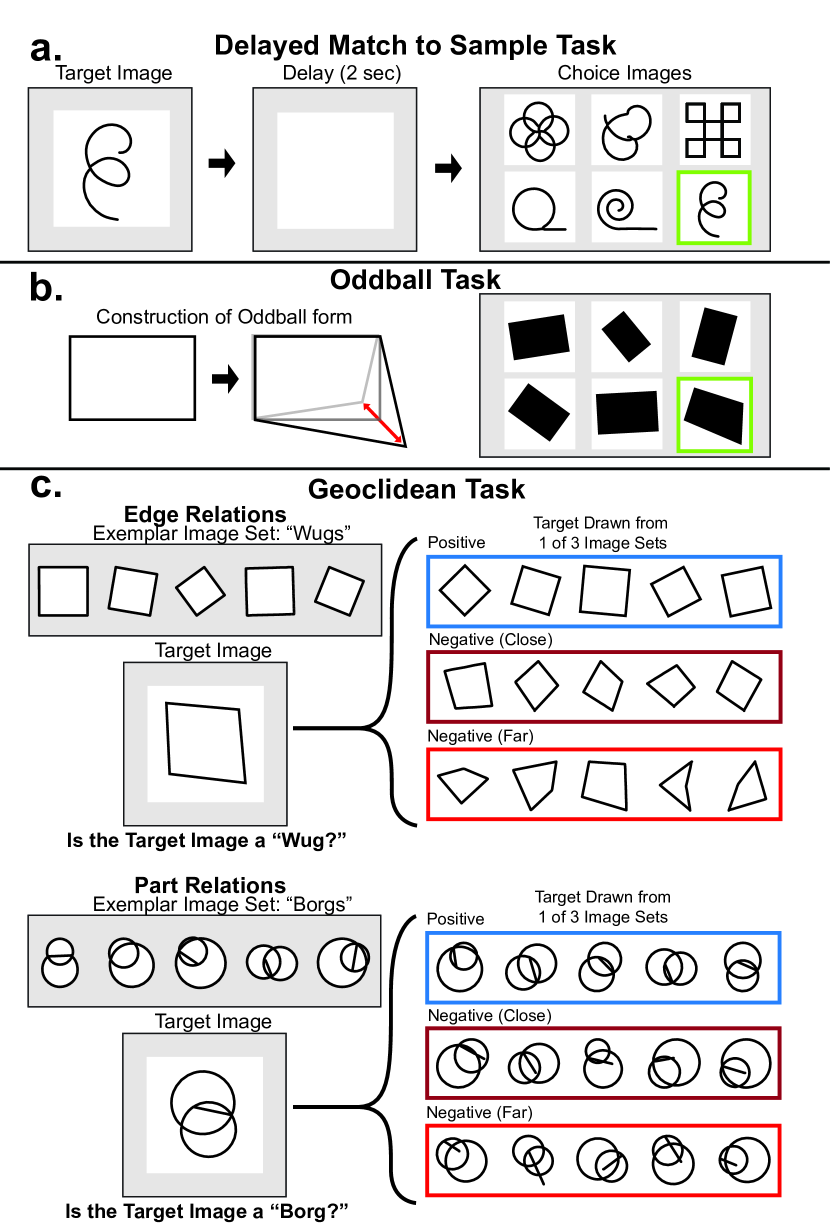
- 应用认知科学文献中的三项行为任务:基于层级形状的延迟匹配任务、用于检测规则性敏感性的四边形异常检测任务,以及涉及部件关系结构的类别判断任务。
- 使用预训练的视觉变换器(DINOv2 和 CLIP)以及一个 ResNet-50 基线模型,所有模型均在几何推理任务上进行微调或评估。
- 采用可微分的几何刺激生成器(Dreamcoder DSL)创建具有受控层级结构和几何特性的刺激。
- 通过比较模型预测准确率和响应模式与人类行为数据在各项任务中的表现来衡量模型性能。
- 利用内部表征(激活值)分析几何抽象是否在特征空间中被编码,尤其关注注意力模式和嵌入相似性。
- 在架构差异方面进行模型比较:仅视觉(DINOv2)与视觉-语言(CLIP)模型,以及变换器与 CNN 架构(ResNet-50)之间的对比。
实验结果
研究问题
- RQ1大规模预训练神经网络是否在视觉处理任务中再现类人对几何复杂性的敏感性?
- RQ2视觉变换器能否在形状分类任务中表现出类人对几何规则性的偏好,如对称性和平行性?
- RQ3神经网络在多大程度上能够像人类一样将几何刺激分解为部件与关系,从而推广到新实例?
- RQ4与仅图像预训练(DINOv2)相比,联合视觉-语言预训练(CLIP)是否增强或削弱几何抽象能力?
- RQ5在模型规模、自监督、注意力机制等架构或训练因素中,哪些对神经网络实现类人几何推理的贡献最大?
主要发现
- DINOv2 和 CLIP 在所有三项几何推理任务中均优于 ResNet-50,表明基于变换器的架构更适合抽象几何处理。
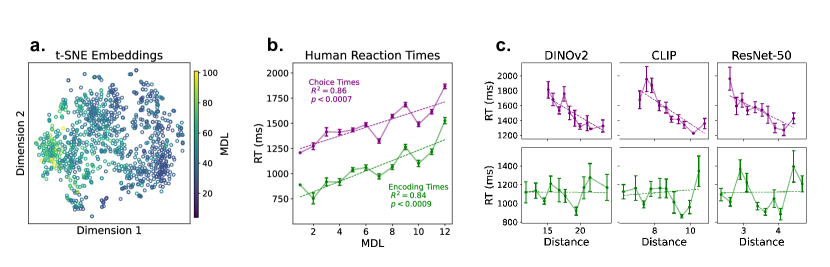
- DINOv2 和 CLIP 均对几何复杂性表现出敏感性,复杂形状的响应时间更长——与人类行为模式一致。
- 模型在分类规则形状(如正方形)时的准确率高于不规则形状(如梯形),表明其具有类人对几何规则性的偏见。
- DINOv2 在再现人类行为方面优于 CLIP,表明联合视觉-语言预训练可能并未增强几何抽象能力,甚至可能产生负面影响。
- 在涉及层级部件与关系的 Geoclidean 任务中,DINOv2 和 CLIP 的泛化能力优于 ResNet,但仍不及人类水平表现,表明在部件-关系分解方面仍存在差距。
- 内部表征分析表明,自监督对比学习目标和变换器注意力机制可能支持抽象几何推理,尽管显式符号处理并非必需。
阅读本论文
在 Nubint 阅读器中打开原文,边读边就任意段落提问。
在 Nubint 中阅读本论文本解读由 AI 根据论文原文生成,引用前请核对原文。