
[论文解读] Human Preference Score: Better Aligning Text-to-Image Models with Human Preference
本论文收集了大量经人工注释的 Stable Diffusion 输出偏好数据集,表明传统指标不能很好预测人类选择,训练一个基于人类偏好的分类器以得到人类偏好分数(HPS),并利用 HPS 指导 Stable Diffusion 的适配以生成更符合人类偏好的图像。
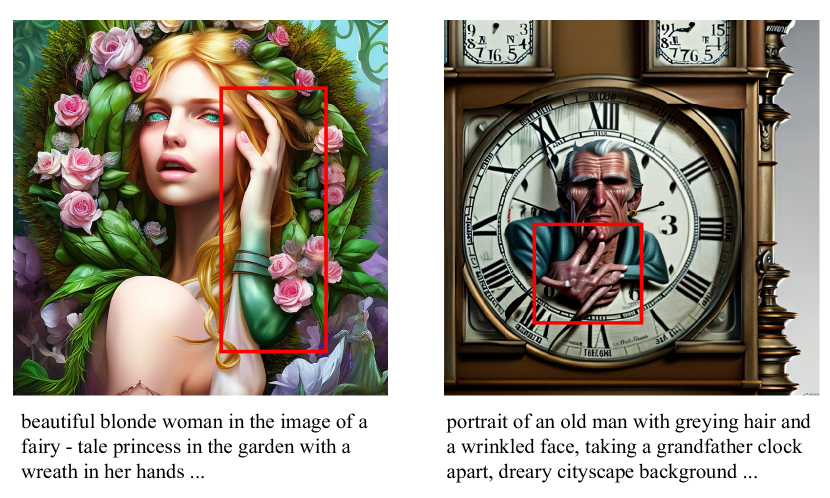
Recent years have witnessed a rapid growth of deep generative models, with text-to-image models gaining significant attention from the public. However, existing models often generate images that do not align well with human preferences, such as awkward combinations of limbs and facial expressions. To address this issue, we collect a dataset of human choices on generated images from the Stable Foundation Discord channel. Our experiments demonstrate that current evaluation metrics for generative models do not correlate well with human choices. Thus, we train a human preference classifier with the collected dataset and derive a Human Preference Score (HPS) based on the classifier. Using HPS, we propose a simple yet effective method to adapt Stable Diffusion to better align with human preferences. Our experiments show that HPS outperforms CLIP in predicting human choices and has good generalization capability toward images generated from other models. By tuning Stable Diffusion with the guidance of HPS, the adapted model is able to generate images that are more preferred by human users. The project page is available here: https://tgxs002.github.io/align_sd_web/ .
研究动机与目标
- 用一个常见提示生成的图像,创建大规模的人类选择数据集。
- 评估现有指标(IS、FID、CLIP)与人类偏好之间的相关性。
- 在数据集上进行微调以开发人类偏好分类器,从而推导出 HPS。
- 演示如何用 HPS 指导对 Stable Diffusion 的适配以产生更受人类偏好的图像。
提出的方法
- 通过对包含多张生成图像和一张首选图像的提示进行微调 CLIP ViT-L/14 来训练人类偏好分类器。
- 将人类偏好分数(HPS)定义为来自人类偏好分类器的视觉嵌入与文本嵌入之间余弦相似度的 100 倍。
- 通过使用分类器对提示标注首选和非首选图像来构建训练数据集。
- 通过 LoRA 对 Stable Diffusion 进行自适应,创建一个将提示与首选/非首选图像配对的训练集,并给非首选图像前缀非首选描述以引导模型远离伪影。
- 推理阶段,在无分类指导中将特殊标识符用作负提示,以避免非首选输出。
实验结果
研究问题
- RQ1标准指标(IS、FID、CLIP)与生成图像的人类偏好之间相关性有多强?
- RQ2在大规模有注释数据集上训练的人类偏好分类器是否能比仅使用 CLIP 更准确地预测人类选择?
- RQ3我们能否使用以人类偏好为导向的目标来调整 Stable Diffusion 以生成更多偏好图像?
- RQ4HPS 是否能够跨越除 Stable Diffusion 之外的不同文本到图像模型进行泛化?
主要发现
- IS、FID 和 CLIP 分数与数据集上的人类选择并不完全一致。
- 基于 CLIP 的微调人类偏好分类器在与人类选择的一致性方面优于单独的 CLIP。
- HPS 与人类偏好相关并且可以泛化到来自其他模型的图像(如 DALL·E、Stable Diffusion)。
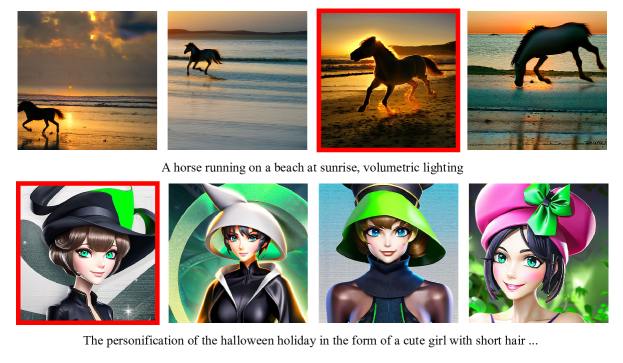
- 在用户研究中,使用 HPS 指导的 LoRA 对 Stable Diffusion 的适配得到的图像伪影更少、且人类偏好更高。
- 定量比较显示,与基线(SD v1.4)相比,适配后的 SD v1.4 模型具有更低的 FID、以及更高的美学分数和 CLIP/HPS 指标。
阅读本论文
在 Nubint 阅读器中打开原文,边读边就任意段落提问。
在 Nubint 中阅读本论文本解读由 AI 根据论文原文生成,引用前请核对原文。