
[论文解读] Human Preference Score v2: A Solid Benchmark for Evaluating Human Preferences of Text-to-Image Synthesis
本文介绍 HPD v2,一个用于文本到图像输出的大规模人类偏好数据集,以及 HPS v2,一个基于 CLIP 的细调模型,能够预测人类图像偏好,还有跨多种提示和模型的稳健评估基准。
Recent text-to-image generative models can generate high-fidelity images from text inputs, but the quality of these generated images cannot be accurately evaluated by existing evaluation metrics. To address this issue, we introduce Human Preference Dataset v2 (HPD v2), a large-scale dataset that captures human preferences on images from a wide range of sources. HPD v2 comprises 798,090 human preference choices on 433,760 pairs of images, making it the largest dataset of its kind. The text prompts and images are deliberately collected to eliminate potential bias, which is a common issue in previous datasets. By fine-tuning CLIP on HPD v2, we obtain Human Preference Score v2 (HPS v2), a scoring model that can more accurately predict human preferences on generated images. Our experiments demonstrate that HPS v2 generalizes better than previous metrics across various image distributions and is responsive to algorithmic improvements of text-to-image generative models, making it a preferable evaluation metric for these models. We also investigate the design of the evaluation prompts for text-to-image generative models, to make the evaluation stable, fair and easy-to-use. Finally, we establish a benchmark for text-to-image generative models using HPS v2, which includes a set of recent text-to-image models from the academic, community and industry. The code and dataset is available at https://github.com/tgxs002/HPSv2 .
研究动机与目标
- 在来自不同模型和真实图像的文本提示生成的图像上,创建一个偏差减少的大规模人类偏好数据集。
- 通过在 HPD v2 上微调 CLIP,训练一个最先进的偏好预测器(HPS v2)。
- 提供一套稳定、公平的评测提示集合,覆盖多种风格,用于基准测试文本到图像模型。
- 证明 HPS v2 在图像分布上的泛化能力及对模型改进的敏感性。
提出的方法
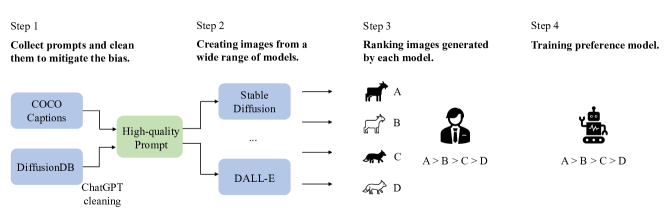
- 使用 9 种模型及 COCO 标注,共 798,090 个关于 433,760 对图像的人工偏好选择来收集 HPD v2。
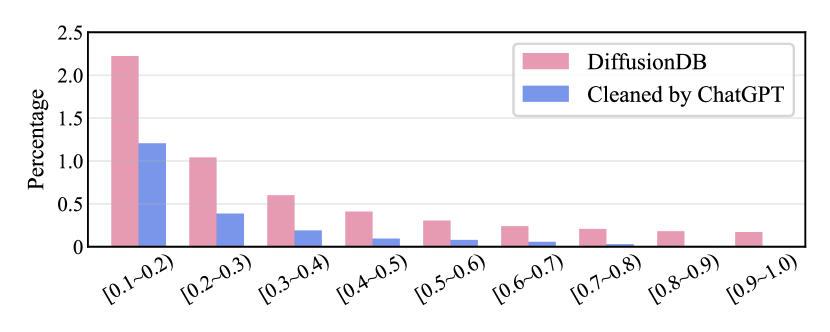
- 通过 ChatGPT 清洗提示以减少风格词偏见,并将提示重组为清晰的句子。
- 通过在 HPD v2 上对 ViT-H/14 OpenCLIP 编码的 CLIP 进行 KL 散度目标的二元偏好微调,训练 HPS v2。
- 在 HPD v2 测试集和 ImageReward 上对比先前的预测器和基准指标,并进行消融研究。
- 组建一套稳健的评估协议,将提示分为动画、概念艺术、绘画和照片,总共 3,200 条提示用于基准测试。
实验结果
研究问题
- RQ1HPD v2 能否在跨越不同图像分布的情况下生成与人类一致的评估数据,同时降低偏差?
- RQ2HPS v2 在对新模型和提示的泛化方面是否优于现有偏好预测器?
- RQ3哪些提示集合能够提供稳定、公平且可扩展的文本到图像模型评估?
- RQ4HPS v2 是否对检测文本到图像生成的算法改进足够敏感?
主要发现
- HPD v2 包含来自 9 种模型及 COCO 的 434k 图像的 798k 二元偏好,设计以降低源偏差和提示偏差。
- HPS v2 通过在 HPD v2 上微调 CLIP 训练,在 HPD v2 和 ImageReward 基准上达到比以往预测器更高的准确性(例如在所报道的测试中优于 HPD v1、ImageReward 和 PickScore)。
- 通过 ChatGPT 对提示进行清理可减少 NSFW 和风格词偏见,提升评估公平性。
- HPS v2 与人类判断相关且对模型改进有响应,使其成为对现代文本到图像模型的实用基准。
- 基准结果显示 HPS v2 在一系列近期模型上的分数,表明社区模型在此评估中常常优于某些学术模型。
阅读本论文
在 Nubint 阅读器中打开原文,边读边就任意段落提问。
在 Nubint 中阅读本论文本解读由 AI 根据论文原文生成,引用前请核对原文。