
[论文解读] Humanoid Locomotion as Next Token Prediction
一个因果变换器被训练为自回归地预测用于人形运动的标记化传感-运动轨迹,从而利用包括不完整模态在内的多样数据源实现对现实世界的零样本走路。
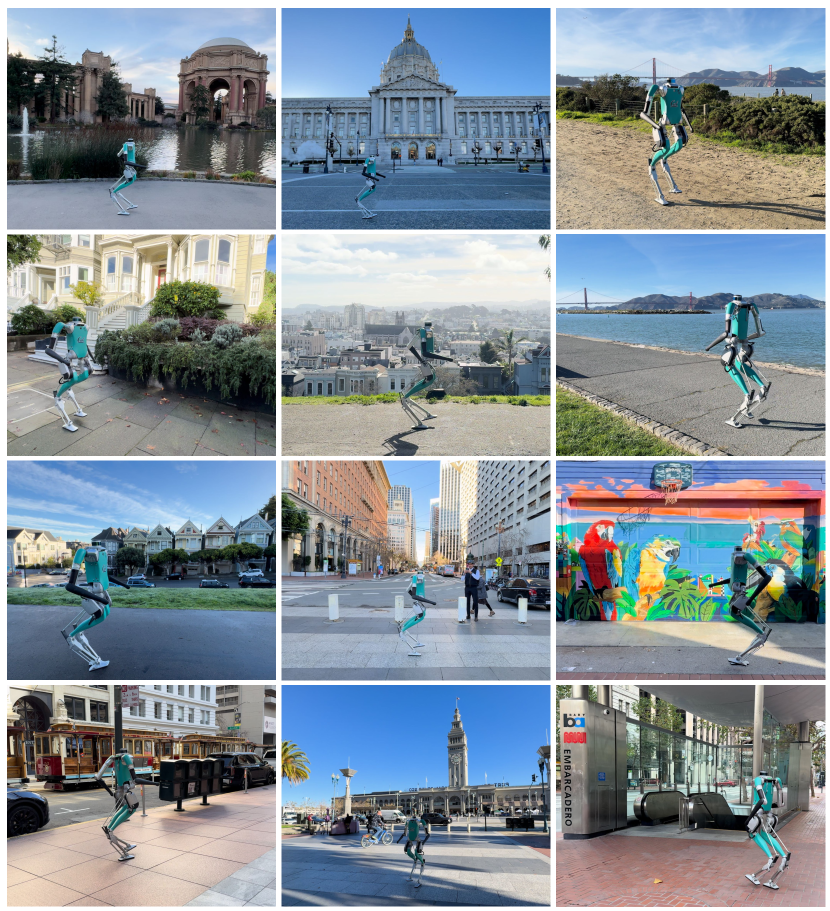
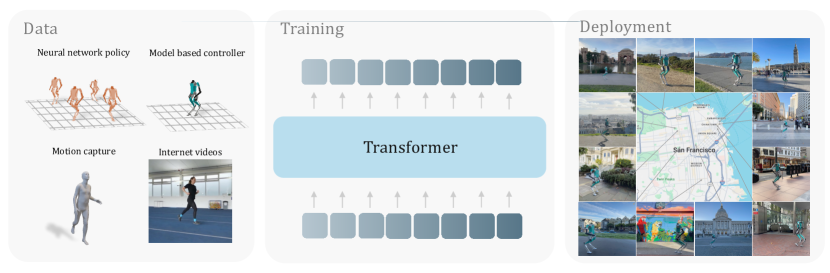
We cast real-world humanoid control as a next token prediction problem, akin to predicting the next word in language. Our model is a causal transformer trained via autoregressive prediction of sensorimotor trajectories. To account for the multi-modal nature of the data, we perform prediction in a modality-aligned way, and for each input token predict the next token from the same modality. This general formulation enables us to leverage data with missing modalities, like video trajectories without actions. We train our model on a collection of simulated trajectories coming from prior neural network policies, model-based controllers, motion capture data, and YouTube videos of humans. We show that our model enables a full-sized humanoid to walk in San Francisco zero-shot. Our model can transfer to the real world even when trained on only 27 hours of walking data, and can generalize to commands not seen during training like walking backward. These findings suggest a promising path toward learning challenging real-world control tasks by generative modeling of sensorimotor trajectories.
研究动机与目标
- 通过对传感-运动轨迹的生成建模来激发真实世界的人形控制学习。
- 开发一个模态对齐的自回归变换器,能够处理不完整的数据源。
- 证明在多样化来源上训练(包括人类视频)能够实现对现实世界的零样本部署。
- 研究预测质量如何与运动跟踪性能和泛化性相关。
提出的方法
- 将传感-运动轨迹标记化为令牌,并训练一个因果变换器通过负对数似然自回归地建模 p(t)。
- 通过将同一模态的下一个令牌建模为输入令牌来对齐预测。
- 通过使用 [M] 令牌进行掩码来处理缺失模态,并对被遮蔽部分的损失忽略。
- 在异构数据源(神经策略、基于模型的控制器、MoCap、YouTube 视频)上进行联合或阶段性策略的训练。
- 使用分离的模态投影和一个共享的变换器,结合位置嵌入和因果自注意力。
实验结果
研究问题
- RQ1自动回归变换器模型在多样传感-运动数据上训练,是否能够在测试时无需强化学习就实现现实世界的人形步态?
- RQ2模态对齐、缺失数据处理以及联合学习与分阶段训练如何影响性能和泛化?
- RQ3在不完整数据(例如人类视频)上训练的模型,在现实世界中转移到完整人形的程度如何?
- RQ4下一个令牌预测误差与运动跟踪性能之间的关系是什么?
- RQ5数据规模、上下文长度和模型规模如何影响运动质量以及对未知指令的泛化?
主要发现
- 模型使一个全尺寸人形在旧金山不同表面上实现零样本行走。
- 仅需大约 27 小时的步行数据即可实现现实世界的零样本部署。
- 预测误差与跟踪性能相关(r = 0.87)。
- 包括不完整轨迹(含缺失动作)相较仅使用完整数据时性能更好。
- 对齐的模态预测在跟踪和下一个令牌预测任务中均优于未对齐的设置。
- 该方法可推广到未知指令,包括反向走路,且随数据、上下文和模型规模的增加而提升。
阅读本论文
在 Nubint 阅读器中打开原文,边读边就任意段落提问。
在 Nubint 中阅读本论文本解读由 AI 根据论文原文生成,引用前请核对原文。