
[论文解读] ImageDream: Image-Prompt Multi-view Diffusion for 3D Generation
ImageDream 引入了一个图像提示的多视图扩散框架,具备规范相机坐标与多层级控制器,以提升从单幅图像进行 3D 生成的几何与图像-文本对齐质量,超过现有方法在几何质量和图像文本对齐方面的现有最优方法。
We introduce "ImageDream," an innovative image-prompt, multi-view diffusion model for 3D object generation. ImageDream stands out for its ability to produce 3D models of higher quality compared to existing state-of-the-art, image-conditioned methods. Our approach utilizes a canonical camera coordination for the objects in images, improving visual geometry accuracy. The model is designed with various levels of control at each block inside the diffusion model based on the input image, where global control shapes the overall object layout and local control fine-tunes the image details. The effectiveness of ImageDream is demonstrated through extensive evaluations using a standard prompt list. For more information, visit our project page at https://Image-Dream.github.io.
研究动机与目标
- 促使从单幅图像进行 3D 对象生成,并在几何精度方面优于仅文本或仅图像基线方法。
- 利用规范相机坐标化来简化输入图像到多视图的映射,并提升多视图的一致性。
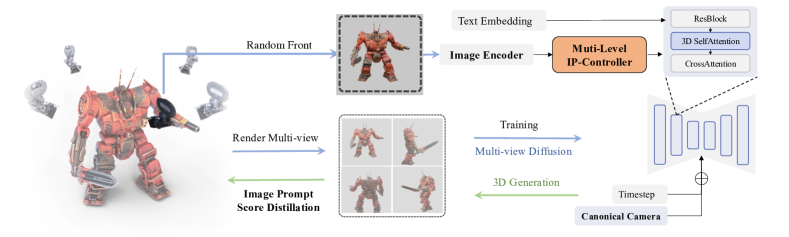
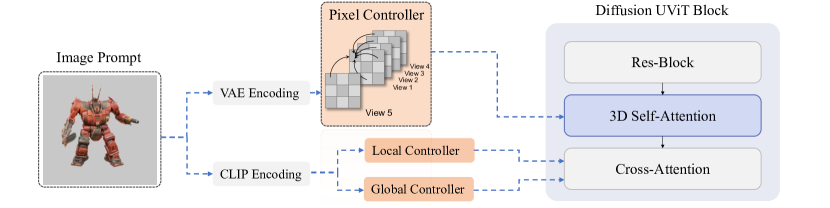
- 引入全局、局部与像素三级的图像提示控制器,以在各建筑块中引导扩散过程。
- 将图像提示扩散整合到基于 NeRF 的 SDS 流程中,以生成具有细化纹理的一致性 3D 资产。
提出的方法
- 采用规范的世界坐标系,使默认视角为物体正视,以使图像提示与多视图扩散对齐。
- 使用 MV 损失和 MV-SDS,在四个正交视角上训练一个多视图扩散网络(MVDiffusion),以优化基于 NeRF 的 3D 模型。
- 引入全局图像提示适配器(MLP)和跨注意力,将图像特征与文本条件扩散在解耦注意力中进行融合。
- 引入采用 CLIP 隐藏特征的局部图像提示控制器,并通过重新采样步骤防止过度曝光与不稳定性。
- 通过将输入图像作为第五帧连接到 3D 自注意力中,添加像素控制器,以在各视图之间强化图像驱动的纹理细节。
- 应用带背景与相机参数对齐的图像提示分数蒸馏,以在 NeRF 优化阶段提升几何保真度。
实验结果
研究问题
- RQ1图像提示是否能在现有图像条件的 3D 扩散方法之上进一步提升几何与纹理质量?
- RQ2规范相机协调是否提升单图像到 3D 生成的多视图一致性与几何准确性?
- RQ3全局、局部与像素三级图像提示控制器对扩散引导与最终 3D 质量有何影响?
- RQ4图像提示 SDS 如何与 NeRF 优化交互以产生一致的 3D 资产?
主要发现
- ImageDream 在零样本单图像 3D 生成中显著提升对象几何精度,较之前的 SoTA 方法如 Magic123 和 Zero123 有所超越。
- 像素控制器提升纹理与基于 CLIP 的跨视图图像对齐,在融合后获得更好的图像提示相似度。
- 全局与局部控制器有助于在语义对齐与视觉细节之间取得平衡;与像素控制结合时获得最强的性能。
- 定量指标显示 ImageDream 的各变体在扩散阶段和后期 3D 融合阶段,获得更高的 CLIP 分数以及修正后的仅质量 Inception 分数(QIS),相较基线方法。
- 用户研究表明 ImageDream(尤其是带有像素控制器时)在几何质量与 IP 相似性方面更受偏好,优于 SD-XL、MVDream、Zero123、Magic123、SyncDreamer。
- 消融分析揭示当图像提示过度约束细粒度面部细节时的局限性,提示未来在训练提示中增加随机性或改进内在/外在属性估计的研究。
阅读本论文
在 Nubint 阅读器中打开原文,边读边就任意段落提问。
在 Nubint 中阅读本论文本解读由 AI 根据论文原文生成,引用前请核对原文。