
[论文解读] IML-ViT: Benchmarking Image Manipulation Localization by Vision Transformer
IML-ViT 引入了一种基于 ViT 的图像篡改定位模型,能够保持高分辨率、采用多尺度监督并使用以边缘为重点的监督,在多个公开数据集上实现了最先进的结果。它被提出作为 IML 的新基准。
Advanced image tampering techniques are increasingly challenging the trustworthiness of multimedia, leading to the development of Image Manipulation Localization (IML). But what makes a good IML model? The answer lies in the way to capture artifacts. Exploiting artifacts requires the model to extract non-semantic discrepancies between manipulated and authentic regions, necessitating explicit comparisons between the two areas. With the self-attention mechanism, naturally, the Transformer should be a better candidate to capture artifacts. However, due to limited datasets, there is currently no pure ViT-based approach for IML to serve as a benchmark, and CNNs dominate the entire task. Nevertheless, CNNs suffer from weak long-range and non-semantic modeling. To bridge this gap, based on the fact that artifacts are sensitive to image resolution, amplified under multi-scale features, and massive at the manipulation border, we formulate the answer to the former question as building a ViT with high-resolution capacity, multi-scale feature extraction capability, and manipulation edge supervision that could converge with a small amount of data. We term this simple but effective ViT paradigm IML-ViT, which has significant potential to become a new benchmark for IML. Extensive experiments on three different mainstream protocols verified our model outperforms the state-of-the-art manipulation localization methods. Code and models are available at https://github.com/SunnyHaze/IML-ViT.
研究动机与目标
- 识别图像篡改定位(IML)与传统分割之间的关键差异。
- 提出一个基于 ViT 的 IML 模型,能够保持分辨率、使用边缘监督并融入多尺度特征。
- 证明具备窗口注意力的 ViT 结合 MAE 预训练可以在跨数据集基准上超越基于 CNN 的 IML 方法。
- 展示对常见失真(JPEG、Gaussian blur)的鲁棒性,并倡导开放基准和公平的跨数据集评估。
提出的方法
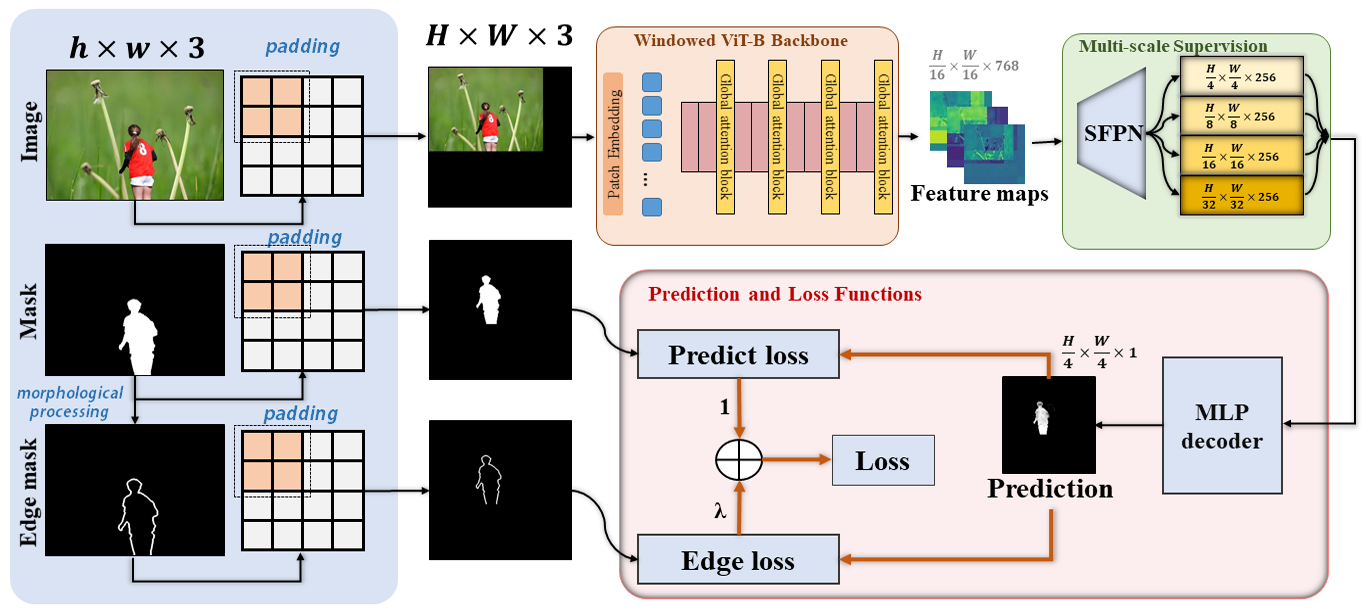
- 使用具备窗口化注意力的高分辨率 Vision Transformer(ViT)以在准确性与计算量之间取得平衡。
- 将图像填充到固定的 1024x1024 分辨率,以在不引入重新缩放伪影的情况下保留伪影。
- 纳入一个简单的特征金字塔网络(SFPN),用于多尺度监督。
- 采用轻量级的 MLP 解码头(类似 SegFormer)进行最终像素级预测。
- 通过基于形态学的边缘损失引入边缘监督,强调篡改区域边界,并与分割损失结合。
- 在 ImageNet-1k 上用 MAE 进行预训练,以提高小型 IML 数据集上的泛化。

实验结果
研究问题
- RQ1纯粹的 ViT 主干是否能有效建模 IML 任务中的非语义伪影?
- RQ2保持全分辨率并加入边缘监督是否能改善在多样数据集上的篡改区域定位?
- RQ3多尺度监督对 IML 的跨数据集泛化有何影响?
- RQ4基于 MAE 的预训练如何影响 ViT 基 IML 在数据有限情况下的性能?
主要发现
- IML-ViT 在五个公开 IML 基准上实现了 F1 和 AUC 的最先进性能。
- 通过零填充保留原始图像分辨率(1024x1024)有利于伪影保留和模型学习。
- 边缘监督对稳定收敛和高性能至关重要;没有它,训练可能发散。
- 多尺度监督提供泛化优势,特别是在具有多样化篡改类型的数据集上。
- MAE 预训练在 ImageNet-1k 上对基于 ViT 的 IML 至关重要,因为数据有限,促进更好收敛与泛化。
- IML-ViT 展示了强大的跨数据集鲁棒性,包括对 JPEG 压缩和高斯模糊的抗性。
阅读本论文
在 Nubint 阅读器中打开原文,边读边就任意段落提问。
在 Nubint 中阅读本论文本解读由 AI 根据论文原文生成,引用前请核对原文。