
[论文解读] Improved Baselines with Visual Instruction Tuning
论文表明,对 LLaVA 的简单修改——一个全连接的视觉-语言跨模态连接器(MLP)以及带有应答格式化提示的学术任务导向的 VQA 数据——在约一天内用一个 13B 模型在 8 个 A100 GPU 上对 1.2M 公共图片/文本进行训练后,在11个基准测试中实现了最先进的结果。
Large multimodal models (LMM) have recently shown encouraging progress with visual instruction tuning. In this note, we show that the fully-connected vision-language cross-modal connector in LLaVA is surprisingly powerful and data-efficient. With simple modifications to LLaVA, namely, using CLIP-ViT-L-336px with an MLP projection and adding academic-task-oriented VQA data with simple response formatting prompts, we establish stronger baselines that achieve state-of-the-art across 11 benchmarks. Our final 13B checkpoint uses merely 1.2M publicly available data, and finishes full training in ~1 day on a single 8-A100 node. We hope this can make state-of-the-art LMM research more accessible. Code and model will be publicly available.
研究动机与目标
- 评估在 LLaVA 框架内,数据、模型规模和输入分辨率对视觉指令微调的影响。
- 证明简单的架构变化和数据增强在有限数据下也能产生强基线。
- 建立一个使用公开数据和中等算力的具有竞争力且完全开放的基线。
- 展示最终模型在学术性 VQA 和视觉语言任务上的优势。
提出的方法
- 用两层 MLP 投影替换视觉-语言跨模态连接器。
- 在 VQA 数据上附加一个单一的应答格式提示,以控制输出长度和风格。
- 通过学术任务导向的 VQA 数据(OKVQA, A-OKVQA, OCRVQA, TextCaps, Visual Genome, RefCOCO 等)来增强对细粒度视觉理解的训练。
- 将输入图片分辨率提升至 336px,并将大型语言模型扩展到 13B,以提升视觉对话能力。
- 仅使用公开数据进行训练,采用与 LLaVA 相当的轻量预训练方案。
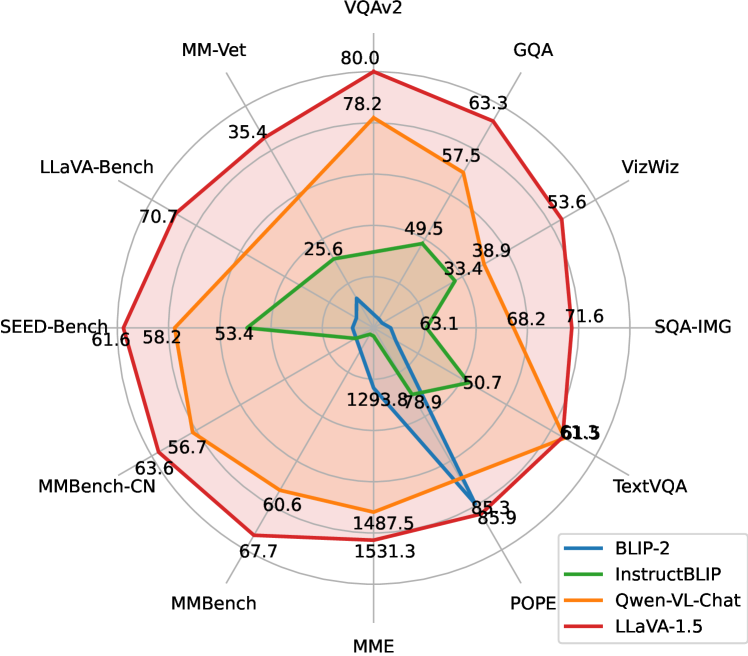
实验结果
研究问题
- RQ1在 LLaVA 中加入一个简单的 MLP 跨模态连接器,是否能提升 LMM 的性能?
- RQ2将带有明确应答格式的学术任务导向的 VQA 数据结合起来,是否能改善简短回答与长篇视觉推理与对话?
- RQ3数据规模、模型大小和图像分辨率如何共同作用于广泛的视觉-语言基准测试的性能?
主要发现
- LLaVA-1.5 结合 MLP 连接器和格式化的 VQA 提示,在 11/12 项学术基准上取得显著性能,超过了此前的基线。
- 使用公开数据和适度计算,最终的 13B 模型在 11 项基准上达到最先进的结果,在其他基准上则具竞争力。
- 仅使用 1.2M 公共图文对,模型在单个 8-A100 节点上大约一天内完成训练。
- 将图像分辨率提升至 336 并加入更广泛的 VQA/OCR/区域级数据,显著提升 VQA 和视觉推理任务的准确性。
- 零样本格式化提示实现受限输出(如单词答案或 JSON),而无需对数据管线进行大规模重构。

阅读本论文
在 Nubint 阅读器中打开原文,边读边就任意段落提问。
在 Nubint 中阅读本论文本解读由 AI 根据论文原文生成,引用前请核对原文。