
[论文解读] Improved machine learning algorithm for predicting ground state properties
本文提出了一种经典的机器学习算法,仅使用 O(log n) 个训练数据点即可预测 n 量子比特的非简并局部哈密顿量的基态性质,该方法利用几何偏置的非线性特征映射和 L1-正则化回归。该方法实现了近线性的 O(n log n) 训练和预测时间,显著优于以往 O(n^c) 的样本复杂度,在最多 45 个量子比特的系统上实现了高精度。
Finding the ground state of a quantum many-body system is a fundamental problem in quantum physics. In this work, we give a classical machine learning (ML) algorithm for predicting ground state properties with an inductive bias encoding geometric locality. The proposed ML model can efficiently predict ground state properties of an $n$-qubit gapped local Hamiltonian after learning from only $\mathcal{O}(\log(n))$ data about other Hamiltonians in the same quantum phase of matter. This improves substantially upon previous results that require $\mathcal{O}(n^c)$ data for a large constant $c$. Furthermore, the training and prediction time of the proposed ML model scale as $\mathcal{O}(n \log n)$ in the number of qubits $n$. Numerical experiments on physical systems with up to 45 qubits confirm the favorable scaling in predicting ground state properties using a small training dataset.
研究动机与目标
- 开发一种高效的经典机器学习算法,用于预测量子多体系统的基态性质。
- 通过将几何局域性编码为归纳偏置,将现有机器学习方法的样本复杂度从 O(n^c) 降低至 O(log n)。
- 在量子比特数 n 上实现近线性的计算时间扩展,从而实现在更大系统上的高效预测。
- 在仅使用小规模随机采样训练数据集的情况下,展示在最多 45 个量子比特的物理系统上的鲁棒性能。
- 在不依赖量子态访问或哈密顿量结构知识的前提下,验证该方法在各种哈密顿量参数化和可观测量上的有效性。
提出的方法
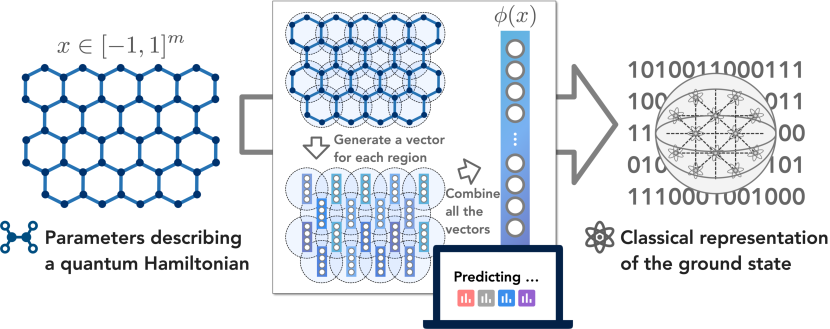
- 该算法使用非线性特征映射 φ(x),通过将哈密顿量参数空间的局部区域映射到高维特征向量来编码几何局域性。
- 每个局部区域对应于晶格上的边或相互作用,特征通过可调参数 R、γ 的随机傅里叶特征计算得出。
- 模型在特征空间上执行 L1-正则化回归(LASSO),以学习线性预测器 w*,从而近似 Tr(Oρ(x))。
- 特征映射通过将参数向量 x 分解为局部分量,对每个分量应用 φ,并将结果连接起来形成 φ(x)。
- 模型超参数 R、γ 和 α(正则化强度)通过在保留数据子集上进行四折交叉验证选择。
- 数值实验使用 T 个随机化的泡利测量的经典阴影,从采样数据中估计基态性质。
实验结果
研究问题
- RQ1经典机器学习模型能否仅使用与量子比特数 n 呈对数规模的训练数据,预测非简并局部哈密顿量的基态性质?
- RQ2在特征映射中引入几何局域性作为归纳偏置,是否能够使样本复杂度低于多项式扩展?
- RQ3所提出的算法能否在保持高精度的同时实现近线性的 O(n log n) 训练和预测时间?
- RQ4当训练数据量最小时,该模型在不同系统尺寸和可观测量上的表现如何?
- RQ5该方法在训练数据量和经典阴影测量数变化时是否具有鲁棒性?
主要发现
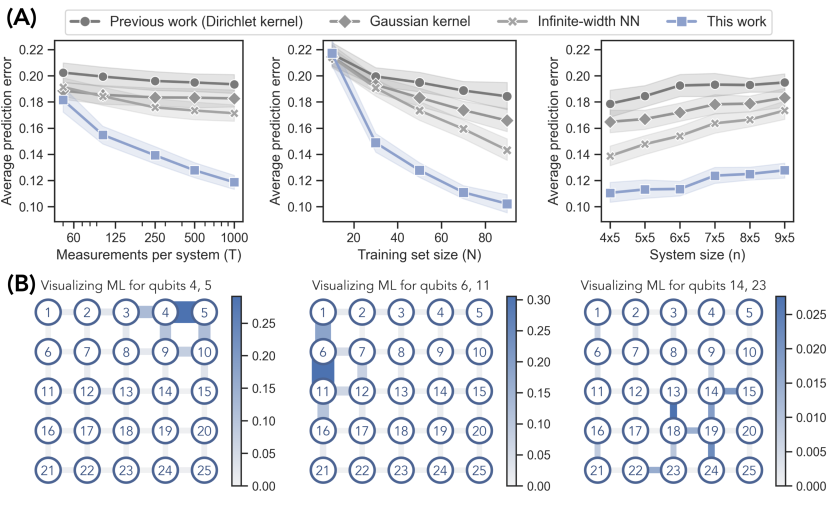
- 所提算法实现了 O(log n) 的样本复杂度,相较于以往方法的 O(n^c) 扩展(c 为较大常数)有显著改进。
- 训练和预测时间扩展为 O(n log n),使得在最多 45 个量子比特的系统上实现高效推理成为可能。
- 数值实验表明,即使仅有约 50 个训练数据点,对 1500 至 3500 个关联函数预测的平均预测误差仍具有统计可靠性。
- 该方法在不同系统尺寸下保持较低的均方根误差,关联函数的归一化标准差约为 0.191。
- 当训练数据量(pM,其中 p ∈ {0.1, 0.3, 0.5, 0.7, 0.9})和经典阴影大小(T ∈ {50, 100, 250, 500, 1000})变化时,性能保持稳定。
- 通过交叉验证进行的模型选择成功识别出最优超参数 R、γ 和 α,从而在测试数据上实现一致的泛化性能。
阅读本论文
在 Nubint 阅读器中打开原文,边读边就任意段落提问。
在 Nubint 中阅读本论文本解读由 AI 根据论文原文生成,引用前请核对原文。