
[论文解读] Improving Retrieval-Augmented Generation in Medicine with Iterative Follow-up Questions
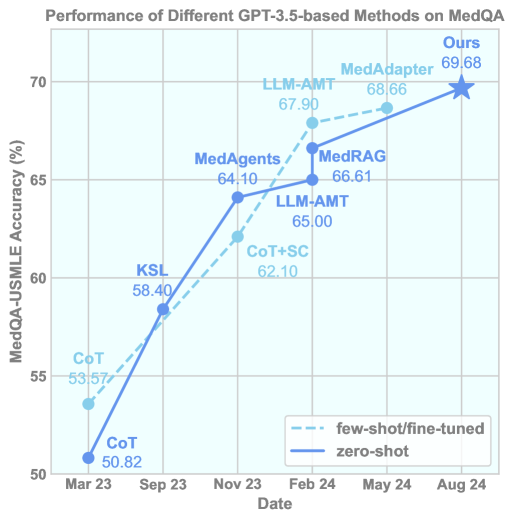
本文提出 i-MedRAG,一种检索增强生成框架,使大型语言模型(LLMs)能够通过迭代生成后续问题来增强医学问答能力。通过在多轮中利用 RAG 对查询进行优化,i-MedRAG 在使用 GPT-3.5 的 MedQA 数据集上实现了 69.68% 的新 SOTA 零样本准确率,优于所有先前的提示工程与微调方法。
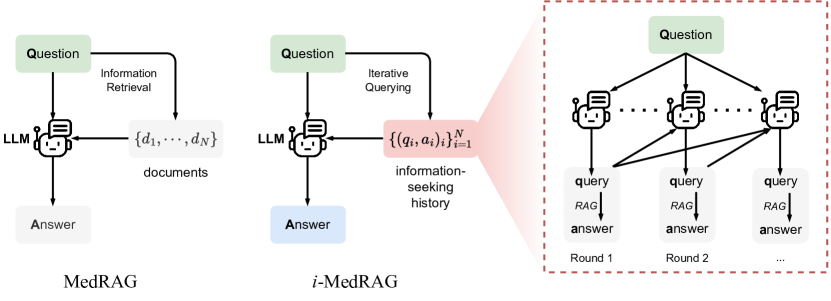
The emergent abilities of large language models (LLMs) have demonstrated great potential in solving medical questions. They can possess considerable medical knowledge, but may still hallucinate and are inflexible in the knowledge updates. While Retrieval-Augmented Generation (RAG) has been proposed to enhance the medical question-answering capabilities of LLMs with external knowledge bases, it may still fail in complex cases where multiple rounds of information-seeking are required. To address such an issue, we propose iterative RAG for medicine (i-MedRAG), where LLMs can iteratively ask follow-up queries based on previous information-seeking attempts. In each iteration of i-MedRAG, the follow-up queries will be answered by a conventional RAG system and they will be further used to guide the query generation in the next iteration. Our experiments show the improved performance of various LLMs brought by i-MedRAG compared with conventional RAG on complex questions from clinical vignettes in the United States Medical Licensing Examination (USMLE), as well as various knowledge tests in the Massive Multitask Language Understanding (MMLU) dataset. Notably, our zero-shot i-MedRAG outperforms all existing prompt engineering and fine-tuning methods on GPT-3.5, achieving an accuracy of 69.68% on the MedQA dataset. In addition, we characterize the scaling properties of i-MedRAG with different iterations of follow-up queries and different numbers of queries per iteration. Our case studies show that i-MedRAG can flexibly ask follow-up queries to form reasoning chains, providing an in-depth analysis of medical questions. To the best of our knowledge, this is the first-of-its-kind study on incorporating follow-up queries into medical RAG. The implementation of i-MedRAG is available at https://github.com/Teddy-XiongGZ/MedRAG.
研究动机与目标
- 为解决原始 RAG 在处理医学中复杂、多步骤临床推理任务时的局限性。
- 通过启用通过后续问题进行迭代信息检索,减少 LLM 中的幻觉与知识过时问题。
- 开发一种可泛化的零样本框架,在无需微调的情况下提升 LLM 在医学问答任务中的表现。
- 表征迭代查询生成在迭代次数与每轮查询数量方面的缩放行为。
- 通过案例研究证明迭代推理链在解决复杂临床病例方面的有效性。
提出的方法
- 该框架通过提示 LLM 基于先前的检索结果和答案历史来生成后续问题。
- 每个后续问题通过原始 RAG 系统处理,以检索相关文档并生成答案。
- 检索到的答案用于优化下一轮的查询生成,从而形成推理链。
- 该过程在多轮中重复进行,每一步均提升所寻求信息的聚焦度与相关性。
- 最终答案由 LLM 使用完整的检索信息链与推理步骤生成。
- 该方法在零样本设置下应用,无需微调或任务特定的提示工程。
实验结果
研究问题
- RQ1迭代式后续问题生成能否提升 LLM 在复杂医学问答任务中的性能?
- RQ2迭代次数与每轮查询数量如何影响检索增强推理过程的性能?
- RQ3i-MedRAG 是否能在无需模型微调的情况下超越现有提示工程与微调方法?
- RQ4不同 LLM(如 GPT-3.5、Llama-3.1-8B)在 i-MedRAG 下于多样化医学数据集上的表现如何?
- RQ5当使用迭代查询时,LLM 形成何种推理链,以及它们如何提升答案准确率?
主要发现
- i-MedRAG 在使用 GPT-3.5 的 MedQA 数据集上实现了 69.68% 的新 SOTA 零样本准确率,优于所有先前的提示工程与微调方法。
- 该框架显著提升了在 MedQA 的 USMLE 子集上复杂临床问题以及 MMLU-Med 数据集上的性能。
- 性能随迭代次数与每轮查询数量的增加而提升,但在某一点后出现收益递减现象。
- 案例研究表明,i-MedRAG 使 LLM 能够通过有针对性的查询逐步缩小诊断与治疗范围,形成连贯的推理链。
- 该方法通过在多轮检索中基于检索到的证据来减少幻觉,从而有效提升答案准确性。
- i-MedRAG 在多样化医学问答基准上,对闭源模型(GPT-3.5)与开源模型(Llama-3.1-8B)均表现出良好的泛化能力。
阅读本论文
在 Nubint 阅读器中打开原文,边读边就任意段落提问。
在 Nubint 中阅读本论文本解读由 AI 根据论文原文生成,引用前请核对原文。