
[论文解读] Incompressible Navier-Stokes solve on noisy quantum hardware via a hybrid quantum-classical scheme
该论文提出了一种混合量子-经典算法,用于在噪声中等规模量子(NISQ)硬件上求解不可压缩的纳维-斯托克斯方程。通过将经典压力投影方法与变分量子线性求解器(VQLS)结合求解压力泊松方程,并采用HTree层析成像和多重网格预处理,该方法在IBM的超导量子处理器上实现了高保真度解,尽管存在硬件噪声和资源限制,仍证明了其在近期量子流体动力学模拟中的可行性。
Partial differential equation solvers are required to solve the Navier-Stokes equations for fluid flow. Recently, algorithms have been proposed to simulate fluid dynamics on quantum computers. Fault-tolerant quantum devices might enable exponential speedups over algorithms on classical computers. However, current and foreseeable quantum hardware introduce noise into computations, requiring algorithms that make judicious use of quantum resources: shallower circuit depths and fewer qubits. Under these restrictions, variational algorithms are more appropriate and robust. This work presents a hybrid quantum-classical algorithm for the incompressible Navier--Stokes equations. A classical device performs nonlinear computations, and a quantum one uses a variational solver for the pressure Poisson equation. A lid-driven cavity problem benchmarks the method. We verify the algorithm via noise-free simulation and test it on noisy IBM superconducting quantum hardware. Results show that high-fidelity results can be achieved via this approach, even on current quantum devices. Multigrid preconditioning of the Poisson problem helps avoid local minima and reduces resource requirements for the quantum device. A quantum state readout technique called HTree is used for the first time on a physical problem. Htree is appropriate for real-valued problems and achieves linear complexity in the qubit count, making the Navier-Stokes solve further tractable on current quantum devices. We compare the quantum resources required for near-term and fault-tolerant solvers to determine quantum hardware requirements for fluid simulations with complexity improvements.
研究动机与目标
- 开发一种适用于当前噪声量子硬件的不可压缩流体流动模拟实用量子算法。
- 通过高效的层析成像方法,解决近期设备中高保真度量子态读出的挑战。
- 通过多重网格预处理提高变分量子算法的收敛性和可训练性。
- 对VQLS、VQE和HHL求解器在流体动力学问题中的量子资源需求进行基准测试。
- 在真实IBM量子处理器上对二维顶盖驱动腔流进行实验验证。
提出的方法
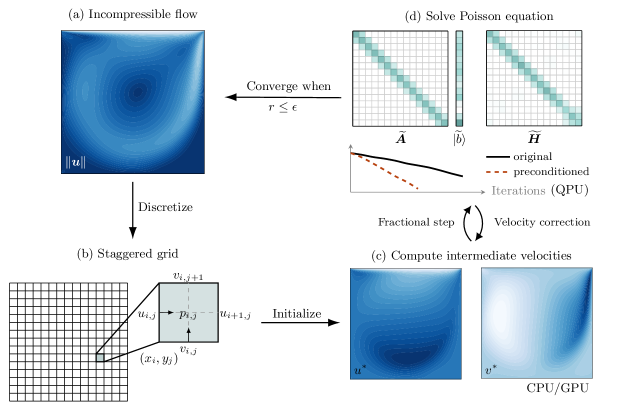
- 该算法使用经典压力投影方法处理非线性项和时间推进,而压力泊松方程则通过变分量子线性求解器(VQLS)求解。
- 基于线性系统的残差构建代价函数,利用经典优化器训练量子线路参数。
- 采用HTree方法——一种线性复杂度的量子态层析成像技术——以高效重建实值态矢量,减少读出时间。
- 对线性系统应用多重网格预处理,以改善条件数并避免优化过程中的局部极小值。
- 该方法在IBM的ibm_kolkata、ibm_sherbrooke和ibm_torino量子处理器上实现并测试,使用Qiskit并启用高优化级别。
- 资源估算比较了VQE、VQLS和HHL在量子比特数、两量子比特门数、电路深度和127量子比特ibm_sherbrooke处理器上的估计运行时间方面的表现。
实验结果
研究问题
- RQ1混合量子-经典算法是否能在当前噪声量子硬件上以高保真度求解不可压缩的纳维-斯托克斯方程?
- RQ2多重网格预处理在提升变分量子算法于流体动力学问题中可训练性和收敛性方面效果如何?
- RQ3HTree层析成像在近期应用中是否能显著减少与传统方法相比的量子态读出时间?
- RQ4VQLS、VQE和HHL在NISQ设备上求解流体流动问题时的相对量子资源需求是什么?
- RQ5在超导量子处理器中观察到的真实噪声水平下,该方法是否仍具有鲁棒性?
主要发现
- 该混合算法在真实IBM量子处理器上成功计算出二维顶盖驱动腔流的高保真度解,验证了其在当前硬件上的可行性。
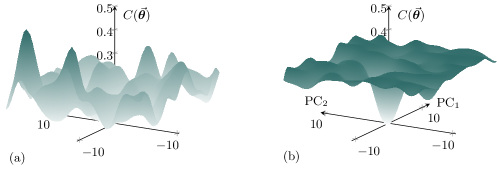
- 多重网格预处理显著提升了VQLS优化过程中的收敛速度,并降低了陷入局部极小值的可能性。
- HTree层析成像实现了高效、线性时间的实值态矢量重建,相比标准量子态层析成像显著减少了测量开销。
- 资源估算显示,VQLS在5量子比特系统上需要1,900个两量子比特门和8,700的电路深度,估计在ibm_sherbrooke上的运行时间为1.1毫秒——除非矩阵具有简单的泡利分解,否则对多数NISQ设备而言仍不可行。
- HHL被发现无法在NISQ硬件上实现,因其资源需求过高,需370,000个两量子比特门和170万的电路深度,估计运行时间为240毫秒。
- 研究结论认为,VQLS仅在问题矩阵A具有高效泡利分解时才适用于NISQ设备,这限制了其在工程问题中的通用适用性。
阅读本论文
在 Nubint 阅读器中打开原文,边读边就任意段落提问。
在 Nubint 中阅读本论文本解读由 AI 根据论文原文生成,引用前请核对原文。