
[论文解读] Influence of preferential diffusion on the distribution of species in lean H2-air laminar premixed flames at different equivalence ratios
本研究通过二维模拟研究了当量比φ=0.4和φ=0.7时,贫燃H₂-空气预混火焰中的优先扩散效应,发现当量比降低会加剧热-扩散不稳定性,导致因曲率依赖的热量与物种聚焦/去聚焦效应,使物种质量分数和反应速率(尤其是H₂)出现显著偏差。研究发现,基于H₂的反应进度变量最为适合建模,因其具有单调性和有界性;而基于O₂和H₂O的定义则表现出非单调性及超绝热偏差。
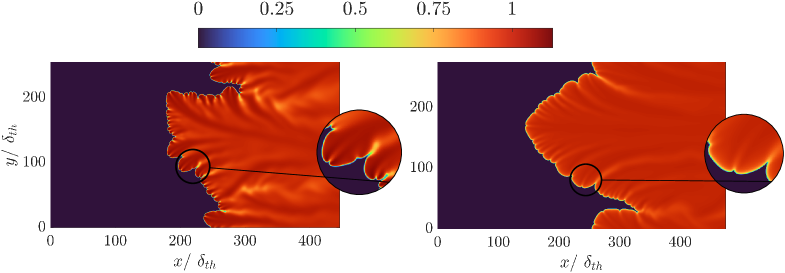
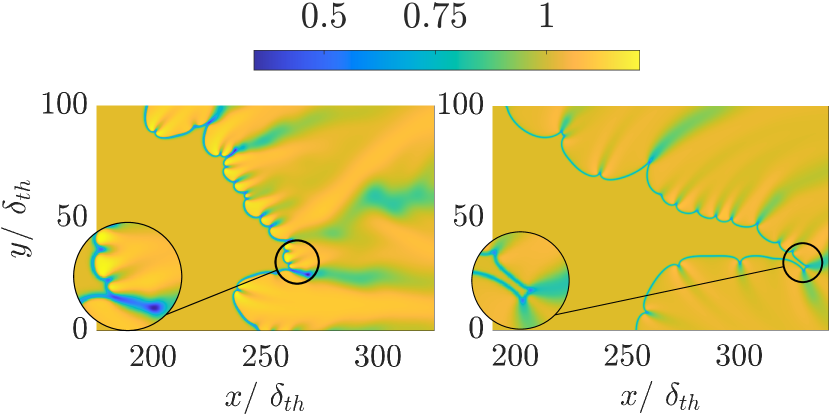
The influence of equivalence ratio on preferential diffusion effects and the resulting changes in the distributions of major species and their reaction rates have been analysed based on 2D simulations of lean ${\mathrm{H_2}}$-air laminar premixed flames, at $ϕ=0.4$ and $0.7$. The enhancements of burning rate, flame surface area, and stretch factor increase with decreasing equivalence ratio with the increase in stretch factor particularly prominent when the burning rate and flame area are evaluated based on normalised mass fraction variation of ${\mathrm{H_2}}$. The preferential diffusion effects have been demonstrated to lead to significant deviations of mass fractions of major species and their reaction rates from the corresponding 1D unstretched laminar premixed flame solution and local variations of equivalence ratio. This tendency is particularly strong for ${\mathrm{H_2}}$ among all the major species. Moreover, mass fractions of ${\mathrm{O_2}}$ and ${\mathrm{H_2O}}$ are found to assume super-adiabatic values at the super-adiabatic temperature zones and this trend is particularly strong for the $ϕ=0.4$ case. It has been demonstrated that the deviations of major species mass fractions and their reaction rates from their corresponding 1D unstretched laminar premixed flame values arise principally due to preferential diffusion effects induced by relative focussing/defocussing of species and heat at the positively and negatively curved regions with the nature of the deviations being opposite to each other depending on the sign of the curvature. The variations of normalised species mass fractions of $\mathrm{O_2}$ and $\mathrm{H_2O}$ are found to be significantly affected by the local equivalence ratio within the 2D laminar flame with $ϕ=0.4$ but these effects weaken with an increase in global equivalence ratio.
研究动机与目标
- 通过分析优先扩散下物种分布,识别用于模拟贫燃H₂-空气预混火焰的最佳反应进度变量。
- 量化当量比对二维层流H₂-空气火焰火焰褶皱、拉伸因子和燃烧速率的影响。
- 评估曲率诱导的优先扩散如何改变局部当量比、物种质量分数和反应速率。
- 评估不同物种(H₂、O₂、H₂O)对火焰表面积和拉伸因子计算的影响。
- 确定O₂和H₂O质量分数在高保真燃烧模拟中作为反应进度变量的适用性。
提出的方法
- 在当量比φ=0.4和φ=0.7下,对层流H₂-空气预混火焰进行了二维直接数值模拟(DNS)。
- 使用H₂、O₂和H₂O的归一化质量分数作为反应进度变量,分析火焰结构和物种分布。
- 基于不同物种定义计算火焰表面积(A′)和拉伸因子(I₀),以评估反应进度变量选择的敏感性。
- 通过分析正曲率和负曲率火焰区域中局部当量比和物种质量分数的变化,研究曲率效应。
- 计算有效Lewis数(Le_eff)以评估热-扩散不稳定性潜力,发现Le_eff在较低φ时减小。
- 在φ=0.4和φ=0.7之间进行燃烧速率、火焰面积和拉伸因子的统计比较,以量化当量比的影响。
实验结果
研究问题
- RQ1当量比(φ)降低如何影响贫燃H₂-空气火焰中的优先扩散和物种分布?
- RQ2火焰曲率对二维H₂-空气火焰中局部当量比、物种质量分数和反应速率有何影响?
- RQ3哪种物种(H₂、O₂、H₂O)最适合作为模拟贫燃H₂-空气预混火焰的反应进度变量?
- RQ4基于不同物种的反应进度变量定义下,火焰表面积(A′)和拉伸因子(I₀)如何变化?
- RQ5O₂和H₂O质量分数在超绝热温度区域超过1.0的程度如何,这如何影响其作为反应进度变量的适用性?
主要发现
- 拉伸因子I₀随当量比降低而增加,在φ=0.4时达到1.70,而在φ=0.7时为1.09,表明在更贫燃条件下火焰拉伸更强。
- 由于更强的热-扩散不稳定性导致火焰褶皱加剧,φ=0.4时的火焰表面积(A′)显著增强。
- H₂质量分数因优先扩散效应,与一维未拉伸火焰解相比偏差最大,尤其在负曲率区域。
- 在高温区域,O₂和H₂O质量分数表现出超绝热值,尤其在φ=0.4时,基于H₂O的进度变量表现出非单调行为。
- 基于H₂的反应进度变量在整个火焰中表现出最单调且有界的特性,因此最适合作为建模工具。
- 当考虑局部当量比变化时,基于O₂的进度变量保持在0.0至1.0之间,而基于H₂O的定义则变得非单调。
阅读本论文
在 Nubint 阅读器中打开原文,边读边就任意段落提问。
在 Nubint 中阅读本论文本解读由 AI 根据论文原文生成,引用前请核对原文。