
[论文解读] Information-Theoretic Limits on Compression of Semantic Information
本文通过贝叶斯网络对作为相关随机变量的语义源建立了无损和有损压缩的信息论极限。证明了在存在辅助信息的情况下,通过分别优化条件独立子集可实现最优压缩,并为二元和高斯语义源推导出闭式率失真函数。
As conventional communication systems based on classic information theory have closely approached the limits of Shannon channel capacity, semantic communication has been recognized as a key enabling technology for the further improvement of communication performance. However, it is still unsettled on how to represent semantic information and characterise the theoretical limits. In this paper, we consider a semantic source which consists of a set of correlated random variables whose joint probabilistic distribution can be described by a Bayesian network. Then we give the information-theoretic limit on the lossless compression of the semantic source and introduce a low complexity encoding method by exploiting the conditional independence. We further characterise the limits on lossy compression of the semantic source and the corresponding upper and lower bounds of the rate-distortion function. We also investigate the lossy compression of the semantic source with side information at both the encoder and decoder, and obtain the rate distortion function. We prove that the optimal code of the semantic source is the combination of the optimal codes of each conditional independent set given the side information.
研究动机与目标
- 建立语义源压缩的理论基础,解决语义通信中缺乏正式信息论的不足。
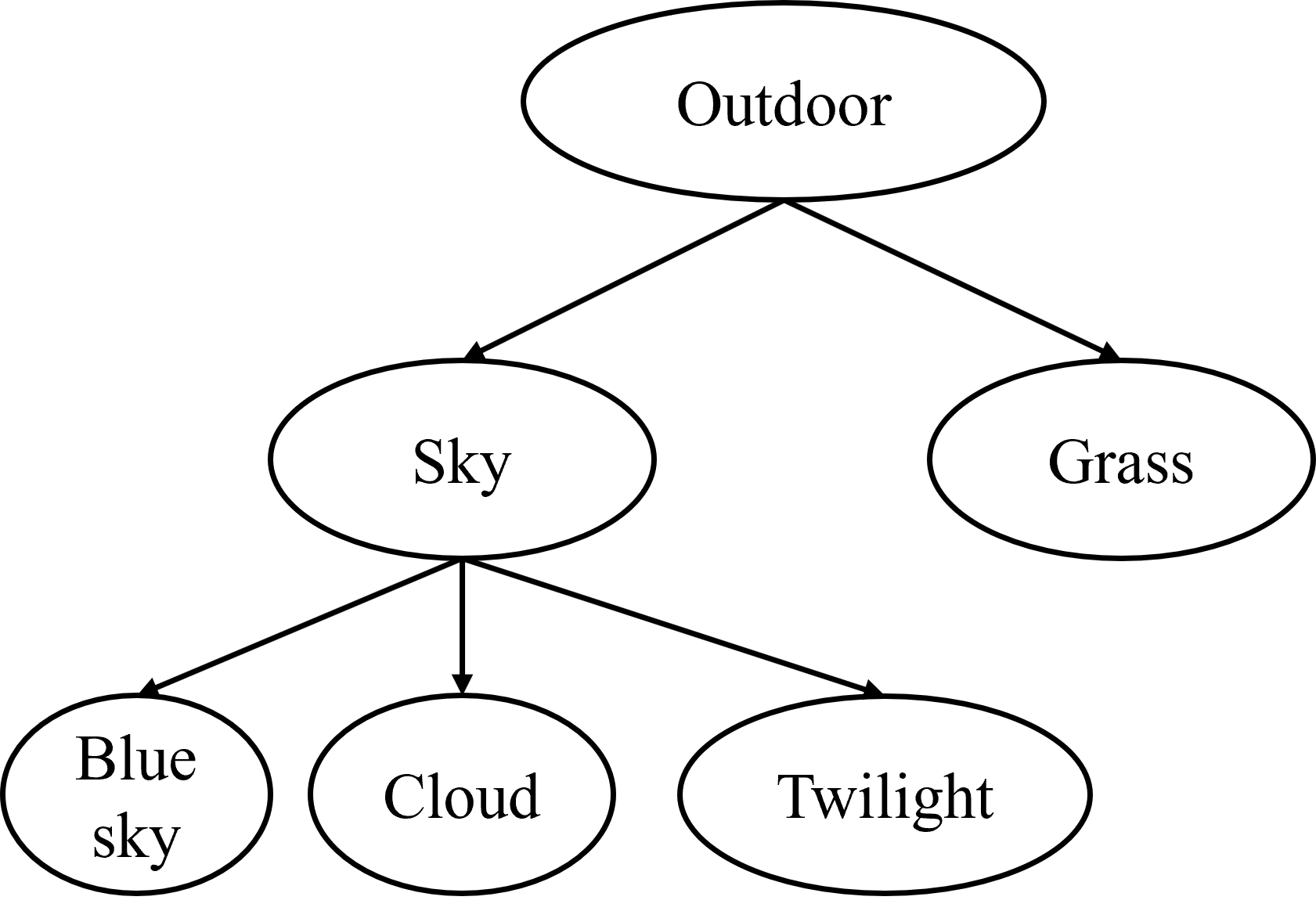
- 将语义源建模为具有由贝叶斯网络(BN)描述的联合分布的相关随机变量。
- 表征此类语义源的无损和有损压缩的信息论极限。
- 研究在编码器和解码器均存在辅助信息时的有损压缩,并推导相应的率失真函数。
- 证明在给定辅助信息时,通过独立编码条件独立子集可实现最优压缩。
提出的方法
- 将语义源建模为一组相关随机变量,其联合分布由贝叶斯网络(BN)表示。
- 利用BN中的条件独立结构,将压缩问题分解为独立的子问题。
- 通过利用条件熵和失真度量,推导有损压缩的率失真函数。
- 将香农的率失真理论应用于给定辅助信息的条件独立子集,证明最优速率的可加性。
- 利用二元熵函数 $ h_b(p) $,为二元源推导出条件率失真函数的闭式表达式。
- 利用均方误差失真和多变量高斯条件分布,推导高斯源的率失真函数。
实验结果
研究问题
- RQ1如何表征以贝叶斯网络建模的语义源的无损压缩信息论极限?
- RQ2如何表征具有相关语义元素的语义源有损压缩的率失真函数?
- RQ3当编码器和解码器均存在辅助信息时,最优压缩策略是什么?
- RQ4能否基于BN中的条件独立性,将率失真函数分解为独立分量?
- RQ5当语义元素服从二元或高斯分布时,率失真函数的闭式表达式是什么?
主要发现
- 在编码器和解码器均存在辅助信息时,语义源的最优编码是给定辅助信息下各条件独立集合最优编码的总和。
- 对于二元语义源,条件率失真函数为 $ R_{X_i|Y}(D_i) = [h_b(p_i) - h_b(D_i)] $,其中 $ 0 \leq D_i \leq p_i $,$ h_b $ 为二元熵函数。
- 对于高斯语义源,条件率失真函数为 $ R_{X_i|Y}(D_i) = \left[\frac{1}{2}\log\frac{\sigma_{X_i}^2(1-r_i^2)}{D_i}\right] $,其中 $ 0 \leq D_i \leq \sigma_{X_i}^2(1-r_i^2) $。
- 完整语义源的率失真函数是条件独立分量各自条件率失真函数的总和。
- 所提出的编码策略下,率失真函数的理论界是紧的且可实现的。
- 该框架为设计具有可证明性能极限的语义通信系统提供了系统化、信息论基础的支撑。
阅读本论文
在 Nubint 阅读器中打开原文,边读边就任意段落提问。
在 Nubint 中阅读本论文本解读由 AI 根据论文原文生成,引用前请核对原文。