
[论文解读] #InsTag: Instruction Tagging for Analyzing Supervised Fine-tuning of Large Language Models
InsTag 自动对开放集 SFT 查询进行标注,以量化指令的多样性和复杂性,并使用以复杂性为焦点的数据选择器来训练 TagLM 模型,从而在相对较少的 SFT 数据下获得强大的 MT-Bench 性能。
Foundation language models obtain the instruction-following ability through supervised fine-tuning (SFT). Diversity and complexity are considered critical factors of a successful SFT dataset, while their definitions remain obscure and lack quantitative analyses. In this work, we propose InsTag, an open-set fine-grained tagger, to tag samples within SFT datasets based on semantics and intentions and define instruction diversity and complexity regarding tags. We obtain 6.6K tags to describe comprehensive user queries. Then we analyze popular open-sourced SFT datasets and find that the model ability grows with more diverse and complex data. Based on this observation, we propose a data selector based on InsTag to select 6K diverse and complex samples from open-source datasets and fine-tune models on InsTag-selected data. The resulting models, TagLM, outperform open-source models based on considerably larger SFT data evaluated by MT-Bench, echoing the importance of query diversity and complexity. We open-source InsTag in https://github.com/OFA-Sys/InsTag.
研究动机与目标
- 定义细粒度的开放集指令标签,以量化 SFT 数据的多样性和复杂性。
- 开发使用 ChatGPT 和归一化的自动标注流程,以生成高质量标签。
- 分析开源 SFT 数据集,揭示多样性和复杂性如何与对齐性能相关。
- 提出基于 InsTag 的数据选择器,用于筛选多样且复杂的 SFT 样本。
- 证明用 InsTag 选择数据进行微调的模型(TagLM)在 MT-Bench 上优于某些基线。
提出的方法
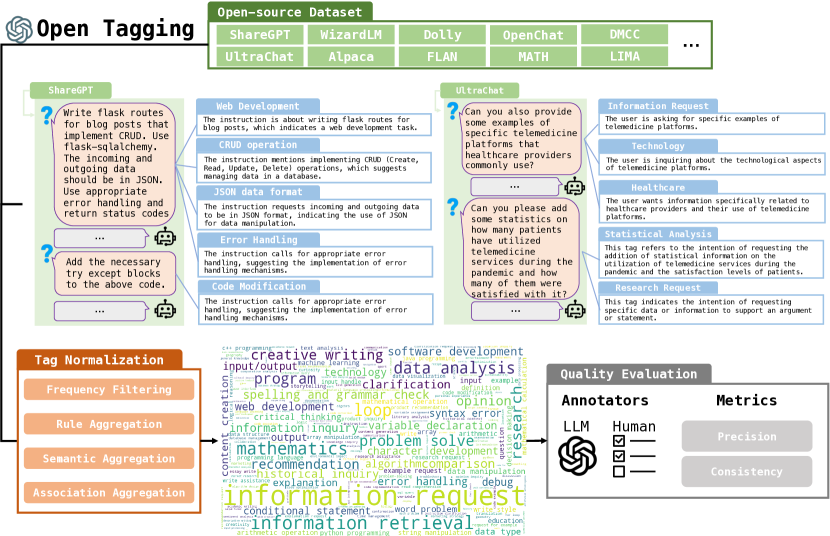
- 对 ChatGPT 发出提示,为查询标注开放集细粒度意图标签。
- 通过频次筛选、规则聚合、语义聚类(DBSCAN)以及关联聚合(FP-Growth)对原始标签进行归一化。
- 用 GPT-4 和人工标注者结合精确度和一致性指标评估标注质量。
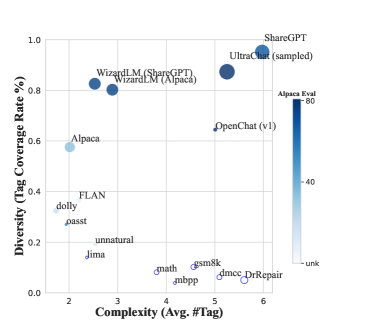
- 使用基于标签的指标分析数据集的多样性和复杂性(唯一标签覆盖、每个查询的平均标签数)。
- 通过 Algorithm 1(以复杂性为先的多样性采样)对 6K 条高复杂性/多样性查询进行 SFT 样本采样。
- 在 InsTag 选择数据上微调 13B LLaMA/LLaMA-2 模型,并用 MT-Bench 评估。
实验结果
研究问题
- RQ1开放集、细粒度指令标注是否能有效量化 SFT 数据集的多样性和复杂性?
- RQ2SFT 数据中的更高指令多样性和复杂性是否与改进的 LLM 对齐性能相关?
- RQ3基于 InsTag 的数据选择是否能在比基线使用更少的 SFT 数据下获得表现更好的 LLM?
- RQ4在 MT-Bench 上用 InsTag 选择数据训练的 TagLM 相较于专有和开源基线的表现如何?
主要发现
- InsTag 在归一化后产生约 6,587 个原子标签,使分析 SFT 数据的多样性和复杂性成为可能。
- 具有更高标签多样性和复杂度的数据集与更高的 MT-Bench 对齐性能相关。
- TagLM-13b-v1.0 (6K 数据) 达到 MT-Bench 6.44±0.04,超越了使用更大数据量的许多开源对齐 LLM。
- TagLM-13b-v2.0 (6K 数据) 达到 MT-Bench 6.55±0.02,接近 LLaMA-2 chat 性能,接近 RLHF-tuned 等价物。
- 在 InsTag 选择数据上训练的模型可以优于使用大量 SFT 数据的开源基线。
- InsTag 的标注质量显示出高精度和一致性(GPT-4: 96.1% 精确度,86.6% 一致性;人工标注者在多数投票中同意)。
阅读本论文
在 Nubint 阅读器中打开原文,边读边就任意段落提问。
在 Nubint 中阅读本论文本解读由 AI 根据论文原文生成,引用前请核对原文。