
[论文解读] Instant3D: Fast Text-to-3D with Sparse-View Generation and Large Reconstruction Model
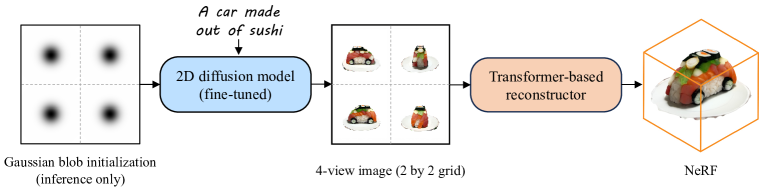
Instant3D 使用两阶段前向流水线: (1) 微调一个二维扩散模型,从文本生成一个 2x2 的稀疏视角图像网格;(2) 使用基于 transformer 的稀疏视图重建器对 NeRF 回归,约 20 秒内提供高质量的 3D 资产。
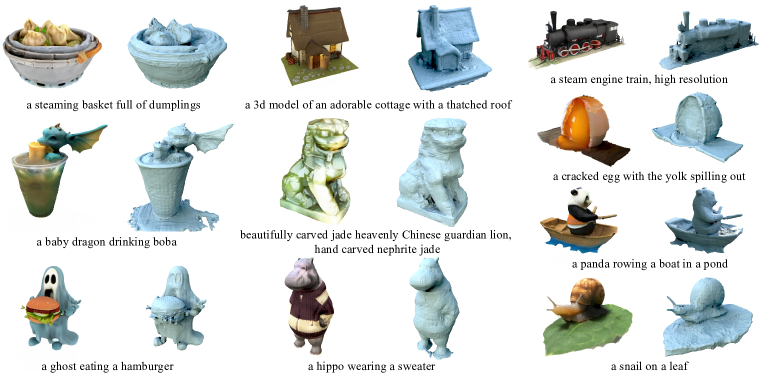
Text-to-3D with diffusion models has achieved remarkable progress in recent years. However, existing methods either rely on score distillation-based optimization which suffer from slow inference, low diversity and Janus problems, or are feed-forward methods that generate low-quality results due to the scarcity of 3D training data. In this paper, we propose Instant3D, a novel method that generates high-quality and diverse 3D assets from text prompts in a feed-forward manner. We adopt a two-stage paradigm, which first generates a sparse set of four structured and consistent views from text in one shot with a fine-tuned 2D text-to-image diffusion model, and then directly regresses the NeRF from the generated images with a novel transformer-based sparse-view reconstructor. Through extensive experiments, we demonstrate that our method can generate diverse 3D assets of high visual quality within 20 seconds, which is two orders of magnitude faster than previous optimization-based methods that can take 1 to 10 hours. Our project webpage: https://jiahao.ai/instant3d/.
研究动机与目标
- 通过实现快速且多样化生成,克服基于优化的缓慢文本到3D方法。
- 利用预训练的 2D 扩散先验,通过稀疏视图引导 3D 重建。
- 开发一个两阶段管线:稀疏视图的 2D 生成,然后是基于大型 Transformer 的 NeRF 重建。
- 在保持快速推理的同时实现高视觉质量和视图一致性。
提出的方法
- 对预训练的 2D 文本到图像扩散模型(SDXL)进行微调,以在单次去噪过程中生成一个 2x2 的四视图网格。
- 以高斯斑块初始化推理,以促进白色背景输出并改善第二阶段重建。
- 从 Objaverse(约 750K 对象)整理数据集,并进行轻量级微调(10K 步,10K 精选样本),以产生一致的多视图图像。
- 引入一个基于 transformer 的稀疏视图大型重建模型,它从四个姿态感知的图像令牌回归一个三平面 NeRF。
- 使用带相机调制的基于 ViT 的图像编码器来产生姿态感知令牌,随后是带跨注意力和自注意力的图像到三平面解码器,以及用于密度和颜色的 NeRF MLP,结合体积渲染。
- 在 Objaverse 渲染(512x512)上进行训练,使用随机视角提升鲁棒性;推理阶段使用来自第一阶段的固定相机位姿。
实验结果
研究问题
- RQ1是否可以将文本提示转换为一致的稀疏四视图图像网格,并捕捉所请求的概念?
- RQ2是否可以让一个大型基于 transformer 的模型在无需逐场景优化的情况下,从四个稀疏视图重建 NeRF?
- RQ3两阶段前馈方法在质量和多样性方面是否能与基于优化的方法相竞争甚至优越,同时实现显著的加速?
主要发现
- 大约 20 秒内生成一个 3D 资产,约比以往基于优化的方法快 200 倍。
- 在基于 CLIP 的文本-3D 对齐方面超过 Shap-E 和 DreamFusion,在对齐和质量方面与 ProlificDreamer 相当。
- 使用微调后的 SDXL 模型生成的 2x2 稀疏视图图像网格在视图一致性方面表现良好。
- 基于 transformer 的稀疏视图重建器在 GSO 数据集上实现了更高的 PSNR (26.54) 和 SSIM (0.8934),且 LPIPS(0.0643)更低,优于 SparseNeus。
- 使用 Instant3D 的推理显示显著加速(20s 对 DreamFusion 的 1.5 小时和 ProlificDreamer 的 10 小时)。
- 基于 CLIP 的评估表明文本-3D 对齐能力强,该方法达到的 CLIP 分数(ViT-L/14: 26.87;ViT-bigG-14: 41.77)超过 Shap-E,接近 ProlificDreamer。
阅读本论文
在 Nubint 阅读器中打开原文,边读边就任意段落提问。
在 Nubint 中阅读本论文本解读由 AI 根据论文原文生成,引用前请核对原文。