
[论文解读] Instruct2Act: Mapping Multi-modality Instructions to Robotic Actions with Large Language Model
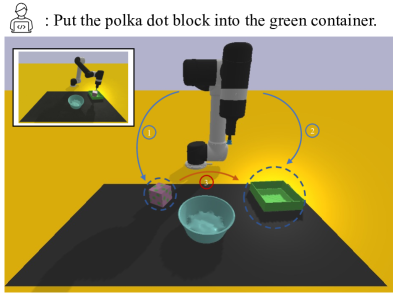
Instruct2Act 使用一个 LLM 生成 Python 策略,通过 SAM/CLIP 来感知、进行规划与执行,以完成桌面机器人任务,实现零-shot 多模态指令落地而无需微调。
Foundation models have made significant strides in various applications, including text-to-image generation, panoptic segmentation, and natural language processing. This paper presents Instruct2Act, a framework that utilizes Large Language Models to map multi-modal instructions to sequential actions for robotic manipulation tasks. Specifically, Instruct2Act employs the LLM model to generate Python programs that constitute a comprehensive perception, planning, and action loop for robotic tasks. In the perception section, pre-defined APIs are used to access multiple foundation models where the Segment Anything Model (SAM) accurately locates candidate objects, and CLIP classifies them. In this way, the framework leverages the expertise of foundation models and robotic abilities to convert complex high-level instructions into precise policy codes. Our approach is adjustable and flexible in accommodating various instruction modalities and input types and catering to specific task demands. We validated the practicality and efficiency of our approach by assessing it on robotic tasks in different scenarios within tabletop manipulation domains. Furthermore, our zero-shot method outperformed many state-of-the-art learning-based policies in several tasks. The code for our proposed approach is available at https://github.com/OpenGVLab/Instruct2Act, serving as a robust benchmark for high-level robotic instruction tasks with assorted modality inputs.
研究动机与目标
- 利用大型语言模型将多模态指令翻译成可执行的机器人动作序列。
- 将感知 API(SAM 和 CLIP)与 LLM 生成的控制代码整合,创建感知–规划–执行循环。
- 在各种桌面操作任务上评估零样本性能,以测试跨模态和场景的泛化。
提出的方法
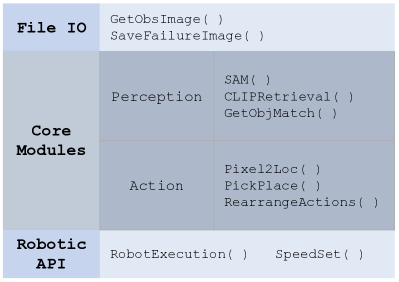
- 提供一个结构化的提示给 LLM 包含 API 定义、库导入,以及上下文示例,以生成 main() Python 函数。
- 使用 SAM 生成分割掩码,使用 CLIP 对对象裁剪进行语义定位分类。
- 通过预定义的变换和边界夹紧,将图像空间信息转换为机器人动作空间。
- 引入一个灵活的模态管理器来处理纯文本、文本-视觉和指向性文本指令。
- 应用处理模块(图像预处理、掩码后处理、非极大抑制)以提升感知的可靠性。
- 用 VIMABench 元任务进行评估,以将零样本性能与 SOTA 基线进行比较。
实验结果
研究问题
- RQ1LLM 是否可以在不进行特定任务训练的情况下,生成可执行的模块化策略代码,将多模态输入映射到机器人动作?
- RQ2感知基础模型(SAM/CLIP)如何与 LLM 推理结合,将指令在实际机器人动作中实现落地?
- RQ3处理步骤和骨干网络选择对在不同任务和模态下的零样本操作成功率有何影响?
- RQ4Instruct2Act 如何在 VIMABench 的 L1/L2/L3 泛化设置中泛化?
- RQ5一个完全零样本、由基础模型驱动的机器人系统的局限性与鲁棒性特征是什么?
主要发现
- Instruct2Act 在六个 VIMABench 元任务的零-shot 设置下,平均性能与 SOTA VIMA 相当。
- 多模态指令通常优于单模态指令,因为有更丰富的上下文定位。
- 消融研究表明掩码后处理和图像预处理共同将成功率提高到平均84.1%。
- 更大的 SAM/CLIP 骨干在各实验中提升 SR%。
- 该方法对人类干预、拼写错误和同义词等指令变化仍具有鲁棒性。
- 不同的 LLM(ChatGPT、LLaMA-Adapter)可能产生合理结果,且通过多次生成尝试可提升性能。
阅读本论文
在 Nubint 阅读器中打开原文,边读边就任意段落提问。
在 Nubint 中阅读本论文本解读由 AI 根据论文原文生成,引用前请核对原文。