
[论文解读] Integrating Large Language Models in Causal Discovery: A Statistical Causal Approach
本文提出一个框架,将统计因果发现与来自 GPT-4 的基于知识的因果推断相结合,通过统计因果提示来改进因果图,即使在偏置或未见数据集上。
In practical statistical causal discovery (SCD), embedding domain expert knowledge as constraints into the algorithm is important for reasonable causal models reflecting the broad knowledge of domain experts, despite the challenges in the systematic acquisition of background knowledge. To overcome these challenges, this paper proposes a novel method for causal inference, in which SCD and knowledge-based causal inference (KBCI) with a large language model (LLM) are synthesized through ``statistical causal prompting (SCP)'' for LLMs and prior knowledge augmentation for SCD. The experiments in this work have revealed that the results of LLM-KBCI and SCD augmented with LLM-KBCI approach the ground truths, more than the SCD result without prior knowledge. These experiments have also revealed that the SCD result can be further improved if the LLM undergoes SCP. Furthermore, with an unpublished real-world dataset, we have demonstrated that the background knowledge provided by the LLM can improve the SCD on this dataset, even if this dataset has never been included in the training data of the LLM. For future practical application of this proposed method across important domains such as healthcare, we also thoroughly discuss the limitations, risks of critical errors, expected improvement of techniques around LLMs, and realistic integration of expert checks of the results into this automatic process, with SCP simulations under various conditions both in successful and failure scenarios. The careful and appropriate application of the proposed approach in this work, with improvement and customization for each domain, can thus address challenges such as dataset biases and limitations, illustrating the potential of LLMs to improve data-driven causal inference across diverse scientific domains. The code used in this work is publicly available at: www.github.com/mas-takayama/LLM-and-SCD
研究动机与目标
- 促成将领域知识整合到统计因果发现(SCD)以获得更有意义的因果模型。
- 提出一种方法论(统计因果提示)以在 SCD 中生成并整合基于 LLM 的背景知识。
- 证明在 LLM 指导的背景知识下可以提升 SCD 的性能,并对数据集偏差更鲁棒。
- 展示 SCP 能在多种算法和数据集上提升 LLM-KBCI 输出和 SCD 结果。
提出的方法
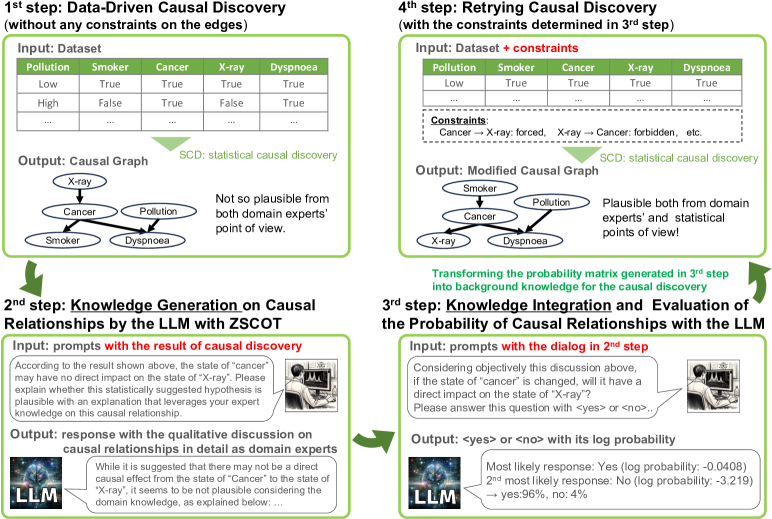
- 在不使用先验知识的情况下,对数据 X 进行初步 SCD,使用 PC、Exact Search 或 DirectLiNGAM (S)。
- 使用零-shot 链式思维提示,从 LLM(GPT-4)生成变量对之间的详细因果知识,受初始 SCD 结果(GKP)的指引。
- 用多次尝试评估 LLM 的回答,以估计因果链接的概率(统计因果提示,SCP)。
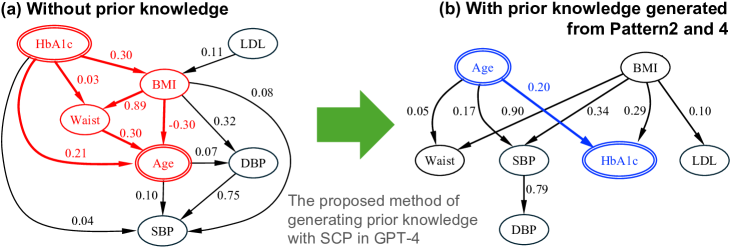
- 通过变换规则将 LLM 推导的概率矩阵转换为先验知识(PK)矩阵,然后用 PK 重新运行 SCD 以获得更精炼的图。
- 利用自助重抽样来量化边的概率,并通过基于规则的约束(禁用/强制边)将其整合到先验知识中。
- 在多组数据集(DWD 气候数据、健康筛查子集)和 SCD 算法上进行测试,以评估鲁棒性和普适性。
实验结果
研究问题
- RQ1当以 SCP 提示时,GPT-4 派生的背景知识是否能提升 SCD 学得的因果图的准确性?
- RQ2SCP 是否实现互相提升,即改进的 SCD 结果进一步改进 LLM-KBCI 输出?
- RQ3所提的以 LLM 辅助的 SCD 是否在不包含在 LLM 预训练数据中的数据集、且可能存在偏差的情况下有效?
- RQ4不同的 SCP 模式(提供给 LLM 的信息量和类型)如何影响性能?
- RQ5在利用 LLM 派生的先验知识的同时,该方法是否能保持统计有效性(例如 CFI、RMSEA、BIC)?
主要发现
- 在 SCP 辅助的 LLM 指导背景知识下,SCD 的结果比不带 PK 的 SCD 更接近真实值。
- 用 PK 增强 SCD 往往提高精确度和 F1,并减少 BIC,表明在领域知识下模型拟合更好。
- SCP 同时提升了 LLM-KBCI 输出与下游的 SCD 结果,展示了互相提升的性能。
- 即使数据集(健康筛查子集)未包含在 GPT-4 的预训练数据中且可能存在偏差,该方法仍然有益。
- DirectLiNGAM 在某些提示模式下特别受益于 SCP,显示出模式依赖的改进。
阅读本论文
在 Nubint 阅读器中打开原文,边读边就任意段落提问。
在 Nubint 中阅读本论文本解读由 AI 根据论文原文生成,引用前请核对原文。