
[论文解读] Integration of Large Language Models and Federated Learning
本论文定位性地定义联邦大模型(FL 对大模型)并概述三部分框架——联邦大模型预训练、微调与提示工程——以及关键的安全、隐私、效率,以及非独立同分布(Non-IID)挑战与潜在防御。
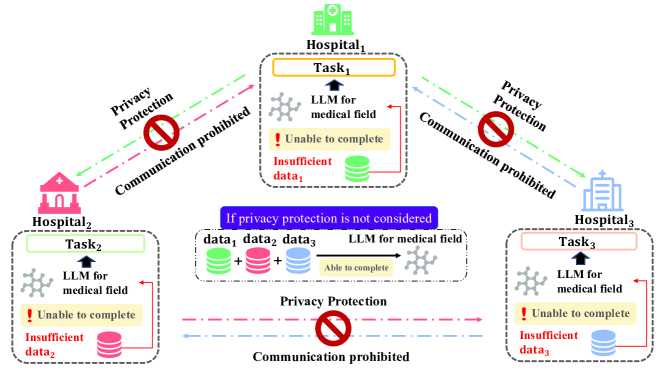
As the parameter size of Large Language Models (LLMs) continues to expand, there is an urgent need to address the scarcity of high-quality data. In response, existing research has attempted to make a breakthrough by incorporating Federated Learning (FL) into LLMs. Conversely, considering the outstanding performance of LLMs in task generalization, researchers have also tried applying LLMs within FL to tackle challenges in relevant domains. The complementarity between LLMs and FL has already ignited widespread research interest. In this paper, we aim to deeply explore the integration of LLMs and FL. We propose a research framework, dividing the fusion of LLMs and FL into three parts: the combination of LLM sub-technologies with FL, the integration of FL sub-technologies with LLMs, and the overall merger of LLMs and FL. We first provide a comprehensive review of the current state of research in the domain of LLMs combined with FL, including their typical applications, integration advantages, challenges faced, and future directions for resolution. Subsequently, we discuss the practical applications of the combination of LLMs and FL in critical scenarios such as healthcare, finance, and education, and provide new perspectives and insights into future research directions for LLMs and FL.
研究动机与目标
- 通过利用去中心化数据源解决大型语言模型(LLM)开发中的数据隐私和数据稀缺问题。
- 提出一个联邦大模型框架,将 FL 集成到 LLM 的训练和使用中。
- 分析将 FL 与 LLM 相结合所带来的挑战(安全、隐私、效率、Non-IID),并概述潜在的策略。
提出的方法
- 将联邦大模型定义为三部分组成:联邦大模型预训练、联邦大模型微调、以及联邦大模型提示工程。
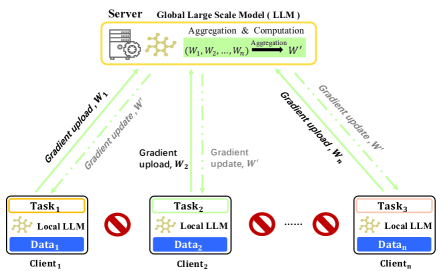
- 在 FL 约束下为每个组件提出架构设计和训练工作流。
- 将传统 LLM 训练与基于 FL 的 LLM 方法进行比较,以突出隐私和效率的权衡。
- 讨论数据隐私、安全威胁和效率考虑,以及提出的防御和缓解策略。
- 在 FL 的约束下,概述潜在的参数高效微调方法(如适配器、LoRA、前缀/提示微调)。
实验结果
研究问题
- RQ1如何在预训练、微调和提示工程中将联邦学习有效整合到大语言模型(LLMs)?
- RQ2在构建联邦大模型时,主要的安全、隐私、效率和数据异质性(Non-IID)挑战有哪些?如何缓解?
- RQ3哪些架构和训练策略选择(如全模型微调 vs 参数高效微调)在性能、隐私和计算成本之间取得平衡?
- RQ4如何将提示工程在联邦场景中进行调整,以实现个性化并在不暴露敏感数据的情况下提升 LLM 性能?
主要发现
- 提出一个基础的联邦大模型框架,由预训练、微调和提示工程组件组成。
- 本文分析了四个核心挑战——安全威胁及防御、隐私威胁及增强、效率,以及 Non-IID 数据,并讨论潜在的缓解方向。
- 它建议在 FL 内部调整参数高效微调方法(如适配器、LoRA、前缀/提示微调)以降低计算和通信成本。
- 联邦大模型提示工程方法通过本地提示学习者更新在不发送原始数据的情况下实现隐私保护、个性化提示。
- 强调鲁棒聚合、隐私保护技术(如差分隐私、安全聚合)以及对抗性训练在 FL-LLMs 中带来实际权衡。
阅读本论文
在 Nubint 阅读器中打开原文,边读边就任意段落提问。
在 Nubint 中阅读本论文本解读由 AI 根据论文原文生成,引用前请核对原文。