
[论文解读] Interaction-induced topological pumping in a solid-state quantum system
本文展示了在36量子比特超导量子系统中,由粒子间相互作用诱导的拓扑泵浦现象,其中相互作用使两个粒子通过拓扑边缘态实现量化、单向的输运。关键结果是出现了一种非线性、由相互作用驱动的输运机制,该机制在无相互作用系统中无对应物,从而实现了鲁棒、拓扑保护的多体态转移。
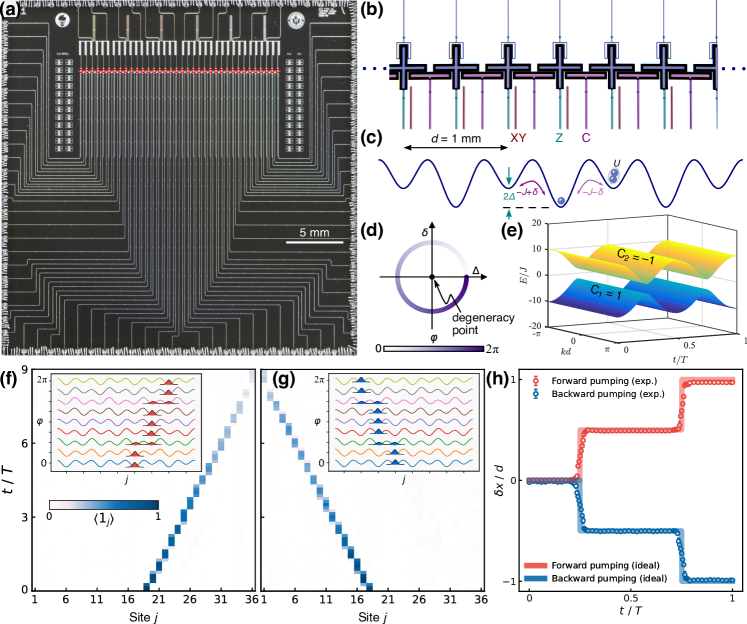
As the basis for generating multi-particle quantum correlations, inter-particle interaction plays a crucial role in collective quantum phenomena, quantum phase transitions, and quantum information processing. It can profoundly alter the band structure of quantum many-body systems and give rise to exotic topological phenomena. Conventional topological pumping, which has been well demonstrated in driven linear or noninteracting systems, may break down in the presence of strong interaction. However, the interplay between band topology and interaction could also induce emergent topological pumping of interacting particles, but its experimental realization has proven challenging. Here we demonstrate interaction-induced topological pumping in a solid-state quantum system comprising an array of 36 superconducting qubits. With strong interaction inherent in the qubits and site-resolved controllability of the lattice potential and hopping strength, we realize the topological Thouless pumping of single and two bounded particles. Beyond these topological phenomena with linear or noninteracting counterparts, we also observe topologically resonant tunneling and asymmetric edge-state transport of interacting particles. Our work creates a paradigm for multi-particle topological effects, and provides a new pathway to the study of exotic topological phenomena, many-body quantum transport, and quantum information transfer.
研究动机与目标
- 探索固态量子系统中能带拓扑与多体关联的相互作用。
- 在无相互作用对应物的多体相互作用系统中实现拓扑泵浦。
- 展示仅由粒子间相互作用诱导的涌现拓扑输运。
- 研究由于相互作用导致的对称性破缺下非对称边缘态输运。
- 验证该机制扩展至二维系统以模拟高维拓扑效应的可行性。
提出的方法
- 实验采用由36个超导transmon量子比特构成的阵列,其被设计为模拟具有可调跃迁和位点势能的Rice-Mele哈密顿量。
- 通过Δ(t) = Δ₀sin(2πt/Te)和δ(t) = -δ₀cos(2πt/Te)对跃迁幅度和位点能量进行绝热调制,驱动拓扑泵浦循环。
- 通过位点库仑排斥能U调节粒子间相互作用,其破坏能谱对称性,并实现从右到左的非绝热泵浦。
- 利用单次测量读出技术对每个位点j的Fock态占据数|nⱼ⟩进行原位测量,以追踪粒子输运和关联动力学。
- 在不同演化时间测量密度-密度关联Γᵢⱼ,以检测束缚态及其在输运过程中的解离。
- 使用相同哈密顿量参数进行理论模拟,与实验数据对比,以验证输运的拓扑本质。
实验结果
研究问题
- RQ1在无相互作用系统的情况下,粒子间相互作用能否诱导拓扑保护的量化输运?
- RQ2在拓扑泵浦循环中,相互作用的存在如何破坏能谱的对称性?
- RQ3两体束缚态在通过势垒实现单向输运中起什么作用?
- RQ4为何在相互作用下,从右到左的泵浦表现出比从左到右更强的非绝热效应?
- RQ5该机制能否扩展至二维系统,以模拟高维拓扑效应?
主要发现
- 粒子间相互作用诱导了一种非线性、单向输运机制,该机制在无相互作用系统中无对应,其存在通过无相互作用时无量化输运得到证实。
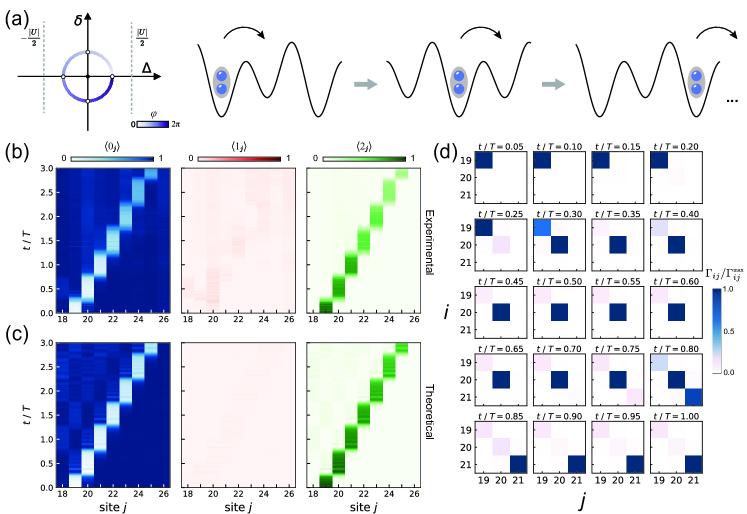
- 该系统表现出拓扑共振隧穿,即两个粒子在一个泵浦周期内通过整数个晶胞被输运,其驱动力来自相互作用、偏置与能带拓扑的协同作用。
- 强对角密度-密度关联表明两体束缚态局域于同一位置,而特定时间的非对角关联则表明其解离为相邻位点上的单体态。
- 相互作用破坏了能谱对称性,导致从右到左泵浦时能带更平坦,从而导致比从左到右输运更强的非绝热效应。
- 左、右边缘态输运的实验数据(图4b、4e)显示,在4 μs周期内,|2₁₉⟩态的占据数成功转移至|2₂₄⟩,反之亦然,与理论模拟结果(图4c、4f)一致。
- 测得的相互作用能量|U|/2π = 190 MHz小于隧穿分裂2|Δ₀|/2π = 300 MHz,证实系统处于相互作用主导于隧穿的区域,从而决定输运行为。
阅读本论文
在 Nubint 阅读器中打开原文,边读边就任意段落提问。
在 Nubint 中阅读本论文本解读由 AI 根据论文原文生成,引用前请核对原文。