
[论文解读] Interactions with Prompt Problems: A New Way to Teach Programming with Large Language Models
本文介绍了 Prompt Problems 和 Promptly 工具,利用大语言模型来教授编程,详细描述设计、初步和大规模研究中学生互动与认知的情况。它分析初学者如何与基于提示的代码生成互动及其对教育的影响。
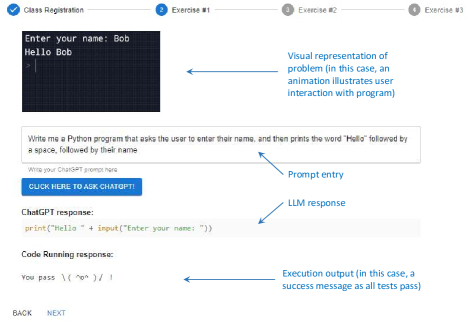
Large Language Models (LLMs) have upended decades of pedagogy in computing education. Students previously learned to code through extit{writing} many small problems with less emphasis on code reading and comprehension. Recent research has shown that free code generation tools powered by LLMs can solve introductory programming problems presented in natural language with ease. In this paper, we propose a new way to teach programming with Prompt Problems. Students receive a problem visually, indicating how input should be transformed to output, and must translate that to a prompt for an LLM to decipher. The problem is considered correct when the code that is generated by the student prompt can pass all test cases. In this paper we present the design of this tool, discuss student interactions with it as they learn, and provide insights into this new class of programming problems as well as the design tools that integrate LLMs.
研究动机与目标
- 提出一种通过基于提示的任务利用大语言模型的新型编程教学法。
- 设计并实现一个教学工具(Promptly),以支撑提示生成和代码评估。
- 研究初学者如何与 Prompt Problems 互动,以及这如何影响对编程概念的学习。
- 评估学生对 Prompt Problems 作为学习辅助工具的感知及其潜在教育收益。
提出的方法
- 设计并部署一种可视化问题表示,学生在其中撰写提示以生成代码。
- 使用自动化测试用例集对生成的代码进行验证,以确保正确性。
- 使用 React/NodeJS、无服务器后端和 CodeRunner 沙箱,迭代开发 Promptly 工具。
- 在 CS1 课程中开展探索性、试点和大规模研究,以观察互动和学习效果。
- 在各项研究中用反思性主题分析法分析质性数据,并用定量参与度指标进行分析。

实验结果
研究问题
- RQ1RQ1:学生在学习编程时如何与 Prompt Problems 互动?
- RQ2RQ2:学生如何看待 Prompt Problems 对学习编程概念的影响?
主要发现
- Prompt Problems 通过问题分解、需求写作和代码阅读来引导初学者,并在测试通过前不断迭代改写提示。
- 在试点研究中,414 名学生中有 58 名(14%)至少尝试过一个 Promptly 问题,每题平均提交提示次数约为 2.7、2.16 和 6.4 次。
- 大规模实验显示在第 10 实验中有 386 次尝试,在第 11 实验中有 381 次尝试,其中涉及 Promptly 练习的尝试分别为 202 次(52%)和 147 次(39%)。
- 多数学生报告的好处包括接触新编程结构和加强计算思维,而少数学生对依赖 AI 工具表示担忧。
- 这些经验促使对问题设计进行调整,旨在平衡提示难度与可访问性,以维持参与度并支撑学习。
阅读本论文
在 Nubint 阅读器中打开原文,边读边就任意段落提问。
在 Nubint 中阅读本论文本解读由 AI 根据论文原文生成,引用前请核对原文。