
[论文解读] InternImage: Exploring Large-Scale Vision Foundation Models with Deformable Convolutions
Introduces InternImage, a large-scale CNN-based vision foundation model built on deformable convolutions (DCNv3) to match or surpass large ViTs in classification, detection, and segmentation across scale variants up to 1B parameters. Achieves state-of-the-art COCO detection and strong ADE20K segmentation while closing the gap with ViTs on ImageNet with massive data.
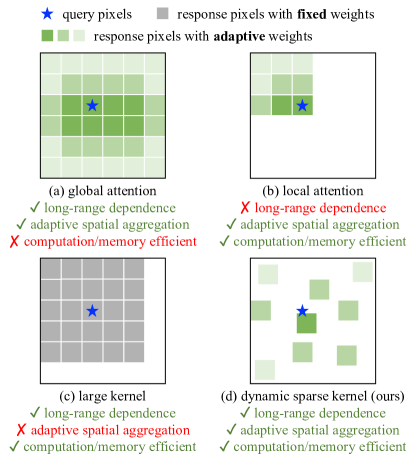
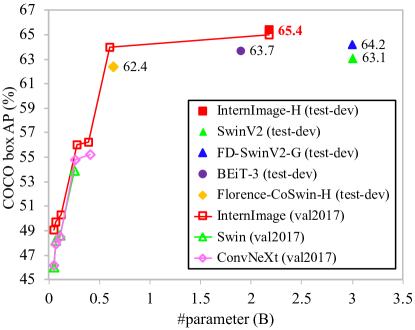
Compared to the great progress of large-scale vision transformers (ViTs) in recent years, large-scale models based on convolutional neural networks (CNNs) are still in an early state. This work presents a new large-scale CNN-based foundation model, termed InternImage, which can obtain the gain from increasing parameters and training data like ViTs. Different from the recent CNNs that focus on large dense kernels, InternImage takes deformable convolution as the core operator, so that our model not only has the large effective receptive field required for downstream tasks such as detection and segmentation, but also has the adaptive spatial aggregation conditioned by input and task information. As a result, the proposed InternImage reduces the strict inductive bias of traditional CNNs and makes it possible to learn stronger and more robust patterns with large-scale parameters from massive data like ViTs. The effectiveness of our model is proven on challenging benchmarks including ImageNet, COCO, and ADE20K. It is worth mentioning that InternImage-H achieved a new record 65.4 mAP on COCO test-dev and 62.9 mIoU on ADE20K, outperforming current leading CNNs and ViTs. The code will be released at https://github.com/OpenGVLab/InternImage.
研究动机与目标
- Motivate CNN-based foundation models to scale with parameters and data like ViTs.
- Design a deformable convolution core operator that enables long-range dependencies and adaptive spatial aggregation.
- Develop a scalable CNN backbone (InternImage) with block design and stacking strategies suitable for large-scale training.
- Demonstrate competitive performance against state-of-the-art CNNs and ViTs on classification, detection, and segmentation.
提出的方法
- Adopts deformable convolution v3 (DCNv3) as the core operator with 3x3 sparsity for efficiency.
- Extends DCNv2 by: (i) sharing projection weights across sampling points; (ii) introducing a multi-group mechanism for diverse aggregation patterns; (iii) normalizing modulation scalars with softmax for training stability.
- Builds a basic block incorporating LN and FFN with DCNv3 plus a separable path to predict offsets and scales.
- Uses a stem and downsampling layout to create a hierarchical feature pyramid.
- Defines stacking rules to form four-stage networks with four key hyper-parameters (C1, C′, L1, L3) and derives a family of models (T/S/B/L/XL/H).
- Presents depth/width scaling rules inspired by prior works to generate multi-scale variants, including a 1B-parameter InternImage-H.
实验结果
研究问题
- RQ1Can a CNN-based foundation model with deformable convolution match or exceed ViT-based models at very large scales and data regimes?
- RQ2How can DCNv3 be tuned and stacked to efficiently learn long-range dependencies and adaptive spatial aggregation for vision tasks?
- RQ3What are the performance gains of InternImage across ImageNet, COCO, and ADE20K compared to contemporary CNNs and ViTs at multiple scales?
主要发现
- InternImage-T achieves 83.5% top-1 accuracy on ImageNet-1K, surpassing ConvNeXt-T by 1.4 points.
- InternImage-S reaches 84.2% top-1 on ImageNet-1K, and InternImage-B reaches 84.9% top-1, both competitive with or superior to previous CNNs at similar scales.
- With large-scale data, InternImage-H attains 89.6% top-1 accuracy on ImageNet-1K, nearing state-of-the-art ViTs and hybrid ViTs.
- On COCO, InternImage-H achieves a new record 65.4 box AP on test-dev with 2.18B parameters, outperforming SwinV2-G and achieving higher efficiency (fewer parameters in many cases).
- On ADE20K, InternImage-H reaches 60.3 MS mIoU (multi-scale) and InternImage-B/L/XL variants surpass prior CNNs, demonstrating strong segmentation performance.
- InternImage demonstrates strong performance gains across tasks (ImageNet classification, COCO detection, ADE20K segmentation) while scaling from tens of millions to over a billion parameters, approaching ViT-level results.
阅读本论文
在 Nubint 阅读器中打开原文,边读边就任意段落提问。
在 Nubint 中阅读本论文本解读由 AI 根据论文原文生成,引用前请核对原文。