
[论文解读] Interpretable and Explainable Logical Policies via Neurally Guided Symbolic Abstraction
NUDGE 通过使用预训练神经策略引导可微分的前向推理,学习可解释且可解释的逻辑策略,在关系型强化学习任务中实现竞争力的表现和鲁棒的适应性。
The limited priors required by neural networks make them the dominating choice to encode and learn policies using reinforcement learning (RL). However, they are also black-boxes, making it hard to understand the agent's behaviour, especially when working on the image level. Therefore, neuro-symbolic RL aims at creating policies that are interpretable in the first place. Unfortunately, interpretability is not explainability. To achieve both, we introduce Neurally gUided Differentiable loGic policiEs (NUDGE). NUDGE exploits trained neural network-based agents to guide the search of candidate-weighted logic rules, then uses differentiable logic to train the logic agents. Our experimental evaluation demonstrates that NUDGE agents can induce interpretable and explainable policies while outperforming purely neural ones and showing good flexibility to environments of different initial states and problem sizes.
研究动机与目标
- 在强化学习中为既可解释又可解释的策略的需求提供动机。
- 提出一个神经引导的可微分逻辑框架(NUDGE)来学习基于逻辑的策略。
- 通过用预训练神经策略引导符号抽象来实现高效的规则发现。
- 证明 NUDGE 能与神经基线竞争并适应环境变化。
- 通过易读的规则集和基于梯度的解释展示可解释性。
提出的方法
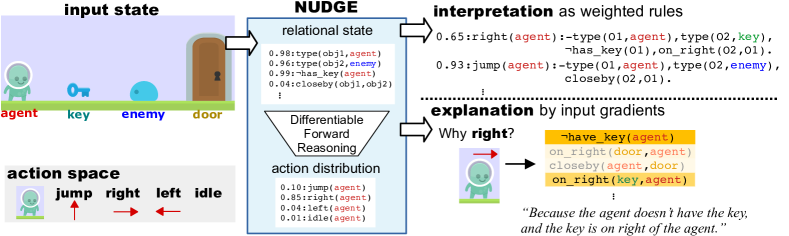
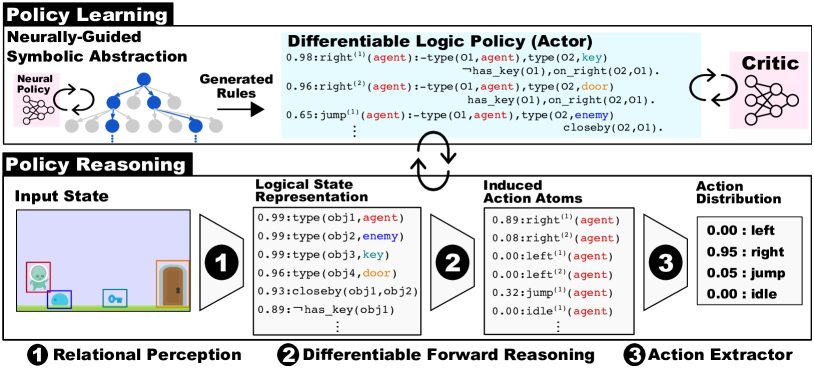
- 定义一个第一阶逻辑的动作-状态语言,将动作谓词与状态谓词分离。
- 使用可微分的前向推理从概率事实计算动作分布。
- 实现神经引导的符号抽象,以基于神经策略选择一组紧凑的候选规则。
- 通过 PPO Actor-Critic 更新训练规则权重,使用神经评估者以最大化回报。
- 通过在概率逻辑表示上计算输入归因分数,提供基于梯度的解释。
实验结果
研究问题
- RQ1Q1: 在标准任务和逻辑导向任务上,NUDGE 与神经基线和纯逻辑基线相比如何?
- RQ2Q2: NUDGE 是否可以在不重新训练的情况下适应环境变化?
- RQ3Q3: NUDGE 的策略是否可解释,是否能够为决策提供解释?
主要发现
- NUDGE 在若干逻辑环境上超越神经基线,在其他环境达到或超过神经性能。
- NUDGE 展现出对环境变化的鲁棒性,无需重新训练。
- NUDGE 以带权规则集的形式产生可解释的策略,并为动作选择提供基于梯度的解释。
- 带神经引导的抽象的 NUDGE 产生紧凑的规则集并实现高效学习。
- NUDGE 明显超越依赖固定模板的非微分符号基线。
- 实验包括 OCAtari 基准测试和三个面向对象的逻辑环境,展示了关系推理能力。
阅读本论文
在 Nubint 阅读器中打开原文,边读边就任意段落提问。
在 Nubint 中阅读本论文本解读由 AI 根据论文原文生成,引用前请核对原文。