
[论文解读] Interpreting CLIP with Sparse Linear Concept Embeddings (SpLiCE)
本文提出 SpLiCE,一种后训练方法,将 CLIP 的密集、不可解释的图像嵌入分解为稀疏、非负的、人类可解释概念的线性组合,无需概念标签或微调。该方法在下游任务中性能损失极小,同时实现高度可解释性,支持偏差检测、模型编辑和分布漂移监控等应用,且保持了最先进性能。
CLIP embeddings have demonstrated remarkable performance across a wide range of multimodal applications. However, these high-dimensional, dense vector representations are not easily interpretable, limiting our understanding of the rich structure of CLIP and its use in downstream applications that require transparency. In this work, we show that the semantic structure of CLIP's latent space can be leveraged to provide interpretability, allowing for the decomposition of representations into semantic concepts. We formulate this problem as one of sparse recovery and propose a novel method, Sparse Linear Concept Embeddings, for transforming CLIP representations into sparse linear combinations of human-interpretable concepts. Distinct from previous work, SpLiCE is task-agnostic and can be used, without training, to explain and even replace traditional dense CLIP representations, maintaining high downstream performance while significantly improving their interpretability. We also demonstrate significant use cases of SpLiCE representations including detecting spurious correlations and model editing.
研究动机与目标
- 为解决密集 CLIP 嵌入缺乏可解释性的问题,从而限制其在实际应用中的透明度。
- 实现在无需概念标注、微调或定性可视化的情况下,对 CLIP 表示进行后训练可解释性分析。
- 开发一种方法,将 CLIP 嵌入分解为稀疏、人类可解释的语义成分,同时保持下游任务性能。
- 展示可解释表示的实际应用,包括检测虚假相关性、模型编辑以及监控数据集分布漂移。
提出的方法
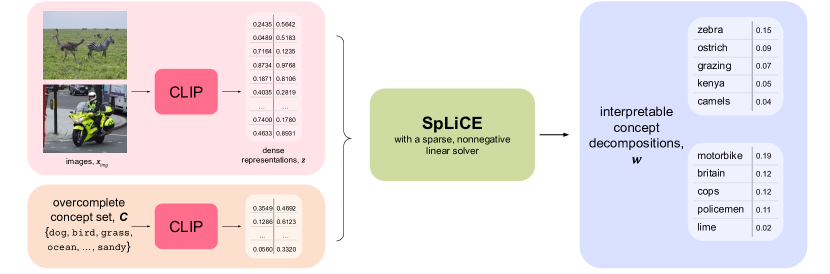
- SpLiCE 将解释任务建模为稀疏非负字典学习问题,求解预定义、人类可解释概念的稀疏线性组合。
- 使用一个过完备的概念集合,涵盖常见视觉属性(例如 'bicycle'、'yellow'、'glasses'),以表示语义空间。
- 通过 ℓ₁ 正则化(Lasso)强制概念权重的稀疏性,以近似 ℓ₀ 正则化,提升可解释性。
- 采用凸松弛方法求解优化问题,实现 CLIP 特征到概念激活的高效且稳定分解。
- 该方法为后训练操作,可应用于任意预训练的 CLIP 模型,无需修改原始架构或重新训练。
- 概念权重通过最小化原始 CLIP 嵌入与概念稀疏线性组合之间重建误差的优化过程学习得到。
实验结果
研究问题
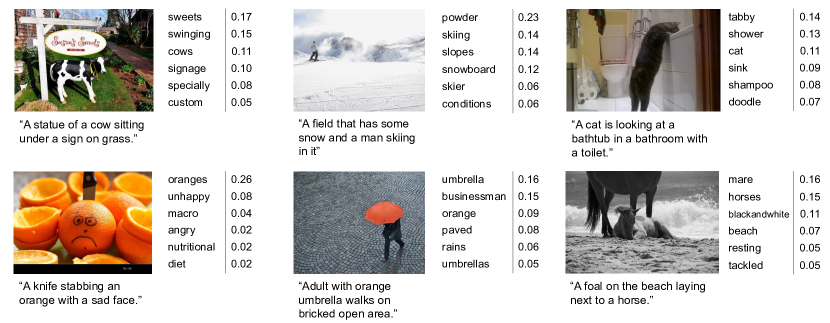
- RQ1CLIP 的密集高维表示能否被有意义地分解为稀疏、人类可解释的语义成分?
- RQ2所得到的稀疏分解与原始 CLIP 特征相比,是否保持了下游性能?
- RQ3SpLiCE 是否可在无真实概念标签的情况下检测数据集中的虚假相关性?
- RQ4SpLiCE 是否能通过修改表示空间中的概念权重,实现有效的模型编辑?
- RQ5SpLiCE 是否能有效监控并量化数据集中语义分布随时间的漂移?
主要发现
- SpLiCE 在下游任务中实现了极高的稀疏性(平均每张图像 10–30 个概念),性能损失极小,零样本和线性探测准确率与原始 CLIP 几乎完全一致。
- 在性别分类任务中,通过 SpLiCE 干预 'glasses' 概念,性别分类准确率从 0.96 降至 0.69,证明其能够揭示并操纵模型偏差。
- SpLiCE 有效检测到 CIFAR100 数据集中女性穿比基尼的虚假相关性,揭示了仅从模型准确率无法察觉的数据集偏差。
- 在 Stanford Cars 数据集中,SpLiCE 对 'convertible' 和 'yellow' 的概念权重随时间变化与真实概念出现频率高度一致,实现了准确的分布漂移监控。
- SpLiCE 表示支持有效的模型编辑:修改概念权重可引起模型行为的显著变化,例如降低人脸识别中的性别偏差。
- 该方法在多个数据集和任务上表现出鲁棒性,表明可解释的稀疏概念分解可作为密集 CLIP 特征的可靠代理。
阅读本论文
在 Nubint 阅读器中打开原文,边读边就任意段落提问。
在 Nubint 中阅读本论文本解读由 AI 根据论文原文生成,引用前请核对原文。