
[论文解读] Investigating the Catastrophic Forgetting in Multimodal Large Language Models
本文提出 EMT,一种将多模态大语言模型(MLLMs)视为图像分类器来评估灾难性遗忘的框架。结果显示,大多数经过微调的 MLLMs 与其基础视觉编码器的对齐度下降,在微调过程中出现幻觉。还分析了在 LLaVA 上的不同微调策略如何影响泛化和幻觉。
Following the success of GPT4, there has been a surge in interest in multimodal large language model (MLLM) research. This line of research focuses on developing general-purpose LLMs through fine-tuning pre-trained LLMs and vision models. However, catastrophic forgetting, a notorious phenomenon where the fine-tuned model fails to retain similar performance compared to the pre-trained model, still remains an inherent problem in multimodal LLMs (MLLM). In this paper, we introduce EMT: Evaluating MulTimodality for evaluating the catastrophic forgetting in MLLMs, by treating each MLLM as an image classifier. We first apply EMT to evaluate several open-source fine-tuned MLLMs and we discover that almost all evaluated MLLMs fail to retain the same performance levels as their vision encoders on standard image classification tasks. Moreover, we continue fine-tuning LLaVA, an MLLM and utilize EMT to assess performance throughout the fine-tuning. Interestingly, our results suggest that early-stage fine-tuning on an image dataset improves performance across other image datasets, by enhancing the alignment of text and visual features. However, as fine-tuning proceeds, the MLLMs begin to hallucinate, resulting in a significant loss of generalizability, even when the image encoder remains frozen. Our results suggest that MLLMs have yet to demonstrate performance on par with their vision models on standard image classification tasks and the current MLLM fine-tuning procedure still has room for improvement.
研究动机与目标
- 激发并量化多模态大语言模型(MLLMs)中的灾难性遗忘。
- 开发 EMT,一种将 MLLMs 视为图像分类器以评估视觉编码器能力记忆保持的评估框架。
- 通过对开源模型和 LLaVA 的实验证明微调如何影响 MLLMs。
- 检查诸如幻觉等故障模式,并识别在何种条件下适度微调可以提高泛化能力。
提出的方法
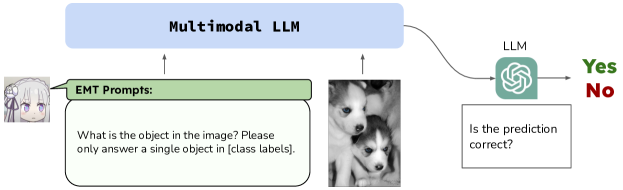
- 介绍 EMT:一个两阶段的评估流程,在该流程中对 MLLM 进行图片分类提示,其输出经后处理以获得准确性。
- 将每个 MLLM 视为图像分类器,并将其零-shot 的视觉编码器性能与微调后的性能进行比较。
- 使用二级大语言模型(GPT-3.5)评估每个数据集上 MLLM 输出的正确性。
- 将 EMT 应用于开源 MLLMs(LLaVA、Otter、InstructBLIP、LENS)以诊断遗忘和幻觉。
- 用线性和 LoRA 适配器对 LLaVA(7b 和 13b)进行微调,并应用 EMT 以监测跨纪元的性能。
- 分析故障模式,包括错误预测、内在幻觉和外在幻觉。)
实验结果
研究问题
- RQ1开源微调后的 MLLMs 是否在标准图像任务上保持与其视觉编码器相当的分类性能?
- RQ2对多模态大模型进行微调如何影响其跨数据集的泛化能力以及幻觉倾向?
- RQ3在微调过程中 MLLMs 性能下降的主要原因是什么?
- RQ4适度微调是否能在不造成显著遗忘或幻觉的情况下改善特征对齐?
主要发现
- 在 EMT 评估中,大多数测试的开源 MLLMs 未能保留与其视觉编码器相同的分类准确性。
- 幻觉是性能下降的主要原因之一,包括给出多标签或无法核实的描述。
- 对 LLaVA 的微调表明,早期阶段的微调可以改善跨数据集的对齐,但过度微调会导致幻觉和泛化能力下降。
- 适度微调可以提升未微调任务的性能,表明特征对齐得到改善,而过拟合会造成遗忘和幻觉。
- 基础语言模型的选择(例如 LLaMA 与 Flan-T5)可能影响遗忘的程度,某些模型显示出更大的缺陷。
阅读本论文
在 Nubint 阅读器中打开原文,边读边就任意段落提问。
在 Nubint 中阅读本论文本解读由 AI 根据论文原文生成,引用前请核对原文。