
[论文解读] Investigating the $M_{GCS}-M_h$ Relation in the Most Massive Galaxies
本研究利用标准化方法测量了 0.1$R_{\text{vir}}$ 范围内球状星团系统(GCS)质量,并结合弱强引力透镜校准的晕质量,调查了最质量最大的星系中的 $M_{GCS}$-$M_h$ 关系。研究发现,在大质量端,$M_{GCS}/M_h = (3.0 \pm 1.8) \times 10^{-5}$ 的关系近乎线性,证实了该关系延续至 $10^{14}M_\odot$ 晷质量区,并支持被俘获的球状星团在大质量星系形成中起主导作用。
The relation between the total mass contained in the globular clusters of a galaxy and the mass of its dark matter halo has been found observationally to be nearly linear over five decades of mass. However, the high-mass end of this relation is not well determined from previous data and shows large scatter. We analyze the globular cluster systems (GCSs) of a homogeneous sample of 11 brightest cluster galaxies (BCGs) through DOLPHOT photometry of their deep Hubble Space Telescope (HST) images in the F814W filter. We standardize the definition of $M_{GCS}$, the total GCS mass, by using the GC total population within a limiting radius of $0.1 R_{virial}$, while the dark-matter halo mass $M_h$ is determined from the weak-lensing calibration of $M_h$ versus $M_{bary}$. When these 11 BCGs are added to the previously studied homogeneous catalogue of Virgo member galaxies, a total value for $η= M_{GCS}/M_h$ is found to be $(3.0\pm1.8_{internal}) imes10^{-5}$, slightly higher than previous estimates but with much reduced uncertainty. Perhaps more importantly, the results suggest that the relation continues to have a near-linear shape at the highest galaxy masses, strongly reinforcing the conclusion that accreted GCs make a major contribution to the GC populations at high galaxy mass.
研究动机与目标
- 约束高质质量端的 $M_{GCS}$-$M_h$ 关系,该区域观测数据稀疏且散射较大。
- 通过在所有 BCG 中统一使用 $0.1R_{\text{vir}}$ 作为截断半径,标准化 $M_{GCS}$ 的定义,以减少测量偏差。
- 通过应用弱强引力透镜校准的 $M_h$-$M_{\text{bary}}$ 关系,提高 $M_h$ 估计的准确性。
- 检验当晕质量超过 $10^{14}M_\odot$ 时,$M_{GCS}$-$M_h$ 关系是否仍保持线性,以解决先前的不确定性。
- 评估对星系形成的影响,特别是吸积在构建大质量星系晕中的作用。
提出的方法
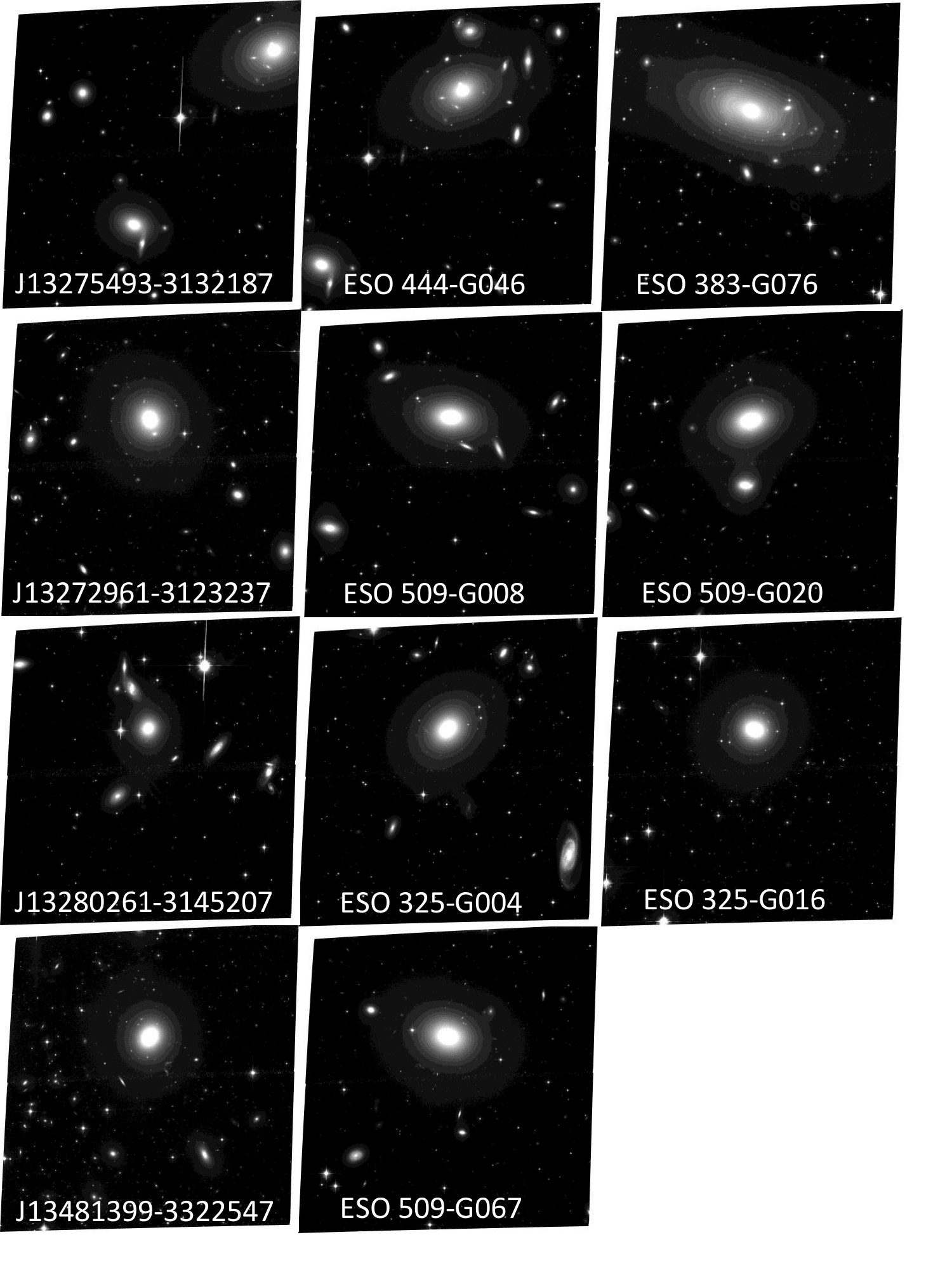
- 从程序编号 10429 和哈勃前沿场项目获取了 11 个 BCG 的深空哈勃空间望远镜(HST)F814W 图像。
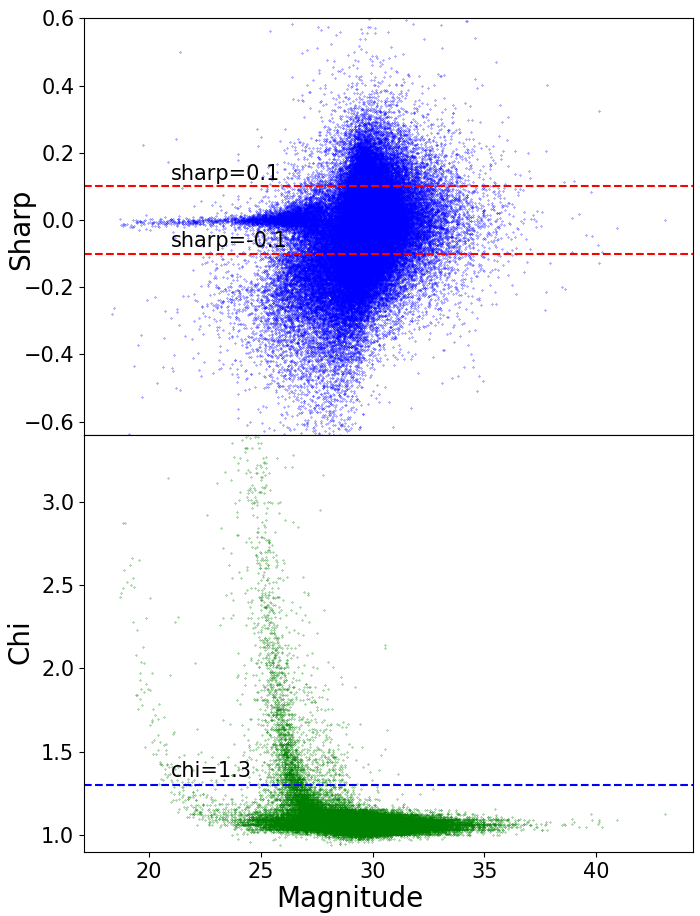
- 使用 DOLPHOT 光度测量法在 HST 图像中检测并测量单个球状星团。
- 将 $M_{GCS}$ 定义为在 $0.1R_{\text{vir}}$ 范围内球状星团的总质量,以实现测量标准化并最小化来自星系间介质球状星团的污染。
- 通过弱强引力透镜校准的 $M_h$-$M_{\text{bary}}$ 关系计算晕质量 ($M_h$),使用光度法估算的恒星质量。
- 将新获得的 BCG 数据与室女座星系团星系的文献目录相结合,扩展了 $M_{GCS}$-$M_h$ 关系的动力学范围。
- 执行对数-对数回归,以评估在整个质量范围内 $M_{GCS}$-$M_h$ 关系的线性度和散射。
实验结果
研究问题
- RQ1在最高星系质量下,即超过 $10^{14}M_\odot$ 时,$M_{GCS}$-$M_h$ 关系是否仍保持线性?
- RQ2在 $0.1R_{\text{vir}}$ 范围内标准化 $M_{GCS}$ 定义后,如何影响 $M_{GCS}$-$M_h$ 关系的一致性和准确性?
- RQ3在使用同质数据和标准化方法时,质量比 $\eta = M_{GCS}/M_h$ 的修正值是多少?
- RQ4被俘获的球状星团在最质量最大的星系的 GCS 中贡献了多少?
- RQ5在高质质量端,$M_{GCS}$-$M_h$ 关系的内在散射行为如何?这对星系形成模型有何启示?
主要发现
- $M_{GCS}/M_h$ 比值测定为 $(3.0 \pm 1.8_{\text{internal}}) \times 10^{-5}$,略高于以往估计值,但因标准化方法的应用,不确定性显著降低。
- $M_{GCS}$-$M_h$ 关系在整个质量范围内(从 $M_h \sim 10^{11}M_\odot$ 到 $M_h > 10^{14}M_\odot$)保持近乎线性,证实了在高质质量端的线性关系。
- 在 $0.1R_{\text{vir}}$ 范围内标准化 $M_{GCS}$ 有效减少了来自星系间介质球状星团的污染,并实现了更一致的跨研究比较。
- 结果强烈支持被俘获球状星团在大质量星系(尤其是 BCG)的球状星团系统中起主要贡献的假设。
- 该关系的内在散射仍难以约束,外部不确定性主要来自恒星质量-光度比和 $M_{\text{bary}}$-$M_h$ 校准。
- 研究结果与理论模型一致,该模型预测在 $z=0$ 时存在线性 $M_{GCS}$-$M_h$ 关系,即使该关系在形成时并非线性,这也是由于中心极限定理的作用。
阅读本论文
在 Nubint 阅读器中打开原文,边读边就任意段落提问。
在 Nubint 中阅读本论文本解读由 AI 根据论文原文生成,引用前请核对原文。