
[论文解读] Investigating the role of model-based learning in exploration and transfer
本文研究了基于模型的强化学习在何种条件下以及为何能提升迁移学习效果,方法是通过在无奖励环境中利用内在探索预训练智能体,随后在下游任务上进行微调。结果表明,基于模型的智能体在迁移任务中优于基于模型的基线方法,其中动态模型和策略先验是成功的关键因素,尤其是在分布内条件下。
State of the art reinforcement learning has enabled training agents on tasks of ever increasing complexity. However, the current paradigm tends to favor training agents from scratch on every new task or on collections of tasks with a view towards generalizing to novel task configurations. The former suffers from poor data efficiency while the latter is difficult when test tasks are out-of-distribution. Agents that can effectively transfer their knowledge about the world pose a potential solution to these issues. In this paper, we investigate transfer learning in the context of model-based agents. Specifically, we aim to understand when exactly environment models have an advantage and why. We find that a model-based approach outperforms controlled model-free baselines for transfer learning. Through ablations, we show that both the policy and dynamics model learnt through exploration matter for successful transfer. We demonstrate our results across three domains which vary in their requirements for transfer: in-distribution procedural (Crafter), in-distribution identical (RoboDesk), and out-of-distribution (Meta-World). Our results show that intrinsic exploration combined with environment models present a viable direction towards agents that are self-supervised and able to generalize to novel reward functions.
研究动机与目标
- 理解基于模型的学习在强化学习中何时以及为何能改善迁移学习。
- 在迁移过程中分离并分析不同组件(策略、动态模型、表征)的贡献。
- 在分布偏移程度不同的环境中评估迁移性能(分布内 vs. 分布外)。
- 在相同架构和内在探索机制下,比较基于模型与基于模型的智能体。
- 评估预训练对环境动态建模和探索质量的影响,以提升下游任务的泛化能力。
提出的方法
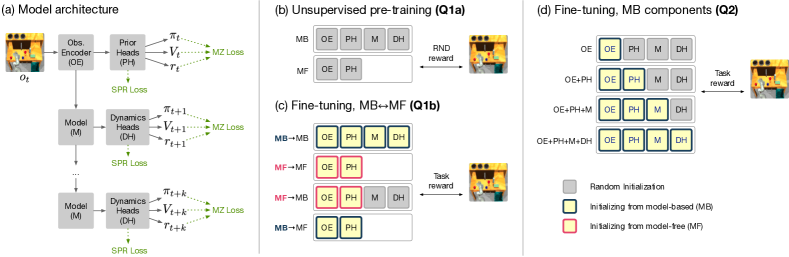
- 在无奖励环境中,通过随机网络蒸馏(RND)的内在探索方式对智能体进行预训练。
- 采用自监督的MuZero变体,结合自预测表征(SPR),同时训练策略和动态模型。
- 在下游任务上对预训练智能体进行微调,引入特定任务的奖励信号,并迁移特定组件(如动态模型、策略先验)。
- 通过重新初始化特定组件(如策略或动态模型)进行消融研究,以隔离其对迁移的贡献。
- 在三个领域中评估性能:程序生成(Crafter)、相同环境(RoboDesk)和分布外(Meta-World)。
- 使用返回曲线和零样本迁移指标,比较基于模型与基于模型的迁移性能。
实验结果
研究问题
- RQ1在缺乏任务奖励的条件下,基于模型的探索是否能带来优于基于模型的探索的迁移性能?
- RQ2在基于模型的智能体中,策略、动态模型或表征中哪一个对成功迁移的贡献最大?
- RQ3环境分布变化(如分布外动态)如何影响从预训练到微调的知识迁移能力?
- RQ4基于模型学习的优势是否在不同类型的环境分布(程序生成、相同环境、分布外)中保持一致?
主要发现
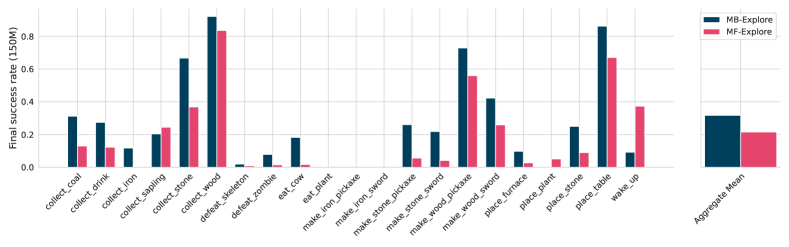
- 基于模型的智能体在内在探索和下游微调中均优于基于模型的基线方法,尤其在分布内设置下表现更优。
- 同时迁移动态模型和策略先验可实现最强的迁移性能,表明两个组件均至关重要。
- 当动态模型在与下游任务相同的环境中进行训练时,基于模型的优势最为显著。
- 在Meta-World等分布外设置中,迁移性能显著下降,因为智能体对动态特性的知识不足以实现正向迁移。
- 在Meta-World中,基于模型的迁移仅在早期训练阶段(最多约2000万帧)提供比随机初始化略高的优势,表明在高分布偏移下泛化能力有限。
- Crafter中的程序变化增强了迁移效果,可能是因为预训练期间动态特性的暴露更丰富,从而支持对新奖励函数的更好泛化。
阅读本论文
在 Nubint 阅读器中打开原文,边读边就任意段落提问。
在 Nubint 中阅读本论文本解读由 AI 根据论文原文生成,引用前请核对原文。