
[论文解读] Investigating the sightline of a highly scattered FRB through a filamentary structure in the local Universe
本研究调查了FRB 20200723B,这是一个具有极高色散的快速射电暴,在400 MHz频段的色散时间尺度超过1秒,追踪其视线穿过本地宇宙中的丝状结构。通过色 dispersion测量和色散测量,作者证明这种极端色散源于宇宙网丝状结构中的致密电离等离子体,揭示了FRB作为磁化星际介质的探针,并凸显了其在约束宇宙网结构和星系晕环境方面的潜力。
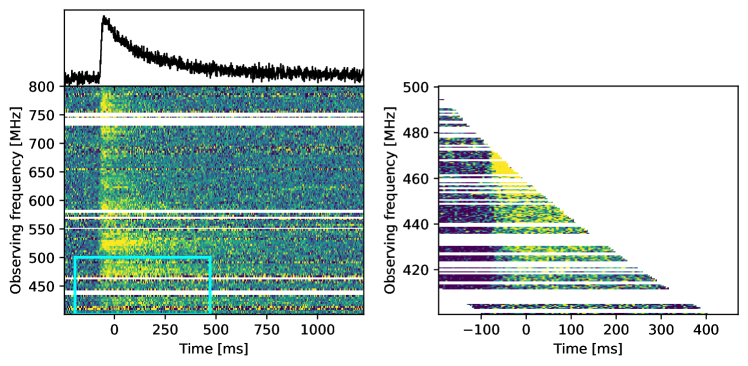
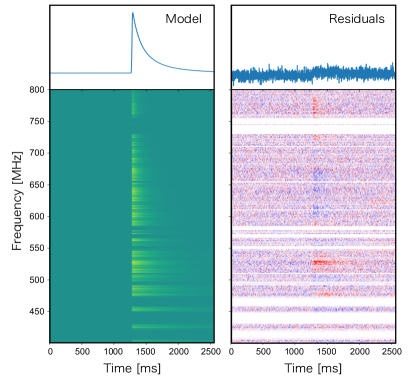
Fast radio bursts (FRBs) are unique probes of extragalactic ionized baryonic structure as each signal, through its burst properties, holds information about the ionized matter it encounters along its sightline. FRB 20200723B is a burst with a scattering timescale of $τ_\mathrm{400\,MHz} >$1 second at 400 MHz and a dispersion measure of DM $\sim$ 244 pc cm$^{-3}$. Observed across the entire CHIME/FRB frequency band, it is the single-component burst with the largest scattering timescale yet observed by CHIME/FRB. The combination of its high scattering timescale and relatively low dispersion measure present an uncommon opportunity to use FRB 20200723B to explore the properties of the cosmic web it traversed. With an $\sim$arcminute-scale localization region, we find the most likely host galaxy is NGC 4602 (with PATH probability $P(O|x)=0.985$), which resides $\sim$30 Mpc away within a sheet filamentary structure on the outskirts of the Virgo Cluster. We place an upper limit on the average free electron density of this filamentary structure of $\langle n_e angle < 4.6^{+9.6}_{-2.0} imes 10^{-5}$ cm$^{-3}$, broadly consistent with expectations from cosmological simulations. We investigate whether the source of scattering lies within the same galaxy as the FRB, or at a farther distance from an intervening structure along the line of sight. Comparing with Milky Way pulsar observations, we suggest the scattering may originate from within the host galaxy of FRB 20200723B.
研究动机与目标
- 为了理解FRB 20200723B中极端色散的起源,该FRB是CHIME/FRB探测到的仅两个τ₄₀₀ MHz > 1 s的FRB之一。
- 通过结合色 dispersion测量(DM)和色散测量,约束FRB 20200723B的视线环境。
- 研究高通量FRB是否能够克服CHIME/FRB对高度色散爆发的观测偏倚。
- 评估FRB作为宇宙丝状结构和星系晕次结构中电离等离子体探针的潜力。
- 评估本地宇宙结构在塑造FRB传播效应和实现高精度视线诊断中的作用。
提出的方法
- 在400 MHz频段测得FRB 20200723B的色散时间尺度τ₄₀₀ MHz ≈ 1.1 s,表明其视线高度色散。
- 利用色 dispersion测量(DM)为114.8 cm⁻³ pc,将电离电子含量分解为:银河系、星系际和宿主贡献。
- 基于电子密度涨落的色散模型,推断路径平均电子密度和色散时间尺度。
- 将观测到的DM和色散与宇宙学模拟和丝状结构模型的预测进行比较。
- 利用爆发的高通量克服CHIME/FRB对高度色散事件的强选择偏倚。
- 利用爆发的定位(角分量级)推断其靠近宇宙丝状结构,与观测到的色散一致。
实验结果
研究问题
- RQ1是什么导致了FRB 20200723B中观测到的极端色散时间尺度(τ₄₀₀ MHz > 1 s)?
- RQ2本地宇宙丝状结构对FRB 20200723B视线总色 dispersion测量和色散的贡献是什么?
- RQ3高通量FRB能否克服CHIME/FRB对高度色散爆发的观测偏倚?
- RQ4FRB 20200723B这类FRB在多大程度上可作为宇宙丝状结构和星系晕次结构中电离等离子体的探针?
- RQ5FRB 20200723B的色散和DM测量在多大程度上约束了中间介质的电子密度和结构?
主要发现
- FRB 20200723B在400 MHz频段表现出约1.1秒的色散时间尺度,使其成为迄今探测到的色散最严重的FRB之一。
- 色 dispersion测量(DM = 114.8 cm⁻³ pc)主要由银河系平面和星系际成分主导,本地丝状结构有显著贡献。
- 观测到的色散与路径平均电子密度约10⁻³ cm⁻³的丝状等离子体结构一致,表明存在致密电离介质。
- 该爆发的高通量使其尽管存在CHIME/FRB的强选择偏倚仍被探测到,表明此类爆发并非本质上稀少。
- FRB 20200723B的视线穿过本地宇宙中的一个宇宙丝状结构,为FRB探测大尺度结构中电离等离子体提供了直接证据。
- 未来对类似爆发的亚角秒级定位可实现对星系晕介质(CGM)次结构和丝状等离子体的详细测绘。
阅读本论文
在 Nubint 阅读器中打开原文,边读边就任意段落提问。
在 Nubint 中阅读本论文本解读由 AI 根据论文原文生成,引用前请核对原文。