
[论文解读] JADES: A large population of obscured, narrow line AGN at high redshift
该研究在 JWST/JADES 深度光谱中识别了42 个窄线型(type-2)AGN 候选对象,覆盖到 z~10,估计AGN宿主分数约为20%,总辐射光度(bolometric luminosities)范围为 10^41.3−10^44.9 erg/s,宿主质量范围为 10^7.2−10^9.3 Msun,并展示它们对紫外光 luminosity 以及恒星形成趋势的贡献。
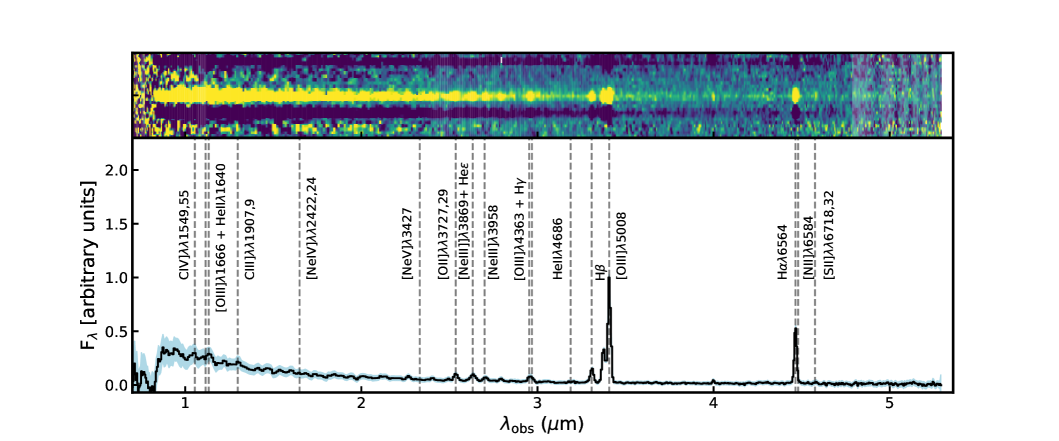
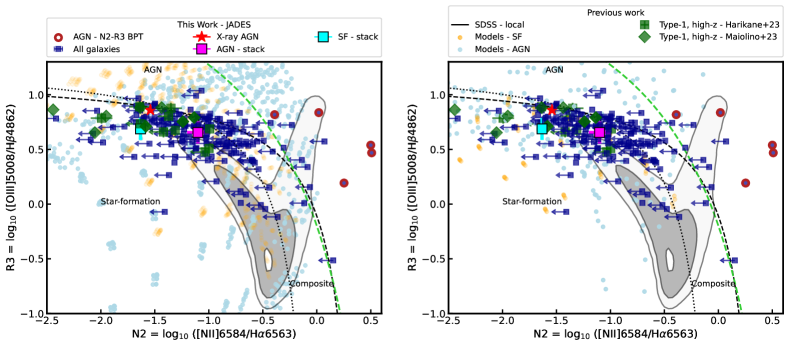
We present the identification of 42 narrow-line active galactic nuclei (type-2 AGN) candidates in the two deepest observations of the JADES spectroscopic survey with JWST/NIRSpec. The spectral coverage and the depth of our observations allow us to select narrow-line AGNs based on both rest-frame optical and UV emission lines up to z=10. Due to the metallicity decrease of galaxies, at $z>3$ the standard optical diagnostic diagrams (N2-BPT or S2-VO87) become unable to distinguish many AGN from other sources of photoionisation. Therefore, we also use high ionisation lines, such as HeII$λ$4686, HeII$λ$1640, NeIV$λ$2422, NeV$λ$3420, and NV$λ$1240, also in combination with other UV transitions, to trace the presence of AGN. Out of a parent sample of 209 galaxies, we identify 42 type-2 AGN (although 10 of them are tentative), giving a fraction of galaxies in JADES hosting type-2 AGN of about $20\pm3$\%, which does not evolve significantly in the redshift range between 2 and 10. The selected type-2 AGN have estimated bolometric luminosities of $10^{41.3-44.9}$ erg s$^{-1}$ and host-galaxy stellar masses of $10^{7.2-9.3}$ M$_{\odot}$. The star formation rates of the selected AGN host galaxies are consistent with those of the star-forming main sequence. The AGN host galaxies at z=4-6 contribute $\sim$8-30 \% to the UV luminosity function, slightly increasing with UV luminosity.
研究动机与目标
- 在来自 JADES 调查的深度 JWST/NIRSpec 光谱中识别 z~12 及以下的 type-2 AGN。
- 使用紫外线和可见/光学线重新评估高红移AGN 与 恒星形成星系诊断。
- 利用光电离模型(Feltre 2016;Gutkin 2016;Nakajima 2022)校准AGN筛选。
- 估计AGN及宿主星系性质(总辐射光度、恒星质量、SFR)。
- 量化AGN对紫外光亮度函数的贡献及其随红shift的演化。
提出的方法
- 来自两个 JADES 计划的深度 JWST/NIRSpec 光谱(1210 与 3215),使用 PRISM 和多种光栅。
- 使用 pPXF 进行连续体与发射线拟合,在线组之间统一运动学,固定多重线的通量比。
- 使用 BEAGLE 进行 SED 拟合,在延迟指数型星形成历史和 Chabrier 初始质量函数下推导恒星质量和SFR。
- 使用高离子化的紫外线线(如 Ne IV、Ne V、N V)以及紫外/可见线,在高z时超越传统 BPT 诊断来识别AGN。
- 将观测到的线比与光电离模型网格(Feltre+2016;Gutkin+2016;Nakajima+2022)进行对比,以界定AGN与恒星形成区域。
- 对所需线采用3σ检出,并整合多种诊断(N2-R3、S2-R3、基于 He II 的图)来筛选AGN。
实验结果
研究问题
- RQ1高红移星系中有多少比例携带窄线(type-2)AGN?以及它们随红移(z≈2–10)的演化如何?
- RQ2在金属丰度较低、离化参数较高的条件下,是否可以利用原始紫外和光学线诊断可靠地区分高红移AGN与恒星形成星系?
- RQ3高-z 的AGN窄线区域与在金属丰度和离化参数范围内的光电离模型预测有何对比?
- RQ4这些高红移型2型AGN宿主星系的总辐射光度、恒星质量与SFR是怎样的?
- RQ5在 z≈4–6 时,AGN宿主对紫外光亮度函数的贡献及其随紫外光 luminosity 的演化如何?
主要发现
- 在209个星系中识别出42个type-2 AGN候选对象,其中有10个不确定案例,AGN宿主分数为20±3%。
- 选出的AGN覆盖总辐射光度 L_bol ≈ 10^41.3–10^44.9 erg s^-1 与宿主星系质量 M_* ≈ 10^7.2–10^9.3 M_sun。
- AGN宿主的星形成率与恒星形成主序列一致。
- 在 z=4–6 的AGN宿主对UV光度函数的贡献约为8–30%,且随UV光度增加而增加。
- 在不确定性范围内,AGN比例在 z≈2 到 z≈10 之间没有显著演化。
- 在高z BPT 类似图中,AGN与恒星形成星系的分界线被细化,以考虑低金属丰度和高离化参数。
阅读本论文
在 Nubint 阅读器中打开原文,边读边就任意段落提问。
在 Nubint 中阅读本论文本解读由 AI 根据论文原文生成,引用前请核对原文。