
[论文解读] JADES + JEMS: A Detailed Look at the Buildup of Central Stellar Cores and Suppression of Star Formation in Galaxies at Redshifts 3 < z < 4.5
本研究利用JADES和JEMS巡天提供的多波段JWST/NIRCam与HST测光数据,分析了红移z ≈ 3.7处六颗大质量星系的恒星族特性。研究发现,其致密的中心恒星核质量超过Toomre质量,极有可能通过团块并合形成而非原位碎片化,且这些核心已开始抑制恒星形成,标志着高红移处星系范围的熄灭过程已启动。
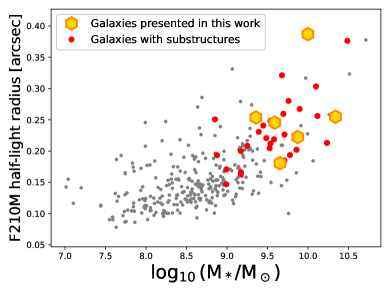
We present a spatially resolved study of stellar populations in 6 galaxies with stellar masses $M_*\sim10^{10}M_\odot$ at $z\sim3.7$ using 14-filter JWST/NIRCam imaging from the JADES and JEMS surveys. The 6 galaxies are visually selected to have clumpy substructures with distinct colors over rest-frame $3600-4100Å$, including a red, dominant stellar core that is close to their stellar-light centroids. With 23-filter photometry from HST to JWST, we measure the stellar-population properties of individual structural components via SED fitting using Prospector. We find that the central stellar cores are $\gtrsim2$ times more massive than the Toomre mass, indicating they may not form via single in-situ fragmentation. The stellar cores have stellar ages of $0.4-0.7$ Gyr that are similar to the timescale of clump inward migration due to dynamical friction, suggesting that they likely instead formed through the coalescence of giant stellar clumps. While they have not yet quenched, the 6 galaxies are below the star-forming main sequence by $0.2-0.7$ dex. Within each galaxy, we find that the specific star formation rate is lower in the central stellar core, and the stellar-mass surface density of the core is already similar to quenched galaxies of the same masses and redshifts. Meanwhile, the stellar ages of the cores are either comparable to or younger than the extended, smooth parts of the galaxies. Our findings are consistent with model predictions of the gas-rich compaction scenario for the buildup of galaxies' central regions at high redshifts. We are likely witnessing the coeval formation of dense central cores, along with the onset of galaxy-wide quenching at $z>3$.
研究动机与目标
- 理解大质量高红移星系中致密中心恒星核的形成机制。
- 研究尽管恒星质量极高,这些星系中恒星形成为何被抑制。
- 确定观测到的核是原位形成还是通过如团块迁移与并合等动力学过程形成。
- 利用空间分辨的SED拟合,评估不同结构组分(核、团块、平滑组分)的恒星形成历史(SFH)
- 检验观测特性是否与高红移星系演化的富气体致密化情景预测一致。
提出的方法
- 获取了六颗红移3 < z < 4.5星系在HST至JWST的23个滤光片测光数据,覆盖星等3600–4100 Å的星系静止系波段。
- 使用Prospector进行空间分辨的SED拟合,推导各组分的恒星族性质(质量、年龄、SFR、sSFR)
- 采用三种SFRH先验:非参数Dirichlet、延迟-τ模型及参数化模型,以检验结果的稳健性。
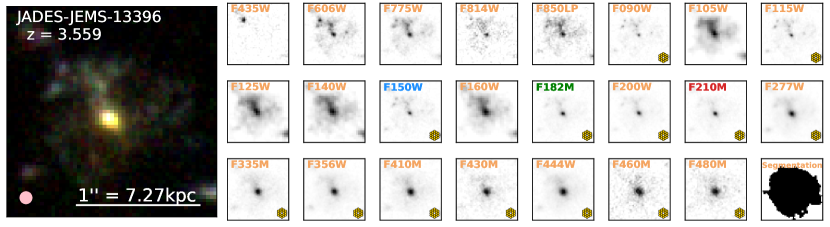
- 通过目视检查与孔径测光定义结构组分,包括中心核、团块(C1–C3)和平滑组分。
- 比较各组分的恒星质量面密度与sSFR,评估熄灭与结构演化情况。
- 评估Toomre质量标准,以判断中心核原位碎片化的可能性。
实验结果
研究问题
- RQ1z ≈ 3.7星系的中心恒星核是通过原位碎片化还是如团块并合等动力学过程形成的?
- RQ2中心核的熄灭程度如何?其sSFR与星系其余部分相比如何?
- RQ3核的恒星年龄是否与团块因动力摩擦向内迁移的时间尺度一致?
- RQ4观测到的恒星族性质是否与高红移星系演化的富气体致密化情景预测相符?
- RQ5中心核、团块与平滑组分的恒星形成历史有何不同?这对星系范围的熄灭意味着什么?
主要发现
- 中心恒星核的质量超过Toomre质量的两倍以上,表明其极不可能通过原位碎片化形成。
- 核的恒星年龄为0.4–0.7 Gyr,与团块因动力摩擦向内迁移的时间尺度一致,支持其通过团块并合形成。
- 星系已低于恒星形成主序列0.2–0.7 dex,表明早期熄灭已开始。
- 中心核的特定恒星形成率(sSFR)低于外延平滑组分,且其恒星质量面密度与同质量、同红移的熄灭星系相当。
- 核的恒星年龄与外延组分相当或更年轻,表明其为近期形成且熄灭过程仍在持续。
- 不同SFRH先验下,各组分的观测SFH保持定性一致,证实了结果的稳健性。
阅读本论文
在 Nubint 阅读器中打开原文,边读边就任意段落提问。
在 Nubint 中阅读本论文本解读由 AI 根据论文原文生成,引用前请核对原文。