
[论文解读] JADES: Using NIRCam Photometry to Investigate the Dependence of Stellar Mass Inferences on the IMF in the Early Universe
论文表明,在 JWST/JADES 光度测量下,通过在 SED 建模中改变 IMF 可以保持对观测 SED 的拟合,同时与局部 Chabrier 型 IMF 相比,推断出的恒星质量可能降低至约三分之一左右,从而有助于缓解与 ΛCDM 的矛盾。
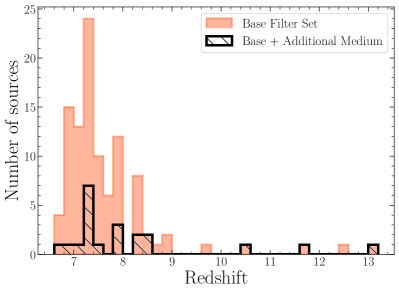
The detection of numerous and relatively bright galaxies at redshifts z > 9 has prompted new investigations into the star-forming properties of high-redshift galaxies. Using local forms of the initial mass function (IMF) to estimate stellar masses of these galaxies from their light output leads to galaxy masses that are at the limit allowed for the state of the LambdaCDM Universe at their redshift. We explore how varying the IMF assumed in studies of galaxies in the early universe changes the inferred values for the stellar masses of these galaxies. We infer galaxy properties with the SED fitting code Prospector using varying IMF parameterizations for a sample of 102 galaxies from the JWST Advanced Deep Extragalactic Survey (JADES) spectroscopically confirmed to be at z > 6.7, with additional photometry from the JWST Extragalactic Medium Band Survey (JEMS) for twenty-one galaxies. We demonstrate that models with stellar masses reduced by a factor of three or more do not affect the modeled spectral energy distribution (SED).
研究动机与目标
- Motivate the need to test how IMF assumptions affect stellar mass inferences for early-universe galaxies observed by JWST.
- Assess whether nonlocal IMF parameterizations can reproduce observed SEDs without requiring extremely high stellar masses.
- Quantify how different IMF prescriptions impact inferred physical properties (mass, age, metallicity, attenuation) using Prospector SED fitting.
- Evaluate whether IMF-driven mass reductions can reconcile observations with LambdaCDM expectations.
提出的方法
- Fit JWST/NIRCam photometry for 102 z > 6.7 galaxies from JADES with Prospector (FSPS-based) under multiple IMF parameterizations.
- Adopt a redshift-fixed SED modeling setup with a nonparametric SFH and flexible dust, nebular, and IGM attenuation.
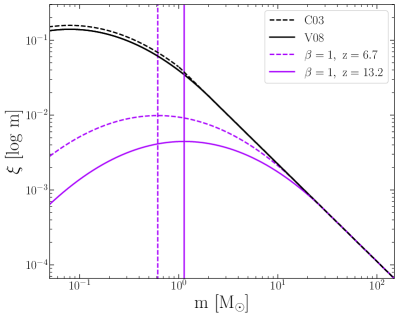
- Compare C03 (Chabrier) IMF with V08-like IMFs where the characteristic mass m_c scales with redshift as (1+z)^β and apply lower mass cutoffs (M_limit = 0.08, 1, or 3 M_sun).
- Use dynamic nested sampling (dynesty) to obtain posterior distributions of physical properties.
- Assess goodness-of-fit via chi-squared and compare inferred properties across IMF variants.
实验结果
研究问题
- RQ1How robust are stellar mass inferences for z > 6.7 galaxies to plausible IMF variations expected in the early universe?
- RQ2Can a redshift-dependent IMF (top-heavier at high z) reproduce observed SEDs without requiring drastically higher stellar masses?
- RQ3What is the quantitative impact of changing IMF form and low-mass cutoff on derived properties (M_total, M_*, age, dust, metallicities, ionization) for JWST-detected high-z galaxies?
主要发现
- SED fits are similarly good across six IMF parameterizations; chi-squared distributions are not significantly different between models.
- Inferred stellar masses can be reduced by factors of about 3 or more when using V08-like IMFs with redshift evolution or higher M_limit, compared to the C03 IMF.
- Compared to C03, the median inferred values shift by roughly +0.1 to +0.2 dex in M_total, -0.4 to -0.5 dex in M_* (surviving stellar mass), and -0.1 to -0.2 dex in mass-weighted age.
- Lower mass cutoffs (M_limit = 1 or 3 M_sun) with redshift-dependent m_c yield median M_* offsets of about -0.4 to -0.5 dex relative to C03 (depending on configuration).
- The analysis suggests IMF-driven mass reductions, together with other evolving star-formation conditions, can alleviate the apparent tension with LambdaCDM without requiring extreme star-formation efficiencies.
阅读本论文
在 Nubint 阅读器中打开原文,边读边就任意段落提问。
在 Nubint 中阅读本论文本解读由 AI 根据论文原文生成,引用前请核对原文。