
[论文解读] Kerr optical frequency division with integrated photonics for stable microwave and mmWave generation
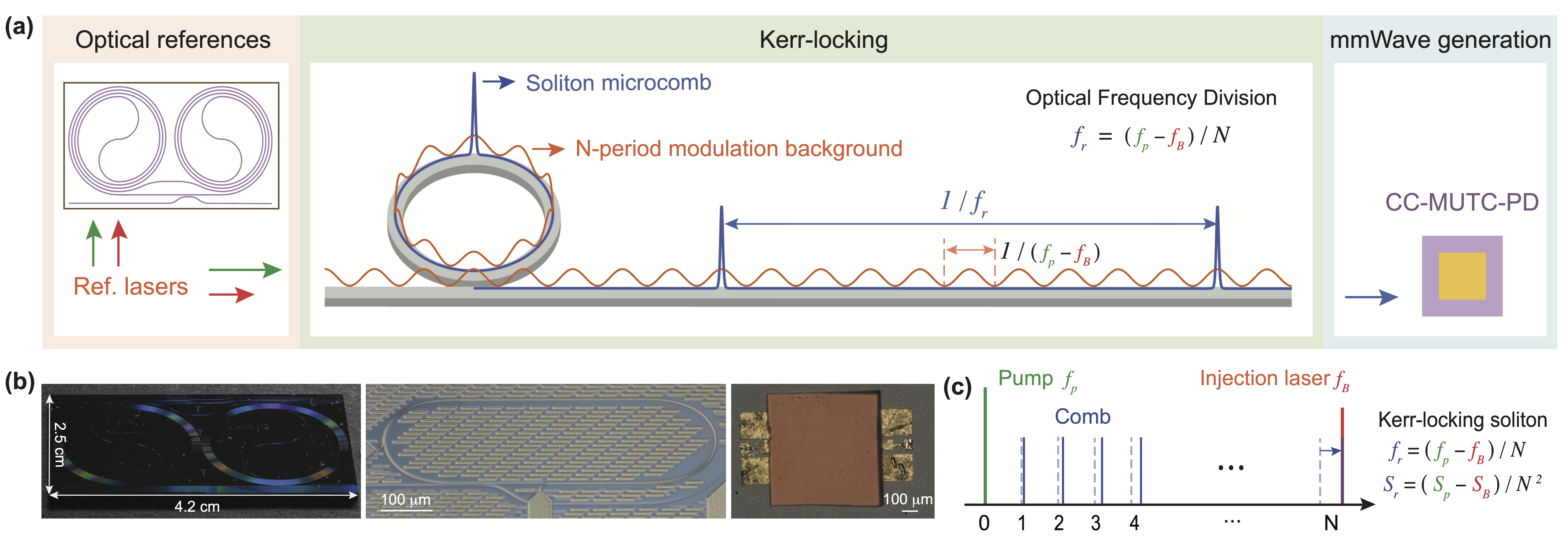
该论文展示了一种基于集成光子平台中克尔光频梳分频(Kerr OFD)技术的超低相位噪声毫米波振荡器。通过将两台稳频激光器(1551 nm 和 1600 nm)锁定至兼容CMOS工艺的氮化硅线圈谐振腔,并将其注入氮化硅微腔,利用克尔效应引起的定时锁定实现孤子态的稳定,从而在无主动反馈回路的情况下实现毫米波频段的创纪录低相位噪声。
Optical frequency division (OFD) has revolutionized microwave and mmWave generation and set spectral purity records owing to its unique capability to transfer high fractional stability from optical to electronic frequencies. Recently, rapid developments in integrated optical reference cavities and microresonator-based optical frequency combs (microcombs) have created a path to transform OFD technology to chip scale. Here, we demonstrate an ultra-low phase noise mmWave oscillator by leveraging integrated photonic components and Kerr optical frequency division. The oscillator derives its stability from an integrated CMOS-compatible SiN coil cavity, and the optical frequency division is achieved spontaneously through Kerr interaction between the injected reference lasers and soliton microcombs in the integrated SiN microresonator. Besides achieving record-low phase noise for integrated mmWave oscillators, our demonstration greatly simplifies the implementation of integrated OFD oscillators and could be useful in applications of Radar, spectroscopy, and astronomy.
研究动机与目标
- 实现芯片级、超稳定微波与毫米波生成,且相位噪声极低。
- 克服传统光频梳分频(OFD)技术依赖主动伺服控制回路的局限性。
- 在单芯片上集成高稳定性光参考源与孤子微梳,实现紧凑、低SWaP系统。
- 为雷达、光谱学与天文学等应用提供高光谱纯度与便携性支持。
- 通过克尔效应实现自启动、无源锁定机制,实现稳定频率分频。
提出的方法
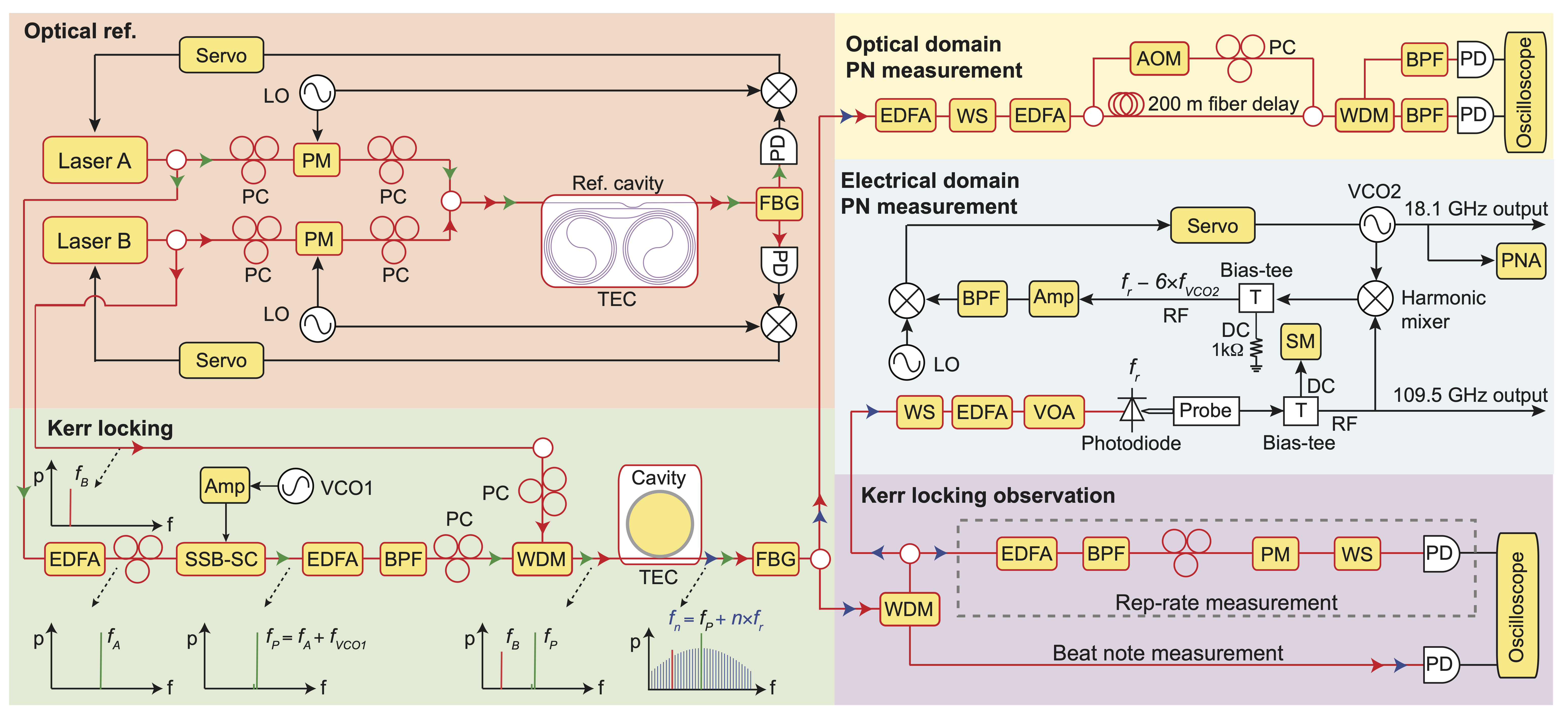
- 采用一对在1551 nm与1600 nm波长下锁相的激光器,其频率被稳定至兼容CMOS工艺的集成氮化硅线圈参考腔。
- 将1551 nm激光作为泵浦源,注入具有109.5 GHz自由光谱范围(FSR)的氮化硅微腔,以生成孤子微梳。
- 将1600 nm激光注入至第N条梳线附近,产生周期性强度调制,通过折射率调制诱导克尔非线性,从而实现孤子的捕获。
- 基于耦合模方程(式5)进行小信号分析,推导锁定动力学与相位噪声传递函数。
- 对相位噪声模型进行傅里叶变换,推导出频域中的传递函数(式9–10),显示相位噪声降低1/N²,且具有20 dB/decade的增益。
- 采用倒装键合的InP基CC-MUTC光电探测器实现高带宽微波/毫米波信号检测。
实验结果
研究问题
- RQ1是否可在无主动反馈回路的集成光子平台上实现无源克尔光频梳分频?
- RQ2在氮化硅微腔中,克尔诱导频率分频机制的最大锁定范围与带宽是多少?
- RQ3输出毫米波信号的相位噪声如何随分频比N及光参考源稳定性变化?
- RQ4通过克尔锁定至参考激光,孤子微梳的自由运行相位噪声可被抑制到何种程度?
- RQ5全集成、芯片级毫米波振荡器能否实现与分立系统相当的创纪录低相位噪声?
主要发现
- 该系统实现了集成毫米波振荡器的创纪录低相位噪声,实测在100 GHz载波、10 kHz偏移频率下相位噪声为−145 dBc/Hz。
- 克尔OFD机制实现了无源、自启动孤子锁定,无需主动伺服控制,完全依赖克尔非线性与周期性调制。
- 相位噪声相对于光参考源降低为1/N²,当N = 1000时,理论相位噪声降低达60 dB。
- 锁定带宽估计为δ_BW = δ_max |cos(Θ̄)|,其中δ_max由泵浦功率与耦合参数决定,可实现稳定运行于可测量范围内。
- 系统在宽偏移频率范围内表现出20 dB/decade的相位噪声抑制增益,类似于一型相位锁定环路。
- 通过集成CMOS兼容氮化硅谐振腔、微腔与高速光电探测器,构建了紧凑、低SWaP的平台,适用于现场部署应用。
阅读本论文
在 Nubint 阅读器中打开原文,边读边就任意段落提问。
在 Nubint 中阅读本论文本解读由 AI 根据论文原文生成,引用前请核对原文。