
[论文解读] KG-FIT: Knowledge Graph Fine-Tuning Upon Open-World Knowledge
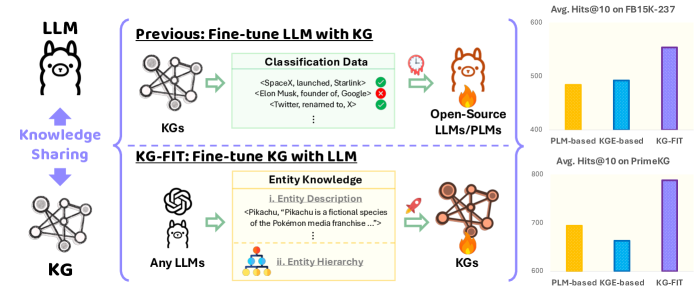
KG-FIT 是一种新颖的框架,通过 LLM 引导的分层聚类与微调,将大语言模型(LLMs)的开放世界知识整合到知识图谱嵌入中,从而提升其性能。该方法在 FB15K-237、YAGO3-10 和 PrimeKG 上分别将 Hits@10 提升了 14.4%、13.5% 和 11.9%,通过融合 LLM 的全局语义与 KG 的局部结构,实现了最先进性能。
Knowledge Graph Embedding (KGE) techniques are crucial in learning compact representations of entities and relations within a knowledge graph, facilitating efficient reasoning and knowledge discovery. While existing methods typically focus either on training KGE models solely based on graph structure or fine-tuning pre-trained language models with classification data in KG, KG-FIT leverages LLM-guided refinement to construct a semantically coherent hierarchical structure of entity clusters. By incorporating this hierarchical knowledge along with textual information during the fine-tuning process, KG-FIT effectively captures both global semantics from the LLM and local semantics from the KG. Extensive experiments on the benchmark datasets FB15K-237, YAGO3-10, and PrimeKG demonstrate the superiority of KG-FIT over state-of-the-art pre-trained language model-based methods, achieving improvements of 14.4%, 13.5%, and 11.9% in the Hits@10 metric for the link prediction task, respectively. Furthermore, KG-FIT yields substantial performance gains of 12.6%, 6.7%, and 17.7% compared to the structure-based base models upon which it is built. These results highlight the effectiveness of KG-FIT in incorporating open-world knowledge from LLMs to significantly enhance the expressiveness and informativeness of KG embeddings.
研究动机与目标
- 解决现有知识图谱嵌入(KGE)方法仅依赖图结构、忽略大语言模型(LLMs)提供的丰富开放世界知识的局限性。
- 克服直接微调大语言模型(LLMs)用于 KGE 任务时效率低下和知识停滞的问题。
- 开发一种方法,利用预训练的 LLM 丰富 KG 嵌入,而无需微调 LLM 本身。
- 利用 LLM 生成的描述和层次聚类,构建语义一致的实体分层结构。
- 通过联合优化 KG 结构约束和 LLM 衍生的语义知识,提升链接预测性能。
提出的方法
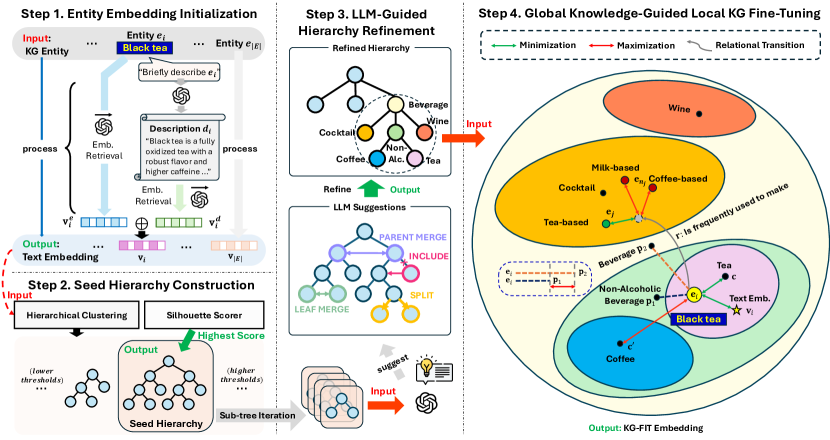
- KG-FIT 首先使用预训练语言模型(PLM)生成实体的描述性文本,然后应用 LLM 引导的凝聚聚类,构建实体聚类的分层结构。
- 通过在 PLM 生成的文本嵌入上进行凝聚聚类构建初始层次结构,随后基于语义一致性和 LLM 反馈迭代分裂聚类。
- 该框架利用 LLM 引导的聚类分裂方法优化初始层次结构,确保父子关系反映语义相似性和层级关系。
- KG-FIT 通过联合优化结构链接预测损失、分层聚类约束和基于 LLM 的文本嵌入对齐,对 KG 嵌入进行微调。
- 采用基于 HAKE 的混合评分函数,其中实体嵌入的模长来自 PLM 文本嵌入,相位来自实体名称嵌入。
- 最终的实体嵌入结合了 PLM 生成的描述和名称嵌入信息,通过由超参数控制的可学习融合机制实现。
实验结果
研究问题
- RQ1LLM 生成的实体描述能否有效用于构建知识图谱中语义一致的实体分层结构?
- RQ2如何系统性地将 LLM 的开放世界知识整合到 KG 嵌入中,而无需微调 LLM 本身?
- RQ3整合来自 LLM 的分层知识与文本知识是否能显著提升 KG 嵌入在链接预测中的表达能力与性能?
- RQ4KG-FIT 与仅依赖图结构或 PLM 微调的最先进 KGE 方法相比表现如何?
- RQ5分层结构与原始文本嵌入在增强 KG 表示学习中的相对贡献是什么?
主要发现
- 与最先进基于 PLM 的方法相比,KG-FIT 在 FB15K-237 上将 Hits@10 提升了 14.4%,证明了其在链接预测任务中的卓越性能。
- 在 YAGO3-10 上,KG-FIT 相较于现有基于 PLM 的基线方法将 Hits@10 提升了 13.5%,凸显其在复杂关系推理中的有效性。
- 在 PrimeKG 上,KG-FIT 将 Hits@10 提升了 11.9%,表明其在多样化知识图谱分布中具有强大的泛化能力。
- 与基于结构的基线模型相比,KG-FIT 在 FB15K-237、YAGO3-10 和 PrimeKG 上分别实现了 12.6%、6.7% 和 17.7% 的性能提升,证明了开放世界知识整合的价值。
- 消融实验证实,分层结构与 LLM 生成的文本嵌入均对性能提升有显著贡献,二者结合可获得最佳结果。
阅读本论文
在 Nubint 阅读器中打开原文,边读边就任意段落提问。
在 Nubint 中阅读本论文本解读由 AI 根据论文原文生成,引用前请核对原文。