
[论文解读] Knowledge Enhanced Machine Learning Pipeline against Diverse Adversarial Attacks
该论文提出知识增强机器学习流水线(KEMLP),一种通过将领域知识——特别是将辅助模型的预测与主深度神经网络(DNN)关联的逻辑规则——整合到概率图模型中,以提升模型对多样化对抗攻击鲁棒性的框架。KEMLP在物理攻击上比最先进防御方法(如对抗训练)显著提升了+16.72%的鲁棒准确率,在未预见攻击上提升了+10.95%,同时保持了高干净准确率。
Despite the great successes achieved by deep neural networks (DNNs), recent studies show that they are vulnerable against adversarial examples, which aim to mislead DNNs by adding small adversarial perturbations. Several defenses have been proposed against such attacks, while many of them have been adaptively attacked. In this work, we aim to enhance the ML robustness from a different perspective by leveraging domain knowledge: We propose a Knowledge Enhanced Machine Learning Pipeline (KEMLP) to integrate domain knowledge (i.e., logic relationships among different predictions) into a probabilistic graphical model via first-order logic rules. In particular, we develop KEMLP by integrating a diverse set of weak auxiliary models based on their logical relationships to the main DNN model that performs the target task. Theoretically, we provide convergence results and prove that, under mild conditions, the prediction of KEMLP is more robust than that of the main DNN model. Empirically, we take road sign recognition as an example and leverage the relationships between road signs and their shapes and contents as domain knowledge. We show that compared with adversarial training and other baselines, KEMLP achieves higher robustness against physical attacks, $\mathcal{L}_p$ bounded attacks, unforeseen attacks, and natural corruptions under both whitebox and blackbox settings, while still maintaining high clean accuracy.
研究动机与目标
- 为解决深度神经网络(DNN)对多样化对抗攻击(包括物理攻击、ε-有界攻击和未预见攻击)的脆弱性。
- 探究整合领域知识——特别是预测之间的逻辑关系——是否能在不牺牲干净准确率的前提下提升鲁棒性。
- 开发一种系统性框架,将弱辅助模型与逻辑约束相结合,以提升联合推理的鲁棒性。
- 从理论上证明知识集成在何种条件下可使鲁棒性优于仅使用主DNN模型。
- 在白盒、黑盒及自然退化设置下,通过实证验证KEMLP在多种攻击类型下优于最先进防御方法。
提出的方法
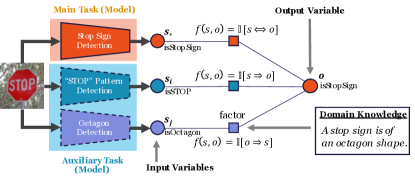
- KEMLP构建一个因子图,其中主DNN的输出和辅助模型的输出被建模为随机输入变量,最终预测为随机输出变量。
- 领域知识以一阶逻辑规则形式编码(例如,“停车标志是八边形”),并转化为连接因子图中相关随机变量的因子函数。
- 在因子图上执行统计推断,以计算输出变量的边缘概率,预测过程中融入逻辑约束。
- 该框架支持允许性规则(B ⇒ A)和预防性规则(A ⇒ B),实现辅助知识的灵活集成。
- 通过加权鲁棒准确率评估鲁棒性,该指标平衡了在干净样本和对抗样本上的性能表现。
- KEMLP在道路标志识别任务上进行了评估,涵盖真实世界物理攻击、ε-有界扰动以及自然退化,在白盒和黑盒设置下均进行了测试。
实验结果
研究问题
- RQ1通过逻辑规则集成领域知识在何种条件下可提升机器学习模型的鲁棒性?
- RQ2KEMLP中的知识集成是否能在多种攻击类型下超越最先进防御方法(如对抗训练)?
- RQ3在集成辅助模型与逻辑约束时,鲁棒性与干净准确率之间的权衡关系如何?
- RQ4不同类型逻辑规则——允许性规则(B ⇒ A)与预防性规则(A ⇒ B)——对KEMLP中联合推理鲁棒性的影响如何?
- RQ5KEMLP是否在实现对未预见攻击和物理攻击的优越鲁棒性的同时,仍能保持高干净准确率?
主要发现
- 在物理攻击上,KEMLP实现了91.46%的加权鲁棒准确率,相比主DNN提升了+16.72%,相比对抗训练提升了+10.95%。
- 在未预见攻击上,KEMLP实现了78.37%的鲁棒准确率,相比主DNN提升了+9.72%,相比对抗训练提升了+6.46%。
- 在黑盒设置下,KEMLP在保持高干净准确率(84.95%)的同时,在ε-有界攻击上实现了79.09%的鲁棒准确率,优于对抗训练。
- 在自然退化场景下,KEMLP在标准测试集上实现了84.95%的鲁棒准确率,显著优于主DNN和对抗训练。
- 理论分析表明,在较温和条件下,KEMLP的预测比仅使用主DNN的预测更具鲁棒性,尤其在集成多个弱辅助模型时更为明显。
- KEMLP在不同攻击类型下表现稳定,包括5x5和7x7物理攻击,干净准确率下降极小(如DOA 5x5仅下降-0.02%),展现出强大的泛化能力。

阅读本论文
在 Nubint 阅读器中打开原文,边读边就任意段落提问。
在 Nubint 中阅读本论文本解读由 AI 根据论文原文生成,引用前请核对原文。